When you click on links to various merchants on this site and make a purchase, this can result in this site earning a commission. Affiliate programs and affiliations include, but are not limited to, the eBay Partner Network.
Im sure it does. They all have them as far as I know. Rated for I believe 20 FT. Lbs. max though. But with 9 to 11 nuts that should be fine. If you over tighten and break the captive studs loose I think your screwed. There doesnt seem to be any viable way to ever replace them. My boards are very tight and stable using 9. The size of carriage bolts they provided were so small that they werent captive. Plus SS is always better around here. Salty winters blow.
Interesting... if the fasteners are captive, and are MALE, and the torque specs are that low, and there is no way to remove or replace the captive fasteners... then that is a strike against any plan that would involve heavy steel grip strut... as the cyclical vibration from bouncing down the road would be amplified by the heavier mass leveraged against the clamping power of the flimsy fasteners (and the flimsy aluminum sheet for that matter).
That points me toward aluminum as a step material. Thanks for the insight!
Anyone know of a company who makes sliders for our trucks? Id just rip steps off my truck with the wheeling I do. I've found local company who can Fab me a nice set, but have pay extra for R&D vs a production set.
Just raise them up with f150 brackets. I did my extended ones and they tuck up nice. Almost like boat sides lol.
So, for those who already have, or are thinking about, raising their cab steps up out of harm's way by replacing their 250/350/450 brackets with the higher positioned F150 brackets, and are wondering what to do with their original lower positioned brackets that were removed, how about sending me a pm?
So, for those who already have, or are thinking about, raising their cab steps up out of harm's way by replacing their 250/350/450 brackets with the higher positioned F150 brackets, and are wondering what to do with their original lower positioned brackets that were removed, how about sending me a pm?
I dumpsterized mine 2 weeks ago when cleaning out the garage. If i still had them i would have sent them to you!
Originally Posted by Mikelikesit
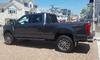
Hey Spool, those Coopers are mean looking. Stock ride height? or what?
Thanks! Just a 2" trail master level up front. Went with the cooper 295s because they measure out to a 35.4" and are lighter than most. And they look badass....lol. Have close to 10k miles on them and still look new.
Well, I finally got under the darn thing to have a look at these captured fasteners. They really are captured. Threaded rivet studs.
I'm going to post a few photos, since photos are what I asked for... and I can't expect to others to post photos unless I am also willing to provide them myself... as I recognize and appreciate the extra effort and time it takes to do so.
So here is the hapless, helpless 2019, sans body or boards...
Now below are the three studded mounting locations, shown individually, and ironically, each appears to only offer three studs at each location, rather than four. More pennies saved it seems. It appears as if the bottom two studs at the pinch flange carry the vertical load on the steps in shear, and any nut on the single top stud simply prevents rotational uplift and twist of the pinch flange from a force pushing underneath the running board... like the rocks some of you guys are worried about running aground on at the break over angle.
FORWARDMOST bracket mounting location:
(top stud biased to aft top mounting hole on bracket)
B PILLAR (OFFSET MIDDLE) bracket mounting location:
(top stud biased to forward top mounting hole on bracket)
REARMOST bracket mounting location:
(top stud biased to forward top mounting hole on bracket)
What has me curious about the rear bracket mounting location are the other two studs that are position even further to the rear than the cab step bracket location. What are they for?
Here is a look at those other two studs from the rear end of the cab...
The lower and closer (in the photo immediately above) of these two lonely studs that are not involved in the third cab step mounting constellation is in the pinch flange. I'm guessing this is for the type of cab step that has the extension tread to access the pick up bed ahead of the rear wheel well?
Then what is the other stud for? It is out of plane with the pinch flange, but also outside of the bracket footprint on the inboard plane. Yet it seems as if it must relate to cab steps in some manner. Does any one have any ideas or experience?
I am going with the AMP electric step. I never intended to keep these steps.
After stepping on and off of the Ford OEM production electric step, I can see why electric steps are so popular.
1. The electric step is genuinely functional as a step... an intermediate level between the ground and the door threshold... as opposed to a platform that is at the same level as the threshold (which isn't really a "step").
2. The electric step folds up and out of the way... removing the boulder bashing concern from a low hanging fixed position step entirely.
OK, these two points may have been painfully obvious to you, but just how well these steps work in reality never sunk in with me until I tried them out personally yesterday.
Here is the 19 Platinum I stepped on...
And here is an up close look at the meat of the matter...
The first notable observation is that the Ford OEM electric steps only use 2 brackets on the crew cab Super Duty, not3 brackets, like the fixed steps.
Just like the F-150, there is no third bracket (or in this case parallelogram hinge bracket) directly under the front driver / passenger footing with the OE electric steps.
Yet, there was no noticeable deflection when stepping up and down. In fact, the electric step offered more assurance in stepping up, as the platform was wider, lower, and permitted the toes to hang off the inboard edge of the platform, so that the heels of the boots could be solidly planted on the step, rather than hanging off the outboard edge due to the cab pinch flange being in the way as a toe kick.
Motor mechanism bracket, aft position, curbside:
The second notable observation is that I think I learned what the extra studs are for, whose purpose was questioned in the previous post. They are there to hold this motor, for trucks so equipped.
A hole in the bracket with no stud:
The third observation is that not even the electric steps, with 33% fewer brackets, use all four holes in the upper plane of the bracket, obviously because there is only one captive stud on the upper plane per bracket position. So that answers the highly unlikely question of whether or not Platinum or Limited cabs have a different cab metal production process that ends up with more studs to support the factory electric steps with fewer brackets. They don't.
Slave bracket, aft position, roadside:
If I remember this correctly, the motor is forward on the driver's side, with the slave to the rear, and the motor is aft on the passenger side, with the slave to the front.
I won't be putting electric steps on the crew's F-550, but I certainly understand now why people do "step up" to them. They really do function more as a step, rather than just a running board. And then they tuck out of the way.
Please keep posting the different types of brackets, bars, boards, and steps that you have.
This Hennessey Takes the Expedition Tremor's Off-Roading Capability to the Next Level
Slideshow: The VelociRaptor Expedition gains a lift, upgraded suspension, Brembo brakes, and trail-ready equipment while retaining the stock 440-horsepower EcoBoost V6.
Rezvani's Latest Post-Apocalyptic Monster Is a Ford F-150 Raptor Underneath
Slideshow: Called the Fortress, the 850-horsepower pickup combines Raptor underpinnings with military-inspired features, survival equipment, and a starting price of $285,000.