When you click on links to various merchants on this site and make a purchase, this can result in this site earning a commission. Affiliate programs and affiliations include, but are not limited to, the eBay Partner Network.
I have two questions
1. My oil pressure gauge is connected however i dont know if it works. I have hooked everything up and ran the starter and turn engine over. The gauge did nothing. Is there another way to tell if i got pressure when i finally crank it?
2. I dont believe i have spark. Now im a 5.0 guy (12 volt). I pulled a plug and looked for spark. Should you 'see' it on 6volt? If so, where do i start testing. What tests would you do to find out the reason of no spark. Assume i dont know much about the truck (still learning)
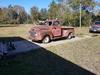
(Coil wire was connected during test, its not in this picture)
New coil, points, condensor, plugs, wires, battery, battery cables, volt reg
I bought an inexpensive oil pressure test gauge and eliminated any uncertainty when firing for the first time.
On the spark, you should see a fat blue/white one when everything is happy. I would start with the battery and ground connections. Six volt systems like clean, shiny connections. I would simply check every part from the battery posts to the plugs. Pay special interest to the capacitor as the new ones are prone to be DOA.
The easiest way to connect an oil pressure gauge is to get a brass adapter, that fits the oil filter inlet tubing (should be a flare fitting) and provides a female NPT connection (pipe thread). Disconnect the tubing from the filter canister, add the adapter, with the gauge connected to the NPT side. Otherwise you have to go to the bottom of the oil filter inlet tube, down on the block near the bellhousing area, disconnect the tubing and remove the adapter in the block. Not an easy place to get to.
So, while checking for spark....i managed to lock up the engine with the starter. (I remember reading a about gentleman with a model A got his starter locked) he rocked the car in gear to dislodge it (if i remember right.) I put a socket on the crank to gentle rock since my rear wheels are seized. Nothing happened. I pulled the starter, now motor turns free.....i was almost in 'o crap' mode. I have a spare starter, i just need to educate myself on how this works.
The sender has a threaded end so it can be unscrewed. The test gauge I bought (for like $20 on ebay) had an assortment of fittings - one fit the threads just fine. Cranking without firing gave me an oil pressure reading - should work for you as well.
I certainly don't qualify as any kind of expert. I had the help of smarter folk and that's what I'm sharing. You get to decide how to proceed.
The sender just unscrews - I likely used a wrench on the fitting.
Can't speak to the plug. But if the gauge isn't reading right now and you need to confirm that there is pressure, keeping the sender in place while messing with other elements didn't appeal to me. You can decide what works for you. The test gauge was attached to a flexible hose and stayed in the engine bay. The dash gauge wasn't touched during this exercise.
Removing the sender is a PITA when the cab is in place, there was indeed a special tool (below). That square-head plug is also in the oil passage, can be removed a lot easier, but clean all the dirt away first.
This Hennessey Takes the Expedition Tremor's Off-Roading Capability to the Next Level
Slideshow: The VelociRaptor Expedition gains a lift, upgraded suspension, Brembo brakes, and trail-ready equipment while retaining the stock 440-horsepower EcoBoost V6.
Rezvani's Latest Post-Apocalyptic Monster Is a Ford F-150 Raptor Underneath
Slideshow: Called the Fortress, the 850-horsepower pickup combines Raptor underpinnings with military-inspired features, survival equipment, and a starting price of $285,000.