




Real World Capability
Tuned

Joined: Nov 2018
Posts: 253
Likes: 32
I can’t figure out all these 250/350 debates. I got a base payload 250 dieselwith a rating of 2000lbs. I wanted the softer ride because what I haul doesn’t require anymore payload than that. If I need more I’ll just add the hd front springs from the plow prep package and add the oem helper spring in the rear and poof just like magic I’ll add enough payload to be a 350 trapped in a 250 body. Had a 19 platinum diesel come in today that had me beat by 1300lbs ish.

Hotshot


Joined: Jun 2003
Posts: 12,353
Likes: 4,388
From: SW VA
Yes, it goes off of GW (same as GVW). If it is 10,000 or less, you qualify for personal tags (no truck tags) and the tax relief.

Logistics Pro


Joined: Apr 2017
Posts: 3,674
Likes: 51
From: SoCal
F350 has a different axle, different rear spring pack, and can have different tires. Its not just, deflate the tires and call it a day. Nor is it, inflate your tires and now you magically have an F350.

5th Wheeling
Joined: Apr 2007
Posts: 48
Likes: 0
Since you are not asking about tax status I'll skip that rat hole.
The single biggest reason Ford produces the F250 is to stay under the USDOT definition of a commercial vehicle which is 10,001 lbs GVWR
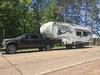
From your attached picture it looks like you are towing a bumper-pull Keystone similar to the one I pulled before trading for a toy hauler. If that is the case, I would put air bags on the Platinum and load it up. You will be fine! Mine pulled it like a dream! Anyone that says the truck isn't capable of more than the payload listed on your sticker is misinformed!
My perspective on why this is possible is the F250's limiting factors are tires and springs. Springs could be addressed in a number of ways. I use air bags. They do a good job of keeping the truck from squatting. The tire weight ratings should not be exceeded. If you keep your weights under the tires' max you would have to drive it and see if you are comfortable. For me, after towing a heavy tongue weight toy hauler 3,400lbs I decided to upgrade to a DRW. It just didn't seem as stable as I would like for cross country trips.
The single biggest reason Ford produces the F250 is to stay under the USDOT definition of a commercial vehicle which is 10,001 lbs GVWR
From your attached picture it looks like you are towing a bumper-pull Keystone similar to the one I pulled before trading for a toy hauler. If that is the case, I would put air bags on the Platinum and load it up. You will be fine! Mine pulled it like a dream! Anyone that says the truck isn't capable of more than the payload listed on your sticker is misinformed!
My perspective on why this is possible is the F250's limiting factors are tires and springs. Springs could be addressed in a number of ways. I use air bags. They do a good job of keeping the truck from squatting. The tire weight ratings should not be exceeded. If you keep your weights under the tires' max you would have to drive it and see if you are comfortable. For me, after towing a heavy tongue weight toy hauler 3,400lbs I decided to upgrade to a DRW. It just didn't seem as stable as I would like for cross country trips.

Hotshot

Joined: Mar 2017
Posts: 10,172
Likes: 1,376
From: Chaz
Its really not the tires as they run the same tires on the 350/250 srw. Its the Sterling 10.5 axle and that limits you to 22,500 GCWR in an F250. You can pretty much max out a 14k rated gooseneck with that combo. Most trailers above that put you in CDL territory.
The F250 isnt trying to avoid any Dot rules its just how the math works out. If you are paranoid about it register you trailer to 12,500 knowing weight will be on the truck too while on the road?
The srw f350 is a bit of an odd ball and a newfangled setup in the last decade or so. Probably for Travel trailer crowds that want to pull a tad more but cant fit a DRW into their life.
The F250 isnt trying to avoid any Dot rules its just how the math works out. If you are paranoid about it register you trailer to 12,500 knowing weight will be on the truck too while on the road?
The srw f350 is a bit of an odd ball and a newfangled setup in the last decade or so. Probably for Travel trailer crowds that want to pull a tad more but cant fit a DRW into their life.

Senior User
Joined: Dec 2018
Posts: 276
Likes: 0
FTE Stories
Ford Trucks for Ford Truck Enthusiasts

Top 10 Fords at 2026 Carlisle Ford Nationals
Joe Kucinski
3 Best / 3 Worst Parts of Modern Ford Ownership
Brett Foote
10 Amazing Upgrades That Solve Common Ford Truck Owner Headaches
Pouria Savadkouei
Every 2026 Ford Engine Explained
Brett Foote
10 Ugly Ford Trucks That We Still Kinda Love
Joe Kucinski
10 Things Every Truck Owner NEEDS (2026 Edition)
Michael S. Palmer
Rezvani's Latest Post-Apocalyptic Monster Is a Ford F-150 Raptor Underneath
Verdad Gallardo
Top 10 Most Expensive Ford Trucks Ever Sold on Bring a Trailer
Joe Kucinski
2027 Ford Super Duty Buyer's Guide (Every Model, Engine, & Package)
Brett Foote

Thread Starter
|
More Turbo

Joined: May 2014
Posts: 643
Likes: 154
From: Poway, CA
Since you are not asking about tax status I'll skip that rat hole.
The single biggest reason Ford produces the F250 is to stay under the USDOT definition of a commercial vehicle which is 10,001 lbs GVWR
From your attached picture it looks like you are towing a bumper-pull Keystone similar to the one I pulled before trading for a toy hauler. If that is the case, I would put air bags on the Platinum and load it up. You will be fine! Mine pulled it like a dream! Anyone that says the truck isn't capable of more than the payload listed on your sticker is misinformed!
My perspective on why this is possible is the F250's limiting factors are tires and springs. Springs could be addressed in a number of ways. I use air bags. They do a good job of keeping the truck from squatting. The tire weight ratings should not be exceeded. If you keep your weights under the tires' max you would have to drive it and see if you are comfortable. For me, after towing a heavy tongue weight toy hauler 3,400 lbs. I decided to upgrade to a DRW. It just didn't seem as stable as I would like for cross country trips.
The single biggest reason Ford produces the F250 is to stay under the USDOT definition of a commercial vehicle which is 10,001 lbs GVWR
From your attached picture it looks like you are towing a bumper-pull Keystone similar to the one I pulled before trading for a toy hauler. If that is the case, I would put air bags on the Platinum and load it up. You will be fine! Mine pulled it like a dream! Anyone that says the truck isn't capable of more than the payload listed on your sticker is misinformed!
My perspective on why this is possible is the F250's limiting factors are tires and springs. Springs could be addressed in a number of ways. I use air bags. They do a good job of keeping the truck from squatting. The tire weight ratings should not be exceeded. If you keep your weights under the tires' max you would have to drive it and see if you are comfortable. For me, after towing a heavy tongue weight toy hauler 3,400 lbs. I decided to upgrade to a DRW. It just didn't seem as stable as I would like for cross country trips.
Thread Starter
|
More Turbo
Joined: May 2014
Posts: 643
Likes: 154
From: Poway, CA
Its really not the tires as they run the same tires on the 350/250 srw. Its the Sterling 10.5 axle and that limits you to 22,500 GCWR in an F250. You can pretty much max out a 14k rated gooseneck with that combo. Most trailers above that put you in CDL territory.
The F250 isnt trying to avoid any Dot rules its just how the math works out. If you are paranoid about it register you trailer to 12,500 knowing weight will be on the truck too while on the road?
The srw f350 is a bit of an odd ball and a newfangled setup in the last decade or so. Probably for Travel trailer crowds that want to pull a tad more but cant fit a DRW into their life.
The F250 isnt trying to avoid any Dot rules its just how the math works out. If you are paranoid about it register you trailer to 12,500 knowing weight will be on the truck too while on the road?
The srw f350 is a bit of an odd ball and a newfangled setup in the last decade or so. Probably for Travel trailer crowds that want to pull a tad more but cant fit a DRW into their life.
I do not have a typical F250. My truck is equipped with the 3"/21,000 lbs. hitch, the Dana M275 axle (same as every SRW F350), 5600 lbs. front springs, and overloads. It is rated to conventionally tow 18,000 lbs and the GCWR is 25,700 lbs. The only reason Ford offers the High Capacity Trailer Tow Package is so that one can purchase a Class 2 truck with near Class 3 capability. The HCTTP even cost the same as the upgrade from a 250 to a 350. If there wasn't a market for people trying to avoid the class 3 rating, Ford wouldn't offer the package. It is a tax and registration shell game.
Because the GVWR is static and assigned, equipping any truck with options that undeniably increase it's capability also decrease it's stated capacity. Diesel engines, high capacity hitches and heavy duty axles are, welll...heavy. That is why focusing on the artificial GVWR as opposed to the actual equipment installed on a truck strikes me as counter intuitive. I seriously don't understand the mindset of purchasing a DRW F350, XL,6.2, extra cab just to bolster the payload sticker. I can guarantee you that from a mechanical perspective, the same truck in Lariat trim with a 6.7 is not less capable no matter what the payload sticker says. Hey, if the lower trim, gas engine truck is what you truly want/need/can afford, great. If you are sacrificing anything just for the sake of increasing "capacity" on a sticker, that seems silly to me.
Hotshot
Joined: Mar 2017
Posts: 10,172
Likes: 1,376
From: Chaz
Yeah it reminds me of that stupid payload video some guy posted on this site awhile back.
But anyway. You are kinda correct about registered weight but the 10.5 axle is the limiting factor in that you cant go past 22,500 GCWR and with most F250s that would max a 14k trailer out. Most trailers over 14k get you into CDL territory. Ford knows what they are doing and there is no reason to install heavier useless components if not needed.
Also instead of the high capacity tow package you could have got a 10,000/9900 derated F350. Unless your purchase had something to do with going over 26,000 GCWR on your white sticker.
But anyway. You are kinda correct about registered weight but the 10.5 axle is the limiting factor in that you cant go past 22,500 GCWR and with most F250s that would max a 14k trailer out. Most trailers over 14k get you into CDL territory. Ford knows what they are doing and there is no reason to install heavier useless components if not needed.
Also instead of the high capacity tow package you could have got a 10,000/9900 derated F350. Unless your purchase had something to do with going over 26,000 GCWR on your white sticker.
Thread Starter
|
More Turbo
Joined: May 2014
Posts: 643
Likes: 154
From: Poway, CA
Yeah it reminds me of that stupid payload video some guy posted on this site awhile back.
But anyway. You are kinda correct about registered weight but the 10.5 axle is the limiting factor in that you cant go past 22,500 GCWR and with most F250s that would max a 14k trailer out. Most trailers over 14k get you into CDL territory. Ford knows what they are doing and there is no reason to install heavier useless components if not needed.
Also instead of the high capacity tow package you could have got a 10,000/9900 derated F350. Unless your purchase had something to do with going over 26,000 GCWR on your white sticker.
But anyway. You are kinda correct about registered weight but the 10.5 axle is the limiting factor in that you cant go past 22,500 GCWR and with most F250s that would max a 14k trailer out. Most trailers over 14k get you into CDL territory. Ford knows what they are doing and there is no reason to install heavier useless components if not needed.
Also instead of the high capacity tow package you could have got a 10,000/9900 derated F350. Unless your purchase had something to do with going over 26,000 GCWR on your white sticker.
Laughing Gas
Joined: Dec 2018
Posts: 837
Likes: 152
From: NE OK
Yeah it reminds me of that stupid payload video some guy posted on this site awhile back.
But anyway. You are kinda correct about registered weight but the 10.5 axle is the limiting factor in that you cant go past 22,500 GCWR and with most F250s that would max a 14k trailer out. Most trailers over 14k get you into CDL territory. Ford knows what they are doing and there is no reason to install heavier useless components if not needed.
Also instead of the high capacity tow package you could have got a 10,000/9900 derated F350. Unless your purchase had something to do with going over 26,000 GCWR on your white sticker.
But anyway. You are kinda correct about registered weight but the 10.5 axle is the limiting factor in that you cant go past 22,500 GCWR and with most F250s that would max a 14k trailer out. Most trailers over 14k get you into CDL territory. Ford knows what they are doing and there is no reason to install heavier useless components if not needed.
Also instead of the high capacity tow package you could have got a 10,000/9900 derated F350. Unless your purchase had something to do with going over 26,000 GCWR on your white sticker.
Hotshot
Joined: Mar 2017
Posts: 10,172
Likes: 1,376
From: Chaz
Because of extenuating circumstances discussed earlier in the thread, a class 3 truck, derated or not, wasn't an option. If you are a GVWR/payload sticker devotee, a derated F350 and an F250 are the same truck...one must adhere to the 10,000 lbs. GVWR no matter the configuration. If you use the truck to it's capability, you will exceed it's capacity. Another reason why devotion to the gross vehicle weight rating and payload sticker without the application of logic is counter intuitive.