When you click on links to various merchants on this site and make a purchase, this can result in this site earning a commission. Affiliate programs and affiliations include, but are not limited to, the eBay Partner Network.
For reference, I am vehicle dynamics engineer. And I am constantly amazed by how such a tall truck feels so stable when cornering. I drive winding mountain roads regularly and the truck does that amazingly well.
Not entirely on topic, but be aware that most truck cabs are not strong enough to bear the trucks weight. Lots of pictures/stories on Google about all kinds of truck roofs caving in when trucks roll. The current generation Ford F150/Super Duty cab has the strongest cab, by far, of all trucks. Believe it has 2x the strength of the Toyota Tundra (I checked cuz my Dad has a TT). But it still isn't nearly enough for trucks that weight between 7,000 and 10,000 lbs.
This is why I marvel at all the guys lifting their trucks and running 35s and 37s. The risk of roll overs is dramatically increased when you lift your trucks center of gravity. And no one bothers to protect themselves with a proper roll bar. Heck, I remember reading about Cam Newton flipping his rig a few years ago, that was lifted. Believe it was a Ram. He broke two of his vertebrae in the accident. Has millions in the bank. Lifts his truck. But doesn't spend $2k to $3k putting in a structural roll bar or cage. Had he been sitting in the passenger seat, where the roof came down to the sill, he'd be dead or severely injured.
To be fair, a roll bar alone wouldn't ensure the roof caving in. But it would certainly reduce the AMOUNT a roof caves in.
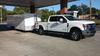
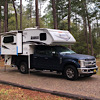
Our 2019 F350 4x2 has the pitch and roll gauges, as did our 2017 F350 4x2. I find them helpful when leveling the truck and camper.
On a somewhat related matter, I find it interesting that Ford does not offer the OEM Camper Package option on trucks equipped with 20” wheel and tires, all,of which are 4x4s.
Not entirely on topic, but be aware that most truck cabs are not strong enough to bear the trucks weight. Lots of pictures/stories on Google about all kinds of truck roofs caving in when trucks roll. The current generation Ford F150/Super Duty cab has the strongest cab, by far, of all trucks. Believe it has 2x the strength of the Toyota Tundra (I checked cuz my Dad has a TT). But it still isn't nearly enough for trucks that weight between 7,000 and 10,000 lbs.
This is why I marvel at all the guys lifting their trucks and running 35s and 37s. The risk of roll overs is dramatically increased when you lift your trucks center of gravity. And no one bothers to protect themselves with a proper roll bar. Heck, I remember reading about Cam Newton flipping his rig a few years ago, that was lifted. Believe it was a Ram. He broke two of his vertebrae in the accident. Has millions in the bank. Lifts his truck. But doesn't spend $2k to $3k putting in a structural roll bar or cage. Had he been sitting in the passenger seat, where the roof came down to the sill, he'd be dead or severely injured.
To be fair, a roll bar alone wouldn't ensure the roof caving in. But it would certainly reduce the AMOUNT a roof caves in.
Cars are actually federally mandated to have a certain amount of roof structure to withstand the vehicle landing on the roof. Trucks, ironically, are not. And truck / SUV roofs typically can in no way support that weight. I agree, the current-gen Fords have the strongest roof structure. But it still isn't enough.
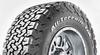
As for lifts / tires...I have installed 35" tires on my otherwise stock truck. The factory 20" size is over 34" tall; so a 35" tire adds less than 1/2" of increased ride height over the stock 20. I'm not concerned. Even lifted trucks, although more roll-prone, can be safe if driven more carefully. It is also worth noting that stability control does indeed reduce the opportunity for rollovers caused by too much speed in a corner, skidding on slippery surfaces, etc.
This Hennessey Takes the Expedition Tremor's Off-Roading Capability to the Next Level
Slideshow: The VelociRaptor Expedition gains a lift, upgraded suspension, Brembo brakes, and trail-ready equipment while retaining the stock 440-horsepower EcoBoost V6.