When you click on links to various merchants on this site and make a purchase, this can result in this site earning a commission. Affiliate programs and affiliations include, but are not limited to, the eBay Partner Network.
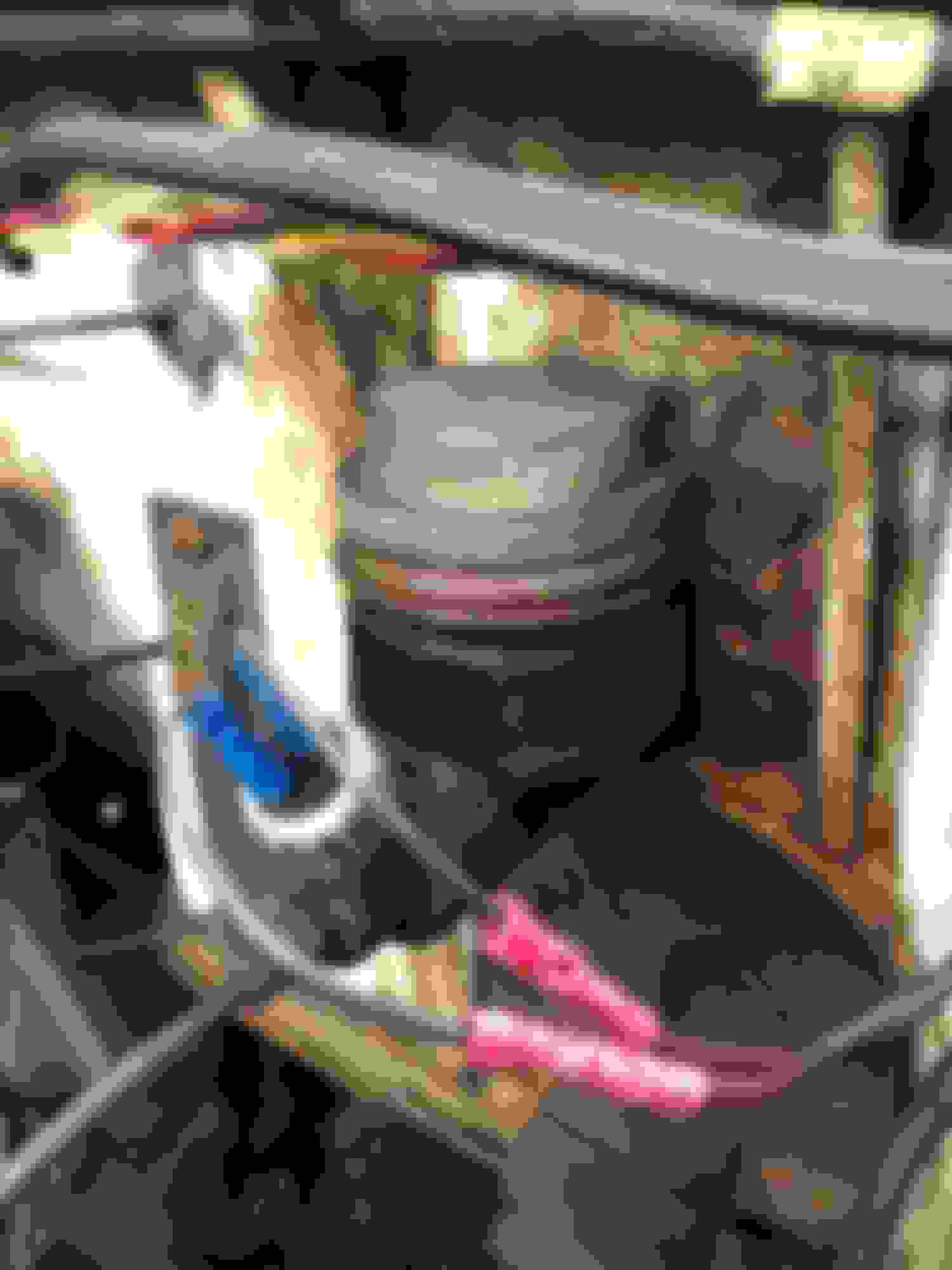
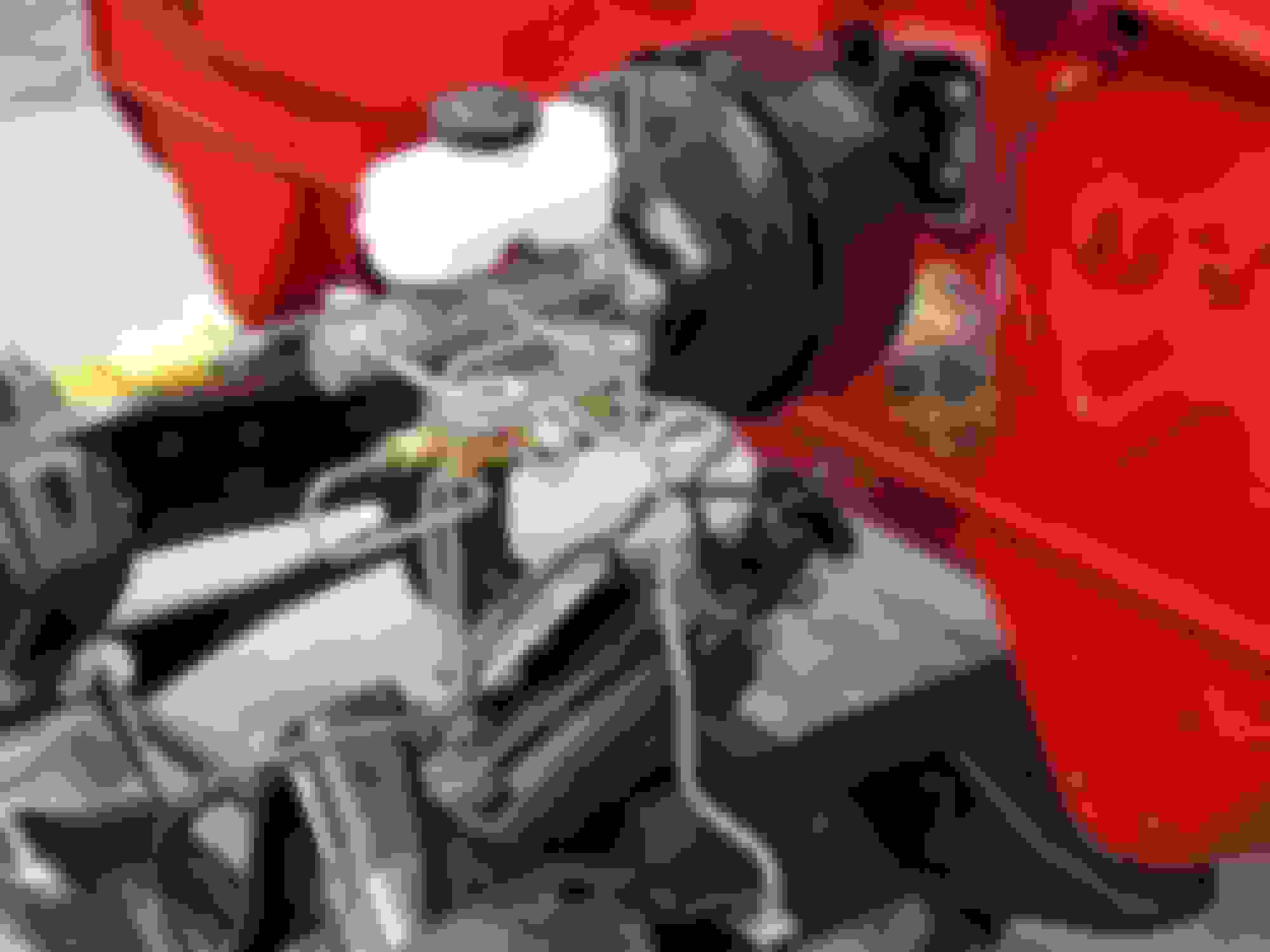
I drove the truck a bit tonight and afterward when looking in the engine bay I noticed that the master cylinder appeared to have some brake fluid leaking out.
Taking to heart the advice from AWSCAWPION and focusing on safety first this seems like it needs to be my starting point.
That said, where would you start? Can I fix this master cylinder or am I better off swapping another one?
At this late date, you'll have to go deeper than that. In my opinion. I don't want this to sound like a lecture, but went through similar with my 64, it would drip brake fluid on the floor mat in cold weather. Replaced the master with a new one, but when I dug into it, looking at it, something else needed replacing. No, everything needed replacing. No way around it.
See the brake line and all the rust? With a single pot master cylinder, if the line busts or leaks anywhere in the system, the pedal goes to the floor. They can be rebuilt sometimes, with a honing of the cylinder, if pitting isn't too bad. That's not the way to bet though.
Wheel cylinders are always the same way. Brake fluid by design absorbs moisture, but it will still cause corrosion and pitting in the cylinder bores if the brake fluid isn't changed regularly. Now, they make wheel cylinder repair kits, and wheel cylinder hones. But if you dig around, wheel cylinders - like NOS Wagners, are only maybe $10 each.
You can try to replace things in stages, but the brakes have to be bled each and every time you open it up. That will get old quick. So if you're like me, you kind of want to make it kind of a one time deal. And it needs new brake hoses. Trust Me. And wheel cylinders... And, everything is rusted to each other.
The good news, Brake parts generally aren't expensive. New master cylinder, hard line, hoses, wheel cylinders, spring kit, shoes, the works, everything but the pedal, will set you back a few hundred bucks. There's a new alloy brake line called NiCopp that is super easy to work with and flare.
Could be the cap just doesn't seal right, or it's overfilled or....
When I rebuilt my brake system I changed everything from front to back, wheel to wheel. The one thing I got away with not changing was the brake booster. Ask me what part failed 2500 miles later. I agree with Tedster on this one. Don't just look for a quick fix with the brakes. Parts don't have to be expensive (I like rockauto) but it's why things wind up costing double what we budgeted in the first place. When I hit 8k into my 5k budget, I stopped counting.
Probably the best thing to do is get rid of the single pot suicide MC and install a brand new (not rebuilt) tandem MC.
'65 F100 I converted to a tandem MC around 2009, after my friend had installed DJM drop beams and '78 front discs.
A few weeks ago, my friend brought the truck (err... the cab and the chassis) back to me to install a power brake booster, 'modern' MC and to run all new brake hard lines from the front to the back. I just finished up all the work this week.
I got rid of the pressure activated brake light switch that was on the old MC and installed a '74 Dentside brake pedal with the brake light switch mounted on the side of the pedal.
Ha not scared away at all! I've learned more about brake systems in the last 12 hours than I knew from the (more than several) decades prior!
I am actually pretty excited to undertake the full replacement process. My question now is what do I need to look for in a tandem master cylinder? Any recommendations there? @ultraranger - yours (both the initial upgrade but also the newest!) looks fantastic and is pretty inspiring. What was the double mc that you used?
Is 3/16" line sufficient everywhere or should 1/4" be used? I've seen conflicting info on that, curious about what others who have done on this update. I'm planning (for now anyway) to keep with the 4 drum setup and have no plans for heavy towing.
Stock drums all around, 3/16" lines are fine. Many people upgrade to dual pot mc to reduce the risk of losing brakes completely in the event of mc failure or leak. Also popular is swapping complete spindles, calipers, mc, booster etc from a later truck. That way you get disc brakes as well as the dual mc upgrade etc. and replacement parts are easily found. Lots of info on that if you search the forums. Been done a billion times. Don't be fooled by the people that tell you 4 way drums are no good though. Bottom line, if done right they work well.
Ha not scared away at all! I've learned more about brake systems in the last 12 hours than I knew from the (more than several) decades prior!
I am actually pretty excited to undertake the full replacement process. My question now is what do I need to look for in a tandem master cylinder? Any recommendations there? @ultraranger - yours (both the initial upgrade but also the newest!) looks fantastic and is pretty inspiring. What was the double mc that you used?
Is 3/16" line sufficient everywhere or should 1/4" be used? I've seen conflicting info on that, curious about what others who have done on this update. I'm planning (for now anyway) to keep with the 4 drum setup and have no plans for heavy towing.
3/16" tubing is the standard diameter line that was used on the trucks (Ford cars too). Best I can remember, the initial tandem MC I installed on my buddy's '65 F100 was a conventional style cast iron 1.00" bore manual brake MC for a '78 Ford truck (but, that was also 9 years ago).
More recently, I installed a (brand new, not rebuilt) 1-1/16" bore MC for a '95 Ford Explorer (part # NMC M3246) on a (newly rebuilt) Bendix dual diaphragm booster meant for a '72 F350 (booster purchased from Prior Remanuactured Brake & Steering Products, Dallas, TX --part # 3700131). The disc/drum brake valve is an aftermarket GM reproduction valve (available from multiple vendors on the internet).
The booster is not a direct bolt-on for a Slick, nor for a '67 Bumpside. The pedal pivot is much more forward (closer to the firewall) on the Slicks (and '67 Bumpsides) than on the '68-'72 Bumpsides or the '73-'79 Dentsides. You would also need the booster-to-firewall mounting brackets/hard plastic dust boot from a '68-up Bumpside or '73-'77 Dentside donor truck to mount the (long input rod, non-bellcrank style) booster.
I would also not recommend installing a dual diaphragm booster on a truck that has 4-wheel drums. This will cause the brakes to be very sensitive to the application of the brake pedal.
So I picked up a dual master (same one I think that ultraranger used) though it didn't specify anywhere whether it was for 4 wheel drum or drum/disc. It has two different size outlets however which I'm guessing perhaps indicates that it's intended for front disc/rear drum? If that is the case should I pick up a proportioning valve (which I see ultra used in his old setup) and be on my way, or am I better off going with a different dual master (and returning this one) that is intended for 4 wheel drum? Related, I also couldn't find anything about whether this part was intended for power or manual brakes (fitment is 1978 Ford F150).
If you have 4 wheel drum brakes, you don't need a proportioning valve. Those are to adjust for front disk/rear drum setups.
"A Proportioning valve is required on vehicles that have disc brakes on the front wheels and drum brakes on the rear wheels. Disc brake pads are normally in contact with the disc, while the drum brake shoes are normally not in contact with the drum. If the pressure was not proportioned the disc brakes would engage before the drum brakes when you depress the brake pedal.
The Proportioning valve compensates for this, allowing the drum brakes to engage first before the disc brakes. The Proportioning valve does not allow any pressure to the disc brakes until a pre-determined pressure has been reached. The pre-determined pressure is low when compared to the maximum pressure in the braking system, this allows the drum brakes to engage before the disc brakes engage. Having the rear brakes engage first provides the control and stability needed to stop your vehicle safety.
The proportioning valve reduces the pressure to the rear brakes. Whichever type of brakes your vehicle has, the rear brakes require less pressure than the front brakes.
If equal braking force were applied to all four wheels during a stop, the rear wheels would lock-up before the front wheels. The proportioning valve only lets a portion of the amount of pressure to the rear wheels thus preventing rear wheel lock-up.
Correct Ford terminology: Brake Pressure Differential Valve.
EVERY FoMoCo vehicle w/a dual master cylinder has it, whether they have drum or disc brakes.
While that is true, the OP was asking about a proportioning valve, and not a brake pressure differential valve. The former is adjustable and controls pressure to the front disks and rear drums. The latter operates a switch to turn on a warning light when there is a difference in pressure between the two circuits.
While that is true, the OP was asking about a proportioning valve (there is no such thing!) and not a brake pressure differential valve.
The former is adjustable and controls pressure to the front disks and rear drums. The latter operates a switch to turn on a warning light when there is a difference in pressure between the two circuits.
There's no such thing as a FoMoCo proportioning valve. This is what people that are unaware call the Brake Pressure Differential Valve.
I posted the pic from the parts catalog for the 1967/72 2B257 valves. How many 1967/72's came with discs?
C8HZ-2B264-A used on 1968 B500/750; C9HZ-2B264-A used on 1969 N500/750; 1969/72 B/C/F500/750 & 1970/72 L series. How many of these trucks came with discs? None!
There's also the D5AZ-2B264-A switch, but it replaced another part number and has a gazillion different applications including 1980/89 F100/350, Bronco & Econoline.
[QUOTE=NumberDummy;18047235]There's no such thing as a FoMoCo proportioning valve. This is what people that are unaware call the Brake Pressure Differential Valve.
I understand Ford didn't have a "proportioning valve" for these trucks. But there is such a thing. I installed one on a Mustang on which I converted the front brakes to disks, and had to adjust it to make the brakes work properly. It was called a proportioning valve, and no, it was not a Ford part. As I recall, it was quite simple in design and easy to adjust.
I have never worked with a pressure differential valve. I don't know if they also work like a proportioning valve to control the amount of brake fluid being pumped fore or aft or if they just turn on the light on the dash when there's a problem. I know one side is supposed to be blocked if it loses pressure, but that isn't what a proportioning valve does. I have read several posts here on the valve and the light switch while trying to determine if I needed to find one of these unobtanium parts when I replace my single chamber m/c with a dual chamber. I am not convinced it is a needed part for the brakes to work properly. Do you know when Ford stopped putting the Brake Pressure Differential Valve Warning Lamp Switch in the vehicles? I didn't have one in my 79 F250. Or at least if I did, I never saw the warning light lit.
I certainly appreciate the help of understanding proper terminology (and look forward to the resolution there of Joe's questions), but am still hoping to understand the following:
1. The dual chamber MC that I bought has two different size outlets - does that indicate that it might be intended for front disc/rear drums?
2. And *if so*, am I better off taking it back and looking for a different MC, or adapt the size down, and if I do that, do I need to use a valve of some sort to make this work with 4 drums?
Please do also carry on with the discussion about the proportioning vs differential valves, I am learning a lot and enjoy it.














 Those are to adjust for front disk/rear drum setups.

 to make this work with 4 drums?