When you click on links to various merchants on this site and make a purchase, this can result in this site earning a commission. Affiliate programs and affiliations include, but are not limited to, the eBay Partner Network.
I’ve mounted two extra batteries under the bed to run the onboard air compressors and power connector for trailer winch, dump trailer, etc. However when I looked to connect battery charge wire off the trailer connector to charge the batteries there wasn’t power. Took it to the dealer who informed me that the wire would only have power if a trailer was connected, the truck running and I had applied the brake pedal for 3 seconds. I was also told that running a line from the alternator could cause a problem, but was vague as to what that problem might be. I saw online where a guy used a couple of lights to make the truck think that a trailer was connected but was hoping for a more elegant solution. Has anyone dealt with this?
While you wait for Jim's post tomorrow I'll tell you what I did in my ATV.
I put in a battery isolator directly between the main battery and the auxiliary battery. The aux battery is used to run the winch and the additional lights. I don't see any reason you couldn't run a line directly from the main truck battery to an isolator, then to your compressor batteries. That way you won't drain the main battery and it also gives you the option to send power back to the main battery (from the compressor batteries) should it become discharged.
I’ve mounted two extra batteries under the bed to run the onboard air compressors and power connector for trailer winch, dump trailer, etc. However when I looked to connect battery charge wire off the trailer connector to charge the batteries there wasn’t power. Took it to the dealer who informed me that the wire would only have power if a trailer was connected, the truck running and I had applied the brake pedal for 3 seconds. I was also told that running a line from the alternator could cause a problem, but was vague as to what that problem might be. I saw online where a guy used a couple of lights to make the truck think that a trailer was connected but was hoping for a more elegant solution. Has anyone dealt with this?
So, the dealer is more or less correct about the "smart trailer connector's" functionality. The directions assume that the trailer has tail lights (running and turn & brake), and that you've created and activated a trailer profile in your truck instrument cluster's "Towing" menu. Once this is all set up and activated, you'll get a "Trailer Connected" message when you start the truck, and the turn signal auto-link function will switch from three-blink to five (or is it six?).
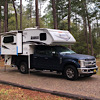
My short-bed slide-in truck camper has LED clearance lights (14 of 'em) but doesn't have taillights, so the smart trailer connector doesn't recognize the camper (and its batteries) when I plug in the umbilical, although the clearance lights are activated when the truck's running lights are on. It's a stupidly incomplete architecture, IMHO, and I'm done venting now.
My current verified solution is as follows: I have a 7-pin "Y" two-to-one adapter plugged into the camper, and the power umbilical from the truck is plugged into one of the "Y" receptacles. I bought a pair of incandescent trailer lamps, wired them to a 7-way plug, and plugged this "dummy load" into the "Y's" other receptacle. The lamp assembly lies in the bed of the truck. The truck now senses I have a valid trailer and will charge the batteries. I use the blink-change feature to manually confirm that my camper is electrically connected.
I haven't tried this work-around with LED trailer lamps. They typically draw MUCH less current than the incandescent bulb models, so that might corn-fuze the trailer connector logic. I have a Curt #57003 adapter (typically ~$25-27) and have validated it using a 7-pin tester (I created a Curt LED Adapter profile in my truck's trailer "library"), but I haven't validated it on our camper. I will try to do that today, and, if it works, then it may be the best solution.
Battery +12 charging circuit indicator is illuminated using the Curt #57003 adapter.
The problem with running wires directly to the alternator is that there's probably a current sensing circuit on the (-) side of the OEM battery wiring harness. If that's bypassed with external wiring, then the battery management system may loose track of battery amps in and out, and this could lead to false positives or false negatives and adversely affect if/how/when the operations of truck's battery protection feature.
HRTKD, That was my first approach but the shop that I contacted to do the work felt there could be a problem with voltage drop given how far apart the batteries are.
SDcrewzer, It looks like a work around that would work but I don't want to override the tow sensors.
What I've found today which MAY work better is a CTED D250S Dual Battery Charger. I'll have to do some more research but it looks promising.
I think you meant CTEK instead of CTED. I have a CTEK MUS 4.3 that I use to charge the dual OEM batteries in my F-350. You don't NEED a charger than has leads for each battery. I also use the same charger on the main battery in my ATV. The aux battery in the ATV is an Odyssey AGM so it gets a different charger.
I verified the Curt adapter between our truck and camper, and the battery charging circuit was operational
Frankly, I don't understand the concern about "overriding the tow sensors". My take is that the lamp sensors' primary purpose is to verify operational trailer lighting for safety reasons.
It is just a personal preference. I have a few trailers and if the vehicle will tell me if I have a light out I'd prefer to maintain that function. Almost all of this is for connivence. The first truck I owned had 4 on the floor with 1st being granny, fixed mirrors and a heater that almost worked, Air conditioning?!!, only on a Cadillac
The adapter won’t permanently defeat the lamp out feature. When you plug in a regular trailer (with lights) using its own profile and without the adapter, then the lamp out feature will function normally.
Put another way, you only need the adapter to facilitate charging the extra batteries when you’re not towing a lighted trailer.
This Hennessey Takes the Expedition Tremor's Off-Roading Capability to the Next Level
Slideshow: The VelociRaptor Expedition gains a lift, upgraded suspension, Brembo brakes, and trail-ready equipment while retaining the stock 440-horsepower EcoBoost V6.
Rezvani's Latest Post-Apocalyptic Monster Is a Ford F-150 Raptor Underneath
Slideshow: Called the Fortress, the 850-horsepower pickup combines Raptor underpinnings with military-inspired features, survival equipment, and a starting price of $285,000.








 I use the blink-change feature to manually confirm that my camper is electrically connected.


 And, it’s inexpensive!