


Compression test

Thread Starter
|
New User
Joined: Nov 2017
Posts: 24
Likes: 0
Compression test
I have a 1982 f150 302 5.0
When doing a compression test online says to remove fuel pump/injectors and or fuel relay.
Since i have a mechanical fuel pump what do i do?
And i my vehicle isnt running so i cannot warm up the engine first.
Will this affect psi?
Thanks
When doing a compression test online says to remove fuel pump/injectors and or fuel relay.
Since i have a mechanical fuel pump what do i do?
And i my vehicle isnt running so i cannot warm up the engine first.
Will this affect psi?
Thanks
Tuned
Joined: May 2014
Posts: 311
Likes: 30
From: MD
I have a carb & mechanical pump setup. To do mine I just removed the connection from the tank to the fuel pump and then ran the engine to clear out the remaining fuel.
Although I'm confused by your comment on the vehicle not running. Are you saying it is a non-running motor you want to compression test?
Although I'm confused by your comment on the vehicle not running. Are you saying it is a non-running motor you want to compression test?

Moderator


Joined: Jan 2001
Posts: 56,995
Likes: 2,741
From: Virginia

Not warmed up may make your readings a little bit lower. It's not going to crank as fast cold.
If you take the ignition wire off, I don't see a little bit of fuel entering the engine as a problem. You do need to tie the carb wide open so it can gulp as much air as possible to get good readings.
If you do not want any fuel entering the engine, you are going to have to drain all the fuel out of the carb and disconnect the input to the fuel pump. All your sparkplugs should be out, all at the same time, so it might shoot some fuel out of the sparkplug holes if there is any entering the engine.
If you take the ignition wire off, I don't see a little bit of fuel entering the engine as a problem. You do need to tie the carb wide open so it can gulp as much air as possible to get good readings.
If you do not want any fuel entering the engine, you are going to have to drain all the fuel out of the carb and disconnect the input to the fuel pump. All your sparkplugs should be out, all at the same time, so it might shoot some fuel out of the sparkplug holes if there is any entering the engine.
Fleet Mechanic


Joined: Jul 2003
Posts: 1,844
Likes: 129
From: Atlantic Canada
I just did a compression test on my '84 302 recently, and I didn't bother draining fuel. However, I only did one side at a time...meaning that I ran the engine in between.

Post Fiend
Joined: Apr 2002
Posts: 19,311
Likes: 97
From: Waterloo, Iowa
Every instruction sez engine warmed up to operating temperature, but. What you're looking for mainly is that all cylinders are close to each other. So if they are all between 140 and 150, that's not too bad. But if one cylinder is 60, you gotta problem. Or for example if two adjacent cylinders are very low that points to a bad head gasket. Ideally each cylinder should pump quickly up to about 90% of the high number on the very first stroke. If you get reasonably good numbers cold it seems to me they would only improve when hot. A mechanic's vacuum gauge also provides a good indication of rings and valves if you look at the charts and what to look for.
FTE Legend


Joined: Nov 2015
Posts: 30,935
Likes: 4,124
From: Angier, NC
Every instruction sez engine warmed up to operating temperature, but. What you're looking for mainly is that all cylinders are close to each other. So if they are all between 140 and 150, that's not too bad. But if one cylinder is 60, you gotta problem. Or for example if two adjacent cylinders are very low that points to a bad head gasket. Ideally each cylinder should pump quickly up to about 90% of the high number on the very first stroke. If you get reasonably good numbers cold it seems to me they would only improve when hot. A mechanic's vacuum gauge also provides a good indication of rings and valves if you look at the charts and what to look for.
Who wants to work on a hot motor and get burned?
I also never had fuel pour into the engine and spit out the plug holes.
Dave ----
Thread Starter
|
New User
Joined: Nov 2017
Posts: 24
Likes: 0
Yes its a non running engine.
Bad timing i believe is the reason my engine isnt running and i just want to make sure everything that has to do with it starting is good.
Bad timing i believe is the reason my engine isnt running and i just want to make sure everything that has to do with it starting is good.
Trending Topics
Cargo Master

Joined: Aug 2007
Posts: 2,561
Likes: 69
From: New Zealand
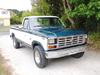
Slight subject change.........do you have a pic of your truck?
My '83 was also Light Spruce/White originally, but it was resprayed in Dark Spruce/White before I bought it.
I haven't seen another truck in LS, & would be interested to.
Thanks.
My '83 was also Light Spruce/White originally, but it was resprayed in Dark Spruce/White before I bought it.
I haven't seen another truck in LS, & would be interested to.
Thanks.
FTE Stories
Ford Trucks for Ford Truck Enthusiasts

3 Best / 3 Worst Parts of Modern Ford Ownership
Brett Foote
10 Amazing Upgrades That Solve Common Ford Truck Owner Headaches
Pouria Savadkouei
Every 2026 Ford Engine Explained
Brett Foote
10 Ugly Ford Trucks That We Still Kinda Love
Joe Kucinski
10 Things Every Truck Owner NEEDS (2026 Edition)
Michael S. Palmer
Rezvani's Latest Post-Apocalyptic Monster Is a Ford F-150 Raptor Underneath
Verdad Gallardo
Top 10 Most Expensive Ford Trucks Ever Sold on Bring a Trailer
Joe Kucinski
2027 Ford Super Duty Buyer's Guide (Every Model, Engine, & Package)
Brett Foote
Top 10 Ford Truck Tragedies
Joe Kucinski


FTE Legend
Joined: Nov 2015
Posts: 30,935
Likes: 4,124
From: Angier, NC
I would say take the color code number off the cert. sticker on the drivers door to a auto body supply store and they should be able to mix the color for you.
Now most mix it in quarts but might be able to get a pint but you need to get thinner and spray it out of a spray gun.
Some can mix it and put it in a spray bomb.....can, so you can spray if you don't have the equipment to spray paint.
Dave ----
Now most mix it in quarts but might be able to get a pint but you need to get thinner and spray it out of a spray gun.
Some can mix it and put it in a spray bomb.....can, so you can spray if you don't have the equipment to spray paint.
Dave ----

Thread
Thread Starter
Forum
Replies
Last Post
Smellii
1967 - 1972 F-100 & Larger F-Series Trucks
7
Jan 5, 2013 05:13 AM
Michigan Rick
Small Block V8 (221, 260, 289, 5.0/302, 5.8/351W)
9
May 29, 2010 11:32 AM