When you click on links to various merchants on this site and make a purchase, this can result in this site earning a commission. Affiliate programs and affiliations include, but are not limited to, the eBay Partner Network.
I have a couple more questions before I tear into my intake swap... gotta leave the truck drivable as long as possible and knock this thing out fast cuz, well... I need it.
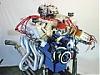
1) What's the port circled in red for? My 2 bbl intake has an undrilled boss there:
2) On my current setup, the circled hole has the vac line to the power booster connected. The PCV is connected to a plate under the carb. New carb=no plate. Can I connect my PCV to this hole and run the booster to the one in the previous pic?
It wouldn't be attractive, but I don't know where else to find the vacuum for both systems.
Derp... just anwered my own question (#2). PCV port on the back of the new carb. Sharp as a razor, Jonny... way to go.
I still wonder what the threaded hole in pic #1 is for, tho. I'll have to get a pipe plug for it, but now it's not a tech issue, just curiosity on my part.
How 'bout this question: Do any of the intake bolts go into a water jacket or oil galley? Do they need sealer on the threads? BTW, I did get new intake bolts, that should make the job a little easier as far as proper torquing goes.
Do you use anti-seize or thread-locker on your intake bolts? I never have before but engine families are different in what they like sometimes.
I'm sure there are a few youtube videos I can watch (I'm sure I will), but who's to say if those guys know what they're talking about...?
Never used anti-seize or thread-locker on intake bolts on any vehicles that didn't have aluminum heads. It's always a good idea to put a drop of oil on the threads to make sure torque values are consistent.
Also, run a tap through the holes in the heads to make sure they are clean.
I don't remember if any of the bolts go into water, I don't think so though - but wait for some more replies.
The male connector of the 3-wire dist. harness. These little connectors are used in several places under the hood, but this one seems pretty specific.
If anybody has one or knows where I can get one, that'd be hugely helpful. I made a new thread about it in this forum, and now I'll be looking at WTS posts. So far I haven't had any luck w Google.
No EGR valves until 1973 and the C6 was installed in F100/350's beginning in 1968 with 360/390 engines.
1968/79 F100/350 C6: 1968/76 F100/350 360/390; 1973/79 F100/350 460; 1977/79 F100/350 351M/400; 1978/79 F100/250 300 & F100/150 302 (C4 was also available in these trucks).
If you look in the hole of the fitting you'll see two small holes, one drilled into the upper runner and the other drilled into the lower runner. a intake I had also had the small fitting on the back of the intake. The PCV valve connected to a pipe that plumbed to both fittings balancing the vacuum to all cylinders. I think they only used that system for a couple of years and when back to the carburetor base PCV connection.
If you don't have the balance tube it's best to connect the PCV at the carb base and connect the power brakes the one of the manifold fittings.
The male connector of the 3-wire dist. harness. These little connectors are used in several places under the hood, but this one seems pretty specific.
If anybody has one or knows where I can get one, that'd be hugely helpful. I made a new thread about it in this forum, and now I'll be looking at WTS posts. So far I haven't had any luck w Google.
I found the pickup coil I needed, but when I got to looking at my factory distributor and how I was going to go about replacing it, I just decided to buy a reman dizzy.
There was no way I was going to get that thing apart without destroying something... too much rust on the E-clips and even the reluctor.
So that problem is solved... lets see what I can break next...
If you look in the hole of the fitting you'll see two small holes, one drilled into the upper runner and the other drilled into the lower runner.
If you don't have the balance tube it's best to connect the PCV at the carb base and connect the power brakes the one of the manifold fittings.
Both ports have the two smaller holes you mentioned. The front one will get plugged and the rear one will supply vacuum to the booster. I just spent 20 min of quality time at my NAPA's Weatherhead display putting together a fitting that I hope will work. Man, brass got expensive!
This Hennessey Takes the Expedition Tremor's Off-Roading Capability to the Next Level
Slideshow: The VelociRaptor Expedition gains a lift, upgraded suspension, Brembo brakes, and trail-ready equipment while retaining the stock 440-horsepower EcoBoost V6.