


Raptor crashed into pool...

Fleet Mechanic


Joined: Feb 2017
Posts: 1,597
Likes: 83
From: N. Texas
If you put either rear wheel on a slippery surface, PARK will do you little good as the wheel on the solid surface will just roll in the direction of gravity.
Hang around public boat ramps a while and watch as the truck, trailer and boat all coast backwards into the lake with the owner riding helplessly on the tongue of the trailer trying to winch (launch) his boat into the water... A couple guys here on FTE have had it happen to them even.
Gotta use 4WD and preferably use the Parking Brake in addition to the Park pawl....
Hang around public boat ramps a while and watch as the truck, trailer and boat all coast backwards into the lake with the owner riding helplessly on the tongue of the trailer trying to winch (launch) his boat into the water... A couple guys here on FTE have had it happen to them even.
Gotta use 4WD and preferably use the Parking Brake in addition to the Park pawl....
Fleet Mechanic
Joined: Feb 2017
Posts: 1,597
Likes: 83
From: N. Texas
Once again, I have NEVER had a vehicle 'roll' when it was in Park. I hardly ever use the e break. The point of the e break is exactly that, for emergencies. For that one odd time your brakes fail.

Post Fiend
Joined: Jun 2004
Posts: 9,293
Likes: 10
From: Parker, CO
In the video the driveshaft is NOT moving. Period. And I can prove it without the driveshaft being visible in the video.
Watch the video again carefully starting at 1:35. At 1:37 you'll notice the driver's side rear wheel is trying to spin FORWARD. You should ask why that is.
Learn how a rear differential operates, and you can correctly answer why that wheel was spinning forward as the truck was rolling backwards.
Fleet Mechanic
Joined: Feb 2017
Posts: 1,597
Likes: 83
From: N. Texas
Others have already explained it, but you refuse to understand or even acknowledge how a rear differential operates.
In the video the driveshaft is NOT moving. Period. And I can prove it without the driveshaft being visible in the video.
Watch the video again carefully starting at 1:35. At 1:37 you'll notice the driver's side rear wheel is trying to spin FORWARD. You should ask why that is.
Learn how a rear differential operates, and you can correctly answer why that wheel was spinning forward as the truck was rolling backwards.
In the video the driveshaft is NOT moving. Period. And I can prove it without the driveshaft being visible in the video.
Watch the video again carefully starting at 1:35. At 1:37 you'll notice the driver's side rear wheel is trying to spin FORWARD. You should ask why that is.
Learn how a rear differential operates, and you can correctly answer why that wheel was spinning forward as the truck was rolling backwards.
Post Fiend
Joined: Jun 2004
Posts: 9,293
Likes: 10
From: Parker, CO
And you avoided answering the question as to why that wheel was rotating forward as the truck was rolling backward.
Let's be honest, you've successfully lost all credibility in your argument at this point. The answer to the question was already posted in this thread by a Ford engineer, all you had to do was copy and paste and you would have been correct. Yet you were unable to identify the terms "pinion", "spider gears", or even the word "stationary".
You're only arguing for the sake of arguing at this point. There's nothing further to discuss.
Fleet Mechanic
Joined: Feb 2017
Posts: 1,597
Likes: 83
From: N. Texas
With that answer there, it clearly means you do NOT understand how a differential works. Furthermore you refuse to even try to learn.
And you avoided answering the question as to why that wheel was rotating forward as the truck was rolling backward.
Let's be honest, you've successfully lost all credibility in your argument at this point. The answer to the question was already posted in this thread by a Ford engineer, all you had to do was copy and paste and you would have been correct. Yet you were unable to identify the terms "pinion", "spider gears", or even the word "stationary".
You're only arguing for the sake of arguing at this point. There's nothing further to discuss.
And you avoided answering the question as to why that wheel was rotating forward as the truck was rolling backward.
Let's be honest, you've successfully lost all credibility in your argument at this point. The answer to the question was already posted in this thread by a Ford engineer, all you had to do was copy and paste and you would have been correct. Yet you were unable to identify the terms "pinion", "spider gears", or even the word "stationary".
You're only arguing for the sake of arguing at this point. There's nothing further to discuss.

Lead Driver


Joined: Jun 2005
Posts: 8,475
Likes: 728
From: Calgary Canada
Just like doing a burnout with an open differential, you will loose traction with one wheel and not both if that one wheel has less grip.
when you are parked and the transmission is in P, if one wheel is held still, the other can still rotate, thus the truck can roll backwards.
when you are parked and the transmission is in P, if one wheel is held still, the other can still rotate, thus the truck can roll backwards.
Fleet Mechanic
Joined: Feb 2017
Posts: 1,597
Likes: 83
From: N. Texas
Just like doing a burnout with an open differential, you will loose traction with one wheel and not both if that one wheel has less grip.
when you are parked and the transmission is in P, if one wheel is held still, the other can still rotate, thus the truck can roll backwards.
when you are parked and the transmission is in P, if one wheel is held still, the other can still rotate, thus the truck can roll backwards.
FTE Stories
Ford Trucks for Ford Truck Enthusiasts

Top 6 Best Deals Available on New Fords & Lincolns Right Now
Brett Foote
This Hennessey Takes the Expedition Tremor's Off-Roading Capability to the Next Level
Verdad Gallardo
Top 10 Fords at 2026 Carlisle Ford Nationals
Joe Kucinski
3 Best / 3 Worst Parts of Modern Ford Ownership
Brett Foote
10 Amazing Upgrades That Solve Common Ford Truck Owner Headaches
Pouria Savadkouei
Every 2026 Ford Engine Explained
Brett Foote
10 Ugly Ford Trucks That We Still Kinda Love
Joe Kucinski
10 Things Every Truck Owner NEEDS (2026 Edition)
Michael S. Palmer
Rezvani's Latest Post-Apocalyptic Monster Is a Ford F-150 Raptor Underneath
Verdad Gallardo
Post Fiend
Joined: Jun 2004
Posts: 9,293
Likes: 10
From: Parker, CO
If both tires have equal grip, it's equivalent to driving in a straight line. The differential keeps both wheels spinning at the same speed. In park, it keeps both wheels locked equally from moving.
If one tire has grip but the other doesn't, the differential is designed to allow the two wheels to move at two different speeds. It's how vehicles turn smoothly without wheel hop in the rear.
Ice is a prime example of how easy it is to make this happen when the transmission is in park, as one wheel can very easily lose grip on an incline - as shown in the video.
This also happens on boat ramps if they are steep enough, and if there's sufficient water, slick algae growth, or enough gravel to allow a wheel to lose grip.
If say you're stuck in mud and doing the one-wheel spin, you actually have two things spinning - the driveshaft and the loose wheel. If you're in park and rolling, the driveshaft isn't spinning, so both wheels spin - in opposite directions as the spider gears walk. At least 2 things have to spin, either a driveshaft and wheel or both wheels.
This isn't easily accomplished with a truck on a lift and trying this by hand. With enough force you can duplicate it, but most people never try so it's not exactly something observed on a daily basis. But in the video, you can clearly see the driver's side wheel moving forward, so that means the other wheel is spinning in the opposite direction, and the driveshaft is not moving because it's locked in place with the transmission in Park.
Fleet Mechanic
Joined: Feb 2017
Posts: 1,597
Likes: 83
From: N. Texas
Correct.
If both tires have equal grip, it's equivalent to driving in a straight line. The differential keeps both wheels spinning at the same speed. In park, it keeps both wheels locked equally from moving.
If one tire has grip but the other doesn't, the differential is designed to allow the two wheels to move at two different speeds. It's how vehicles turn smoothly without wheel hop in the rear.
Ice is a prime example of how easy it is to make this happen when the transmission is in park, as one wheel can very easily lose grip on an incline - as shown in the video.
This also happens on boat ramps if they are steep enough, and if there's sufficient water, slick algae growth, or enough gravel to allow a wheel to lose grip.
If say you're stuck in mud and doing the one-wheel spin, you actually have two things spinning - the driveshaft and the loose wheel. If you're in park and rolling, the driveshaft isn't spinning, so both wheels spin - in opposite directions as the spider gears walk. At least 2 things have to spin, either a driveshaft and wheel or both wheels.
This isn't easily accomplished with a truck on a lift and trying this by hand. With enough force you can duplicate it, but most people never try so it's not exactly something observed on a daily basis. But in the video, you can clearly see the driver's side wheel moving forward, so that means the other wheel is spinning in the opposite direction, and the driveshaft is not moving because it's locked in place with the transmission in Park.
If both tires have equal grip, it's equivalent to driving in a straight line. The differential keeps both wheels spinning at the same speed. In park, it keeps both wheels locked equally from moving.
If one tire has grip but the other doesn't, the differential is designed to allow the two wheels to move at two different speeds. It's how vehicles turn smoothly without wheel hop in the rear.
Ice is a prime example of how easy it is to make this happen when the transmission is in park, as one wheel can very easily lose grip on an incline - as shown in the video.
This also happens on boat ramps if they are steep enough, and if there's sufficient water, slick algae growth, or enough gravel to allow a wheel to lose grip.
If say you're stuck in mud and doing the one-wheel spin, you actually have two things spinning - the driveshaft and the loose wheel. If you're in park and rolling, the driveshaft isn't spinning, so both wheels spin - in opposite directions as the spider gears walk. At least 2 things have to spin, either a driveshaft and wheel or both wheels.
This isn't easily accomplished with a truck on a lift and trying this by hand. With enough force you can duplicate it, but most people never try so it's not exactly something observed on a daily basis. But in the video, you can clearly see the driver's side wheel moving forward, so that means the other wheel is spinning in the opposite direction, and the driveshaft is not moving because it's locked in place with the transmission in Park.
Frmr Ford Trans Engr


Joined: Aug 1999
Posts: 24,739
Likes: 2,669
From: SE Florida
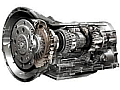
Park holds the output shaft of the transmission from turning. The driveshaft is attached to the output shaft on one end, and the differential pinion on the other end. Since the output shaft and driveshaft can't turn, either can the pinion. If both rear tires have traction the truck cannot move.
Since this truck was on ice, one of the wheels lost traction. From the video it was the right tire, because the left was rolling in the direction that the truck moved. You couldn't see it, but the other wheel was rolling forward, the opposite of the way the truck was rolling.
That's how park holds a vehicle from rolling. The vehicle can only move if one of the wheels rolls in the opposite direction of the vehicle movement. This is not unique to Ford, it is true for ANY vehicle that has an open differential. It's why owner's manuals tell you to set the parking brake in addition to placing the trans in park.

Moderator


Joined: May 2005
Posts: 8,232
Likes: 1,248
From: San Antonio, TX


