When you click on links to various merchants on this site and make a purchase, this can result in this site earning a commission. Affiliate programs and affiliations include, but are not limited to, the eBay Partner Network.
So this being my second 7.3, you'd think I'd know the answer to this one by now. When folks with modified engines, whether mild or crazy, talk about getting to 30psi boost or such, are they referring to 30psia or 30psig? [psia - psi absolute; psig - psi gauge] For me, boost means "boost", and thus over ambient, so "30psi boost" would be 30psig or 44.7psia at sea level. My stock e99 never sees over 25psia (MAP), and even then I really have to plan ahead to see above 22-23 - look for an upcoming hill, slow down, downshift to fourth, floor it (this is fun btw)....
A complete one shot clarification of this, how the redline works, defueling etc., would be fantastic.
My question comes from reading various comments from users, or seeing pictures like this:
Clearly something's amiss here. If MAP stands for Manifold Absolute Pressure - which I believe is true - then either CousinCarl is located in some weird section of the universe, or his gauge is mislabeled. The Absolute part means it can NEVER be negative, so I would take this gauge to be a BOOST gauge, and therefore showing MAP - BARO. In which case his truck is very similar to mine, maxing about 23psia, unless it does reach that 30 mark.
Your assessment in the OP is correct. It might be possible that CousinCarl has the ability to change the parameters or labeling, thus rendering something other than MAP on that gauge on that tablet.
Yeah... that's boost with the MAP label. That's one of the drawbacks (or benefits) of Torque Pro - any gauge can be labeled anything, so long as you get the PID number and name accurate without typos. I can take my Transmission Fluid Temperature gauge and "label" it Volcanometer, Shred Factor, or George.
Mark, I understand that, but really I'd like a classroom presentation on boost, PCM defueling, redline function, etc. Rich just made comment elsewhere about max stock boost being ~17psi. That's either 17psia MAP and 2.3psi of boost, or all boost and 31.7psia MAP. Neither case is true about my truck, and it seems to run pretty good.
I'm constantly considering updating to the late '99 setup and going for some better performance, but I really need to understand the baseline stuff first. Hence your truck **** posts are truly annoying as having a spare 7.3 to rebuild slowly into something reasonable and new and reliable is the kind of thing I would really enjoy doing.
Rich can definitely give you a better, more in depth explanation than I can but boost is MAP-barometric pressure, that math is contained in your boost gauge. Defueling occurs when the PCM cuts fuel when your MAP crosses a threshold, I never really paid attention to what that is but it's in the 20's somewhere. If you goose your truck into higher performance levels you need to mask the higher boost with a boost fooler or have defeuling addressed in the tuning. I don't know what you mean when you refer to red line, unless you mean the red hose to the wastegate. And lastly, after much thought and discussion I am not so sure that upgrading to 99.5+parts yields much of an improvement but the up pipes are cheaper for the later years, much cheaper if you go with IH parts.
No one refers to boost pressure in absolute terms. So if I say I'm running 15 psi of boost pulling a grade, that's 15 psi in addition to the base atmospheric pressure of ~14.7 psi.
I'm no expert on the other stuff you asked about, so I will let others handle it.
I live in a galaxy far, far away.... LOL! I'm in North TX.
I'm new to Torque Pro. Just started messing with it actually. That reading is at idle there. Since I just started monitoring it idk what normal is for this truck. I plan to perform a boost leak test and make sure I'm not losing any anywhere. That PID is listed as FORD specific Boost and when I placed it on the page it labeled it MAP automatically. There is another Boost gauge listed in the PIDs that puts it in Hg/in I believe on default. Sometimes its labeled boost sometimes it labels it Vacuum. When I convert that one to psi in the app, it spits out nearly the same numbers as the MAP gauge but at a delayed rate it seems to me so I got rid of it and kept the MAP one. I don't claim to fully understand all of this myself, so if I have done something in error, please let me know.
I live in a galaxy far, far away.... LOL! I'm in North TX.
I'm from eastern PA near Philly, so yes, you do live in a galaxy far far away from me, and I'd probably love it there!! Except for the lack of real winters and changing seasons...
Odd that your default TP MAP gauge reads actual boost then, as mine reads in absolute. That check is done with the engine off, as the Exhaust Backpressure (EPB) sensor, the internal PCM Barometer (BARO) and the MAP should all read the same absolute air pressure, or ~14.7psia depending upon altitude.
And yes Mark, by red line, I meant that little tube that serves the wastegate. I understand that as MAP increases above a set pressure, the control will open the wastegate and dump exhaust to limit MAP to some pressure, but I don't know whether there's any adjustment that can be made - beyond plugging it. And then there's the whole PCM defueling thingy.
I'd love a nice story telling how these folks get along and play nice with each other, and how the evil PMS villain in us all tries to fool them into blowing up our engines...
I am 3rd owner of my truck. 1st owner was rich (not Tugly) and put bells and whistles on it. He had the wastegate unhooked and the PCM is live tuned and, apparently, is tuned to not defuel. A while back a new owner posted pics of his engine and one of the things in the pic was a boost fooler of some sort, I think it had Diesel Site stamped in it. I installed the van turbo that came on my short bus and those don't have wastegates so I still don't have one and have no experience with one functioning. I'm thinking that if you are going to tune up and can get defueling addressed with the tuning that would be the way I would go. I believe that Tugly has some sort of boost fooler and he could tell you about that.
BARO - atmospheric air pressure. At sea level, it's 14.7 PSI - but in Denver it's 12 PSI. The truck needs to know how dense the air is to get the readings right, so there's a BARO sensor on every vehicle.
MAP - Manifold Absolute Pressure... the word "absolute" is right there in the sensor name. Absolute manifold pressure is the pressure of the atmosphere, plus whatever is added/subtracted by any pressure-enhancing devices (turbo or blower) and the engine draw at the intake manifold. At idle, there is not any real pressure on the exhaust side - so the turbo is freewheeling (more or less). Without any significant push from the turbo, the engine (which is a very big piston air compressor) is sucking air in, pulling the MAP reading down a little.
Boost - this is MAP minus BARO, so you can look directly at what the engine/turbo is doing to the intake manifold pressure. Many people just want the boost number when they glance for that 1/2 second at the gauge. They don't want to take time out for a math quiz while at WOT... calculating their current barometric pressure to work out how the turbo is doing. There actually are laws against this in Washington state - calling it "distracted driving"... but I digress.
Defueling - two things have to happen:
You need to exceed 22 PSI boost (MAP minus BARO)
You need to cross over 2800 RPMs
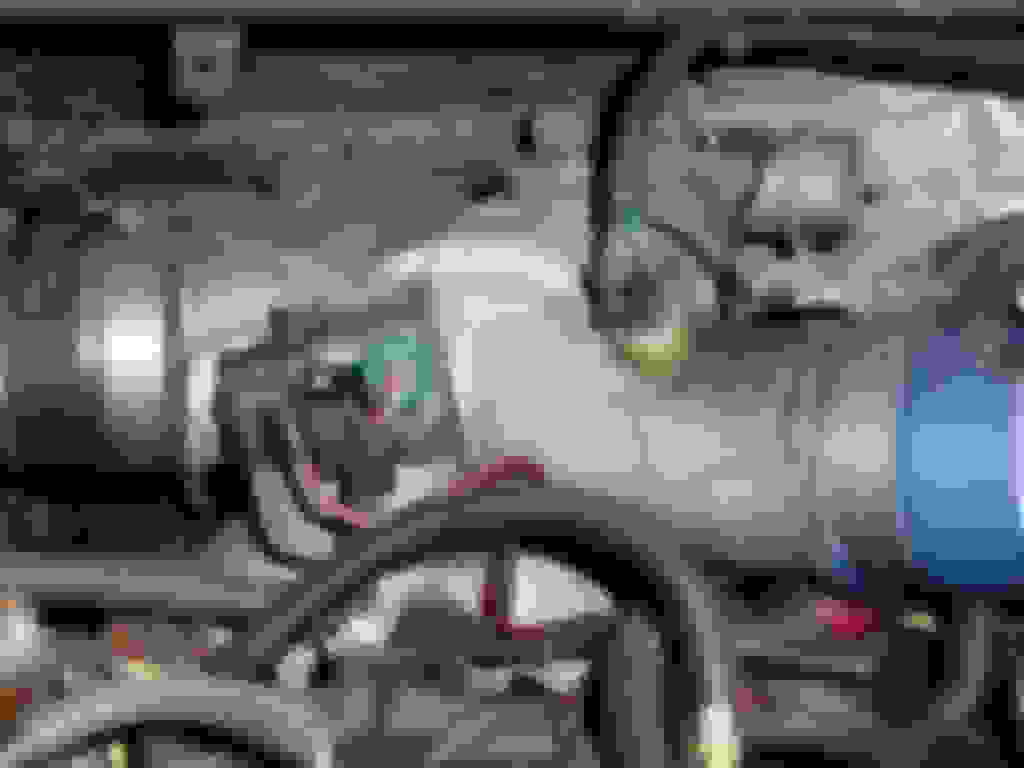
OK... 22 PSI is the number, but how does one exceed 22 PSI on stock tuning with stock injectors and turbo? The graph above is from a vehicle that did exactly that... so it's not fake news or netlore. The red tube to the top of the turbo carries some of the boost pressure to a valve control. That valve is the wastegate, which allows the exhaust backpressure to bleed off - stealing away the driving force behind your turbo. The red tube has air pressure in it much more than many realize, constantly allowing at least a little backpressure to bleed off at throttle far less than wide open. If you cap the red tube off, you block a little boost from escaping from the tube, but more importantly - you prevent a wastegate open command from reaching the wastegate.
Now... here's where I don't have direct experience, because my WG actuator was modified before I bought the truck. I have heard of the "7-turn" mod, where you spin the actuator threads out seven turns to push harder on the wastegate. You can then get full exhaust backpressure to push the turbo - driving your boost up to readings you didn't know you could do. It's not akin to donning rocket boots, but it's like taking off the galoshes and putting on some running shoes. For those concerned - we don't really worry about exceeding the turbo limits until we surpass 26 PSI (tuning territory).
OK... that allows more pressure, but it doesn't necessarily get you to the mystical defueling zone. I have learned that our stock exhaust is pretty much tuned for the limits placed on our beloved 7.3L by the Ford engineers. The pipe allows 20 PSI boost just fine, but anything above that and the pipe protests. Ever try to exhale through one of those coffee stirring straws? It can be done, but it's much more productive to get a Slurpee straw. The 4" lets the exhaust out of the turbo easier and is a huge help for those seeking boost values above 20 PSI. The higher the boost goal, the more one benefits from a bigger tube.
Intake - our stocker doesn't suck... it instead allows the turbo to draw anything except filtered air. Moving to a bigger/better intake is like trading in our coffee stirring straw for a Slurpee straw before drawing from a beverage cup. That was my first step on the truck with the graph above - a Ford AIS on a stock truck. Group that with a bigger exhaust and red line mod, and you find defueling to be your next hurdle. This is where the boost fooler comes in.
Boost fooler - there are a few forms of this, the PO installed a zener diode on the MAP signal line as a cheap boost fooler, but this really messed with the performance of the truck - so out it came.
I instead used the type that is a pressure regulator placed on the air line feeding the MAP sensor. The MAP sensor sees only the boost pressure allowed by the boost fooler, and the regulator never lets the boost pressure to the sensor reach 22 PSI. You can see my boost fooler in the very upper-left corner.
If anybody is wondering - these are the most harmless mods you can perform on a stock truck. If I saw these as the only mods on a pristine Superduty with a 7.3L on the used market, I wouldn't hesitate to buy it because the mods are so conservative and they augment reliability as well as performance.
You have a point... it covers a lot of stuff not usually placed in a single read. I added some art and modified my Intake Mods link in my signature. The link used to compare the AIS with the S&B - but I believe this is of greater use to those not reaching for 400 HP.
Rezvani's Latest Post-Apocalytic Monster Is a Ford F-150 Raptor Underneath
Slideshow: Called the Fortress, the 850-horsepower pickup combines Raptor underpinnings with military-inspired features, survival equipment, and a starting price of $285,000.