When you click on links to various merchants on this site and make a purchase, this can result in this site earning a commission. Affiliate programs and affiliations include, but are not limited to, the eBay Partner Network.
I would have someone weld in some reinforcements on the bent over top and bottom caps on each side, thoroughly attaching those bendovers to the front-to-back interior side plates to convert the folded boxes into fully welded boxes on each end.
They are welded on the inside of the box on my draw tite. Looking at the pictures it is hard to see.
I hate being the Baby Ruth in the pool but, Won't that put a couple K of tongue weight on an already heavy A$$ front end??? U gonna need air bags on the fronts now.....
. Also, on the Drawtite, I would have someone weld in some reinforcements on the bent over top and bottom caps on each side, thoroughly attaching those bendovers to the front-to-back interior side plates to convert the folded boxes into fully welded boxes on each end.
This might be a marginally okay practice on a front hitch, where it will never see true road use. I would seriously hope this advice wouldn't be given for any truck accessory that will see cyclical loading. Hitch, plow mounts, fifth wheel plate, etc. Please stick with unmodified, engineered, fabricated, and dot approved parts. Don't take the liability from the manufacturer and place it on your self. God forbid, something happens; your insurance company isn't going to want to take the claim, nor will the manufacturer and you could be left holding a really big bag.
I went with the Curt, it mounts below the bumper so you get to keep the driving lights and no air flow blockage. It is a heavy duty sucker and to mount it I had to remove spring hangar bolts and fasten in plates then drill and tap the blocker beam for the center bolts. I wouldn't be afraid to push a heavy boat up the drive with it.
Funny thing is I only use it for my home made top side creeper. So I am thinking about removing it and just getting the Harbor Freight bolt on to attach to the blocker beam, that's all I really need.
Between model years 1974 and 1982, FMVSS regulations mandated car bumpers that could withstand, without damage, impacts up to 5mph. Many of the bumpers of that era had sophisticated shock absorbing brackets that looked like this:
An external tube would be rigidly mounted to the car's frame, and an internal tube would be securely mounted to the car's bumper. The internal tube was semi fixed in an extended position that protruded from the external tube. During a low speed impact, the extended internal tube would slide into the fixed external tube, with some means of absorbing the insertion rate. This is how very low speed crash energy was absorbed without transferring the energy (and extensive damage) to the vehicle.
These shock absorbing bumper brackets worked, but were expensive components to make, so manufacturers started looking for ways to do without them and still meet FMVSS regulations, but in a blow to consumers and a boon to car companies, successfully lobbied a new administration in the early 80's to eliminate the "no damage" requirement, and cut the speed in half, to 2.5 mph.
I like how Jalopnik summarizes the automotive industry's perpetual drift toward cheap in these two photos below:
Bear with me... this IS related to front receiver hitches...
When Ford redesigned the frame of the E-Series Econoline for 1992 model year, and followed up with the redesign of the semi full size F-Series 150 in 1997, and the true full size F-Series (now called Super Duty) for the 1999 model year, the front frame itself served as a multistage crumple zone that at least was intended to limit the transfer of damaging energy in some specific ways:
Most important to our discussion is how the front bumper is mounted to frame horn flanges, not the actual frame itself. These flanges are much thinner, and more flexible than the frame. The flanges also have minimal attachment to the frame, being welded on only by thin tabs on the sides, which allows them to more easily bend backwards (and be bent back forwards again) on minimal impacts.
The thin material, and the fact that they are separate pieces tacked onto the frame, rather than the frame itself, and only minimally attached... all work well for reducing the transfer of damaging energy to the frame.
Below is an example of how the frame horn flange "absorbed" the low speed impact energy by being the "fuse" that bends, rather than the frame itself bending. I assume the bumper got trashed, but the bumper has to attach to something, and in this case, the bumper is attached to the flimsier foldaway flanges, rather than the frame itself.
While the above photo is of an F-150 frame, the Super Duty flimsy foldaway bumper mounting flanges are very similar.
Below is a Super Duty front frame section that shows the frame with bumper mounting flanges on the right hand side of the photo. Note that this frame section is UPSIDE DOWN on the pallet, so when looking to the right of the photo at those bumper mounting flanges, NOTICE THE AIR GAP between the lower chord of the flange and the frame itself... there is ZERO TIE IN on the bottom. The flimsy foldaway flange floats, breakaway style, around the real frame opening, attached to the frame only by tabs on the sides.
Allowing metal to fold and bend is cheaper than those sophisticated shock absorbing bumper mounting contraptions of the late seventies. But think about this when attaching a RECEIVER hitch to these breakaway brackets, and think about what the purpose of these flanges are for... to hold a very thin and light steel bumper that can be carried in one hand, and to fold away on impact.
How much does that boat weigh? How much resistance does the water add when pulling the submerged and loaded trailer up the boat ramp, if you choose to look at what you are doing from the windshield instead of the rear view mirror?
Those big aftermarket bumper replacements from ARB, RanchHand, RoadArmor, and the like do not rely on those flimsy foldaway flanges. Instead, they instruct installers to remove the factory tow hooks (that are bolted through the bottom of the frame itself), and use those holes in the frame to mount the bumper replacement, which has it's own tow hooks (or a provision to remount the factory tow hooks).
Warn is in the business of making winches, and some of there winches are portable and designed to be installed in front receiver hitches. Warn tests all of their winches and winch carriers in house. When it came to the Super Duty, Warn found the need to design their own front receiver hitch, because the front hitches on the market at that time (the type that mount to the bumper mounting flanges) did not pull the duty.
This is how Warn's front receiver hitch mounts for the 2000 era Super Duty:
Now you see it.
Now you don't:
Hitch is located UNDER radiator, not in front of it, and is attached directly to the truck frame with 1/2" plate vertically mounted, angled back side plate brackets, not the foldaway bumper flange.
The cross tubing is rectangular, not square, with the wide legs (3") of the tube oriented in the direction of pull, and otherwise matches the standard 2" receiver size in all other respects.
.
Well that there is some good info, and looks like I chose the right hitch with the Curt.
I think you did, given the mounting style of the other options depicted in this thread. I encouraged a friend to avoid using the foldaway bumper flanges, and not only did he save his factory fog lights and not block air flow to his radiator, more importantly, he didn't block airflow to the much smaller POWER STEERING cooler, which depends entirely on that lower through the bumper hole for air flow. The grille is too high up to properly cool the power steering cooler (and the original diesel transmission cooler, for that matter).
Since there is no temperature gauge on the power steering fluid, how would people know whether or not a hitch that blocks air flow is having an effect or not on the power steering fluid heat cycling and thermal breakdown? If there is any effect at all, how would folks see it? Not until a power steering gear or pump failure down the road? Hard to say one way or another.
Take look at every successive generation of Ford Super Duty front end grille and bumper design, and it is clear that Ford places a higher value on lower openings in the bumper (each design cycle they get larger and more open) than on higher openings in the grille (each design cycle they get smaller and more blocked). Just something to observe and consider.
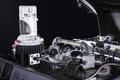
Front hitches are also useful for holding an elevated work platform that won't slip out from underneath your feet as you lean forward over the engine bay, as seen below (supported by a Curt front receiver hitch, BTW)...
Y2KW57's info sure thickens the plot (thanks for that fantastic walk through the details!), now I have mulling to do. As I'm reading this, Draw-Tite engineers designed a stout hitch receiver to handle 9,000 pounds pull weight - but they overlooked what it's mounted to?
Could somebody explain to me what the "blocker beam" is? Thanks!
It is installed on certain vehicles to prevent them from going over the top of a smaller vehicle during a crash. It is designed to push the smaller vehicle out of the way instead.
I have custom front hitches on both of my 6 packs.
makes it so damn easy.
my hitches are below the "air line" and have not caused me issues.
the worst part of it is the tounge weight on the front springs.
your boat is pretty heavy. may wanna consider a bag set up on the fronts?
Since there is no temperature gauge on the power steering fluid
Is that another mod I can do? Another thing to spend money on? Is it something that will provide a tiny bit of somewhat useful information to me if I can find room for one more gauge?
Then SHUT UP AND TAKE MY MONEY!!!
Last edited by andym; Mar 10, 2017 at 09:31 AM.
Reason: Serious but not serious... I think I have PMS
Rezvani's Latest Post-Apocalyptic Monster Is a Ford F-150 Raptor Underneath
Slideshow: Called the Fortress, the 850-horsepower pickup combines Raptor underpinnings with military-inspired features, survival equipment, and a starting price of $285,000.