






 .
.

Frame Weld Repair
Thread Starter
|
Cargo Master


Joined: May 2011
Posts: 2,388
Likes: 138
From: Northern California
Frame Weld Repair
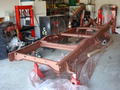
I found a crack in the weld where the front cross-member is bonded to the boxed portion of the frame (right side). Below are a couple of pics so you can see for yourself. My plan is to basically take a thin cutting wheel on my hand grinder and 'open' this crack up a bit so I can get some new weld down in there as opposed to just creating a butt-weld across the surface. My understanding is the more surface area the weld bonds to the stronger the weld will be. In you opinion is this sufficient?
I do plan on turning this over to clean and to further inspect and repair as necessary.
BTW... This thing has some ugly welds on it. I am playing amateur hour here and doing much better than that. Must have been made on a Friday at the end of the shift. I guess I will do a bit of cleaning up too.


I do plan on turning this over to clean and to further inspect and repair as necessary.
BTW... This thing has some ugly welds on it. I am playing amateur hour here and doing much better than that. Must have been made on a Friday at the end of the shift. I guess I will do a bit of cleaning up too.


Elder User
Joined: May 2015
Posts: 785
Likes: 2
I previously posted this reply in a similar thread. Copy/paste here for brevity. Hope it helps.
Typically I avoid responding to questions such as these, and other welding-related posts, to avoid the drama that tends to ensue when "experts" butt heads.
That doesn't seem to be happening here, so I'd like to provide my opinion. I am an x-ray certified pipe welder by profession, and have a considerable amount of structural and fabrication design/construction/repair experience as well.
In all the pertinent work that I've done, the standard procedure is as follows:
1. "Chase" the crack with either a cutoff wheel (typically a .045" wheel on a peanut grinder) or a carbide burr on an end grinder. That is to say, bevel both sides of the crack.
2. Grind *beyond* the visible ends of the crack, to ensure that it doesn't continue beyond what is currently visible. A half inch or so on each end should be sufficient.
3. Drill a hole at each end of the crack, to help prevent it from expanding.
4. Begin to weld it. Now, here is where most people do it in a fashion that I was taught, and have subsequently seen in the field, is often inadequate. They will try and just run a bead down the crack and call it good. Not so. Start *in front of* one of the holes you drilled, NOT on it. The holes need to be welded LAST. Weld approximately two inches of the crack, and stop. Take a hammer and peen the **** out of the weld and surrounding area. Weld another two inches, and repeat. So on and so forth, until the crack is welded completely. This method of welding, along with a preheat/postheat procedure, is critical when welding cast iron or any other high-carbon steel. However, I've found it works well on low- and medium-carbon steels as well.
5. At this time, you can weld up the holes you drilled. The reason behind installing the holes and welding them last is simple; to prevent it from cracking further. But, most people get confused here too. It's not to keep it from cracking down the road, it's to prevent the existing crack from growing as you weld. As we all know, metal expands when heated. As a result, the ends of the crack become pivot points for both "pieces" of metal as you are welding. If you just start welding away, the two sides of the crack expand and all of that tension is focused squarely on the far end of the crack. In drilling holes, you effectively create a hinge that distributes the stresses associated with welding around a greater area, thus reducing the chances of furthering the crack.
Here is where some people tend to say "but I weld cracks like that all the time and never have a problem. Yeah, well, go ahead and run an ultrasound test on the surrounding metal next time. You'd be surprised how many cracks tend to form at the end of what was the original crack.
Installing fish plates in addition to your weld repair is optional, but depending on what type of use (or abuse) the truck will see, it may be an advisable step.
Hope this helps. And no, it's not the only way to do it. In welding, there is rarely only one way. But it's the most effective method I've found to date.
Typically I avoid responding to questions such as these, and other welding-related posts, to avoid the drama that tends to ensue when "experts" butt heads.
That doesn't seem to be happening here, so I'd like to provide my opinion. I am an x-ray certified pipe welder by profession, and have a considerable amount of structural and fabrication design/construction/repair experience as well.
In all the pertinent work that I've done, the standard procedure is as follows:
1. "Chase" the crack with either a cutoff wheel (typically a .045" wheel on a peanut grinder) or a carbide burr on an end grinder. That is to say, bevel both sides of the crack.
2. Grind *beyond* the visible ends of the crack, to ensure that it doesn't continue beyond what is currently visible. A half inch or so on each end should be sufficient.
3. Drill a hole at each end of the crack, to help prevent it from expanding.
4. Begin to weld it. Now, here is where most people do it in a fashion that I was taught, and have subsequently seen in the field, is often inadequate. They will try and just run a bead down the crack and call it good. Not so. Start *in front of* one of the holes you drilled, NOT on it. The holes need to be welded LAST. Weld approximately two inches of the crack, and stop. Take a hammer and peen the **** out of the weld and surrounding area. Weld another two inches, and repeat. So on and so forth, until the crack is welded completely. This method of welding, along with a preheat/postheat procedure, is critical when welding cast iron or any other high-carbon steel. However, I've found it works well on low- and medium-carbon steels as well.
5. At this time, you can weld up the holes you drilled. The reason behind installing the holes and welding them last is simple; to prevent it from cracking further. But, most people get confused here too. It's not to keep it from cracking down the road, it's to prevent the existing crack from growing as you weld. As we all know, metal expands when heated. As a result, the ends of the crack become pivot points for both "pieces" of metal as you are welding. If you just start welding away, the two sides of the crack expand and all of that tension is focused squarely on the far end of the crack. In drilling holes, you effectively create a hinge that distributes the stresses associated with welding around a greater area, thus reducing the chances of furthering the crack.
Here is where some people tend to say "but I weld cracks like that all the time and never have a problem. Yeah, well, go ahead and run an ultrasound test on the surrounding metal next time. You'd be surprised how many cracks tend to form at the end of what was the original crack.
Installing fish plates in addition to your weld repair is optional, but depending on what type of use (or abuse) the truck will see, it may be an advisable step.
Hope this helps. And no, it's not the only way to do it. In welding, there is rarely only one way. But it's the most effective method I've found to date.

Regular User

Joined: Sep 2014
Posts: 1,798
Likes: 15
From: Bathurst, New Brunswick

HIO, I have been on here long enough to know there is NO doubt about that statement! 
Always appreciate your experience, input and humour. Have a great day.
Always appreciate your experience, input and humour. Have a great day.
Thread Starter
|
Cargo Master
Joined: May 2011
Posts: 2,388
Likes: 138
From: Northern California
Many thanks for all the replies... especially Silver & Hunter.
By the looks of it, the crack already goes at least to one end of the weld. The welds on the other end are so buggared up that I can't really tell but this may go all the way around. I guess I need to determine that before moving forward with the repair by cleaning it up a bit.
Assuming it does go around to the other end, I am guessing I chase the crack from one end to the other and simply weld 2" sections, one at a time until its completely welded. In this scenario, no stop drilling? The rest of the welds seem solid so I am not concerned of positioning at this point... it will hold itself together while I complete this repair.
By the looks of it, the crack already goes at least to one end of the weld. The welds on the other end are so buggared up that I can't really tell but this may go all the way around. I guess I need to determine that before moving forward with the repair by cleaning it up a bit.
Assuming it does go around to the other end, I am guessing I chase the crack from one end to the other and simply weld 2" sections, one at a time until its completely welded. In this scenario, no stop drilling? The rest of the welds seem solid so I am not concerned of positioning at this point... it will hold itself together while I complete this repair.
Trending Topics

Elder User
Joined: Sep 2014
Posts: 862
Likes: 7
From: like subarctic, brrr man!
FTE Stories
Ford Trucks for Ford Truck Enthusiasts

Top 6 Best Deals Available on New Fords & Lincolns Right Now
Brett Foote
This Hennessey Takes the Expedition Tremor's Off-Roading Capability to the Next Level
Verdad Gallardo
Top 10 Fords at 2026 Carlisle Ford Nationals
Joe Kucinski
3 Best / 3 Worst Parts of Modern Ford Ownership
Brett Foote
10 Amazing Upgrades That Solve Common Ford Truck Owner Headaches
Pouria Savadkouei
Every 2026 Ford Engine Explained
Brett Foote
10 Ugly Ford Trucks That We Still Kinda Love
Joe Kucinski
10 Things Every Truck Owner NEEDS (2026 Edition)
Michael S. Palmer
Rezvani's Latest Post-Apocalyptic Monster Is a Ford F-150 Raptor Underneath
Verdad Gallardo
Tuned
Joined: Jun 2014
Posts: 475
Likes: 34
From: Vermont
AKHunter mentioned in his reply "cast iron". It doesn't crop up very often in my body shop to weld of course but back in the early fall I was given my Grandparents wood cookstove for the log cabin I am building as a camp. It looked pretty darn good at first glance but boy oh boy ,upon disassembling it was cracked here ,there, everywhere, as a result of almost 100 years of cooking/heating. So,welding,grinding,drilling,chasing cracks etc,etc. You truly have to use the pre-mentioned (is that a word?) methods. It gets a bunch easier,with great results, once you follow proper procedures. Good luck! Gary

Senior User
Joined: Jan 2015
Posts: 447
Likes: 0
I'm a welder and I can agree with everything that has been said however, I would grind or cut out the whole weld and just redo it. That is a crack that I see continuing even if you drill it mainly because it is such a perfect crack along the edge of the weld, not the weld itself or the metal around it. Perfect example of poor fusion. Grind that all out and lay a nice bead in there.

Thread
Thread Starter
Forum
Replies
Last Post