When you click on links to various merchants on this site and make a purchase, this can result in this site earning a commission. Affiliate programs and affiliations include, but are not limited to, the eBay Partner Network.
b.Carefully drive the vehicle at wide open throttle (WOT) / high load to achieve maximum boost.
If the split goes over 15 pretty much ever, the book says new oil cooler. Doesn't matter if it's at 7 or 70mph, 600 or 3000rpm, uphill, downhill, sideways, or over a damn cliff.
This does require a functional brain stem to work though, so if your t-stat doesn't get to 190*f (like in the TSB), if you crest a hill at 30k GCWR and coast down the backside with the fan roaring, or other contrived situations where you can for ECT and EOT to go in opposite directions, it won't work.
The procedure is: 1. Turn Key. 2. Drive truck not like pissed off teenager, but like moderately responsible mid-20s on a rough day. 3. >15* replace oil cooler.
If the split goes over 15 pretty much ever, the book says new oil cooler. Doesn't matter if it's at 7 or 70mph, 600 or 3000rpm, uphill, downhill, sideways, or over a damn cliff.
This does require a functional brain stem to work though, so if your t-stat doesn't get to 190*f (like in the TSB), if you crest a hill at 30k GCWR and coast down the backside with the fan roaring, or other contrived situations where you can for ECT and EOT to go in opposite directions, it won't work.
The procedure is: 1. Turn Key. 2. Drive truck not like pissed off teenager, but like moderately responsible mid-20s on a rough day. 3. >15* replace oil cooler.
Ttech, that service bulletin was for coolant loss. Are you referring to the old WOT procedure?
My real problem with there WOT procedure is the oil cooler bypass valve is open during WOT. Then WTH are we measuring with the WOT? I don't know and I find it ridiculois that Ford ever thought that was a good procedure to determine if an oil cooler is clogged. Perhaps I'm missing something. Let's see, run the truck to a point your not even using a part to test it. Never made any sense to me.
Now a steady state test makes perfect sense. We just need a baseline to compare good oil cooler temps. Thats the difficult part because, as Thor said, there are variances.
Agreed that 15 degrees under "reasonable" highway driving is a problem. I think we would also all agree that eots of 250 are too high regardless of conditions. Any fine tuning of the "test" to measure how plugged an oil cooler might be is in the eyes of the tester I guess.
Yes it's a coolant loss TSB. Ford is saying that, regardless of the circumstances, a difference of greater than 15*f has to be mitigated before any relating to coolant loss is valid. To logically extend that out, a coolant/oil temp difference of >15*f is a problem.
You aren't "measuring at WOT", the statement includes the caveat of "/ high load to achieve maximum boost" as a corollary for "actually work the engine" instead of contriving a hyper-specific set of parameters trying to isolate the one variable. That's not possible because of all the differences that are possible.
Agreed, Thor. Trucks with 3.73 gears are typically 65 mph. There are other differences in drivetrain, gvw, etc..
I'm sure most of us would love to hear your idea for a better procedure.
I've always used the 15* delta as a starting reference, but since I have no EGR cooler, I'm not really too concerned with it. I think a better test would be how fast the cooler cools the oil back after hard acceleration/heavy load, and the highest temp the cooler allows.
For example, I tow a nearly 12k TT with about 1000 lbs. of gear in my bed at any given time. My deltas never get over about 14 when under heavy load, climbing steep grades, while towing. When I reach the peak, and the load is reduced, it literally takes about 10-12 seconds or so for the deltas to come back into the 10-12 degree range.
The biggest things to remember are the max temp the oil should ever see. I believe this to be 250*, although I have never seen anything higher than 233*. During that time that I saw a 233* oil temp, my coolant temp was at 219, which was still within the 15* delta spec.
I have an aftermarket, low cost cooler made by A-1 Cardone. I believe this cooler has been re manufactured, as it bares the factory international etched part numbers on the bottom. The only problem with it I can see is the cooler plate seal, but I used a factory international one when I changed it.
I have never seen anything more than a 14* delta while towing heavy, uphill at 60 MPH. Many people will say not to use them, and will show much evidence on why you shouldn't. I agree with them, unless you are using ELC coolant, have a coolant filter and have deleted your EGR cooler.
Here's the problem I see with the "delta" procedure.
Supposedly, this process was created to give technicians a way to determine oil cooler health. I think it's deeply flawed, simply because of the parameters required. 65MPH yields a different RPM and load with trucks configured with different gear ratios and GVWR. A general speed, such as 65 MPH, is simply not a good parameter to use in a test that can be so crucial to the engine's health. A better procedure would be a set RPM to maintain at a specific GVWR.
Technically speaking you'd be correct, however I don't think, my op, that 65 is crucial. 50 to 65 would probably be just as good as long as you hold the speed steady. Steady coolant flow, load and air intake would be the factors that are imp.
Here's the problem I see with the "delta" procedure.
Supposedly, this process was created to give technicians a way to determine oil cooler health. I think it's deeply flawed, simply because of the parameters required. 65MPH yields a different RPM and load with trucks configured with different gear ratios and GVWR. A general speed, such as 65 MPH, is simply not a good parameter to use in a test that can be so crucial to the engine's health. A better procedure would be a set RPM to maintain at a specific GVWR.
I'm not sure about "deeply flawed." We're talking about a basic guideline for testing, not an exact science to make this determination.
We could also go deeper into parameters such as elevation, tire size, and drag coefficient, but at the end of the day, using this formula should give you a guideline for taking the next steps.
Mine runs about 8-12 degrees unloaded. 12-15 degrees when pulling flat. I can see up to 22 degrees on long hill climbs, dropping back down relatively quickly after the crest. I'm not concerned.
Between 60-68MPH. Its a TT with a large frontal area.
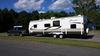
Thor, that looks my rig minus the rear slide. The reason I ask is I've been fighting high EOTs when towing. I average 238 or so and hit 244 last time I towed pulling a 3 mile, ?? grade hill at 80 mph. My deltas are 6 to 7 when tested, and I replaced the oil cooler bypass valve when doing my oil cooler last winter. So, I'm curious why my deltas are so much higher than others .... other than towing at 80 mph--which keeps my engine load up, and oil cooler bypass valve open.
I was originally thinking low on power because of low boost, but I'm not throwing any boost codes. HPO gets over 2500 and not much blowby. So I"m wondering if I'm low on power for some other reason. So I Any ideas, regardless of how silly, are welcome.
I'm looking to upgrade to a 5th wheel and increase my towing weight by about 2500 lbs and I'm a little concerned about the EOTs with my 8500 TT.