When you click on links to various merchants on this site and make a purchase, this can result in this site earning a commission. Affiliate programs and affiliations include, but are not limited to, the eBay Partner Network.
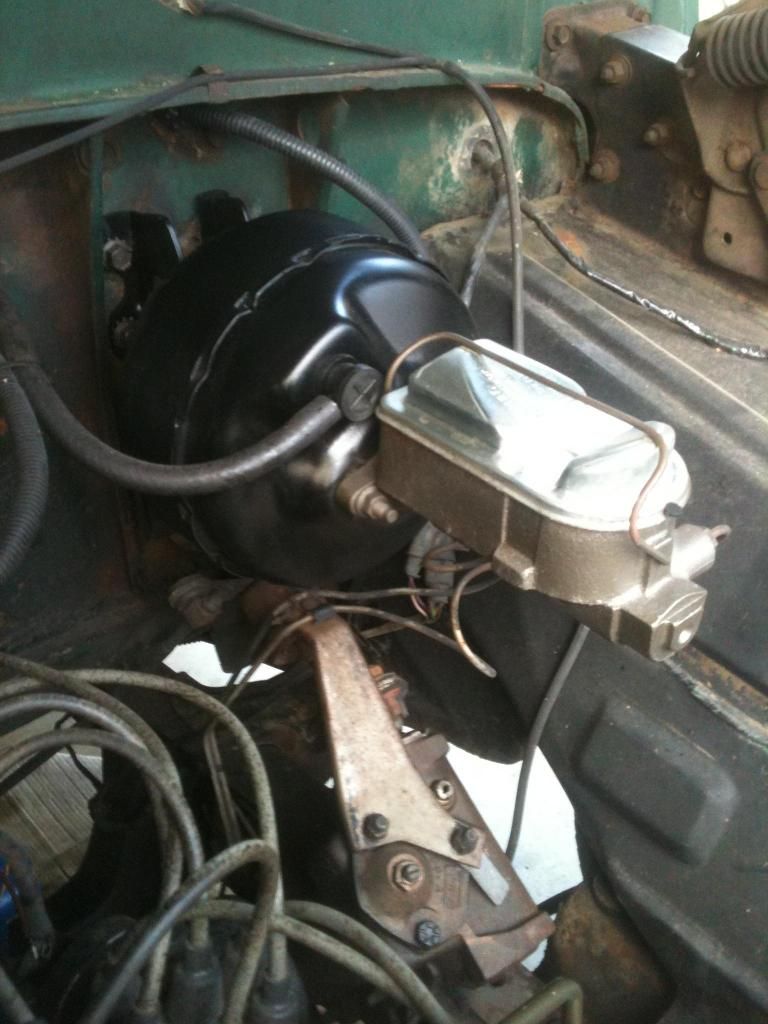
Over my past few months owning my truck I've come to notice my master cylinder slowly leaks until the fluid reaches mid level then the leaking stops.
At first I thought it was leaking out the bottom but upon closer inspection I discovered it's leaking from under the lid. There is a rubber gasket in place, and the wire clip fits very tightly.
I usually top off the fluid to within 1/4" from the top, I thought maybe this was too high so I lowered it to 1/2" from the top, the leaking still persisted.
Is this normal? should I buy a new master cylinder? The brakes work fine but I'm a bit uncomfortable with keeping the reservoirs only half full.
Also, make sure the lid is "flat" lengthwise. Back in 2013 I did a complete brake upgrade (https://www.ford-trucks.com/forums/1...e-upgrade.html) and when I finished, one leak I had was from the lid. I compared the lids to my old one, it was made of thinner stuff and was bowed in center. I cleaned my original F150 lid and used it with the OEM gasket on the new F350 MC, no more leak there.
....another alternative to eliminate multiple, potential problems with a cast iron MC is to run a 'modern' MC.
There are several primary reasons you don't see a conventional style cast iron MC on vehicles anymore.
Cast iron rusts on the outside as well as the inside. Outside rust isn't such a big deal, other than it makes the MC ugly to look at. The real primary problem is rust on the inside. The rust scale flakes off, settles to the bottom of the reservoirs, gets sucked into the bore, grinds on the MC bore and puts abrasions on the MC piston seals. The scale can also work it's way down into the brake valve and even throughout the brake system.
A conventional cast iron MC requires removal of the lid to check the brake fluid level. Removing the lid can dislodge rust scale and dirt/debris from around the rim that falls over into the reservoirs and does the same thing as described in the previous paragraph.
Another negative consequence of removing the lid is that it lets air come in contact with the brake fluid. Air contains moisture and exposure to moisture contaminates the brake fluid by absorption. The added accumulation of moisture also perpetuates more rust development in the brake system.
Modern MCs have aluminum bodies and plastic reservoirs. These items don't rust and since you can see the fluid level through the reservoir, without taking the cap off, you're not unecessarily opening the MC to expose the brake fluid to rust, dirt, debris or moisture. They don't have problems with the cap sealing off and puking fluid either.
The conventional cast iron MC I was running before I switched to a modern MC for a '95 Ford Explorer.
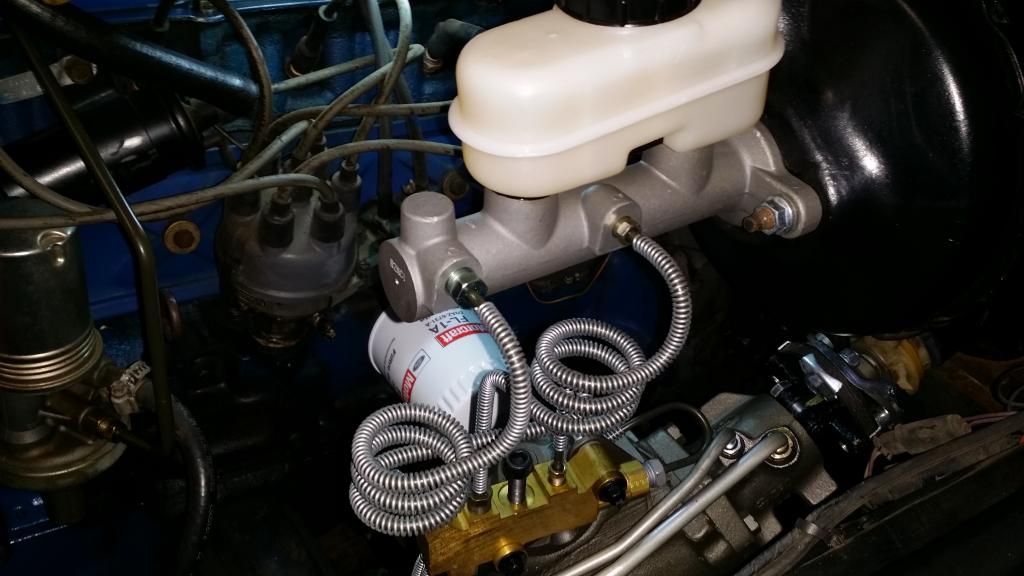
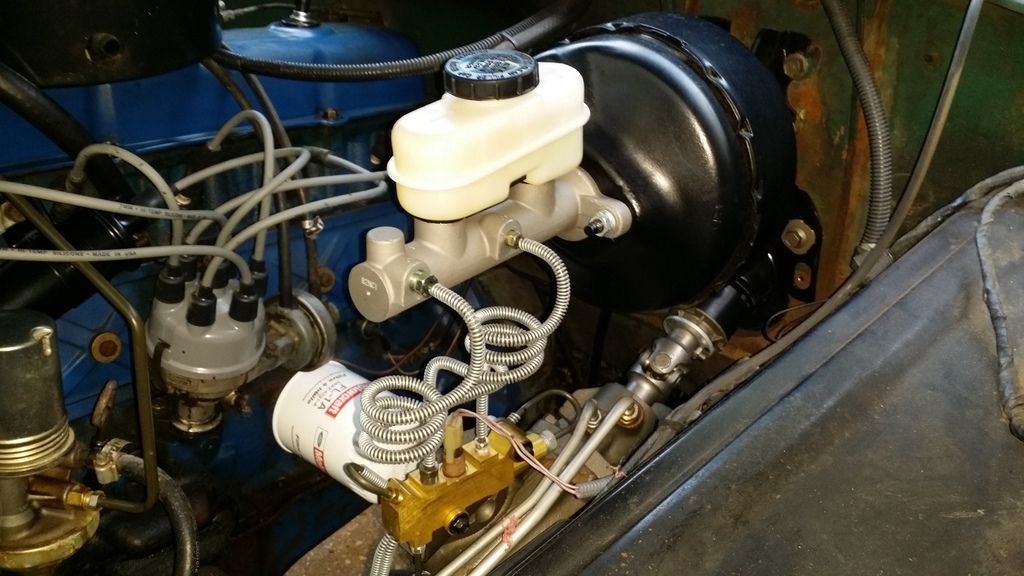
....replaced by this (new, not rebuilt) MC for a '95 Explorer.
The cast iron MC weighs 8 lbs. The Explorer MC weighs under 2 lbs.
For Spoonman:
Yep, could be rust causing the lid to not seal properly, or could be a new lid that is too flexible to seal properly.
For ultraranger:
This is one of those topics where I would like to see NumberDummy's input as I thought FORD produced a variety of MC's for these 70s trucks, I know there's a difference between half ton, 3/4ton, and 1 ton, and hydroboost setups, and theres different options for some of those setups as well.
I see the 6cylinder, is your truck halfton or heavier?
My concern is will the Explorer MC work on a 3/4ton or 1ton? as the Explorer wasn't built for hauling around weight like the trucks were, but I dont know the rating for it, so I could be wrong or out of line...
I also see the oil filter seems to be rotating forward in your series of pics lol
I also also see, that you went from a ragjoint to a cv-style steering setup connection (terminology escapes me right now)
For Spoonman:
Yep, could be rust causing the lid to not seal properly, or could be a new lid that is too flexible to seal properly.
For ultraranger:
This is one of those topics where I would like to see NumberDummy's input as I thought FORD produced a variety of MC's for these 70s trucks, I know there's a difference between half ton, 3/4ton, and 1 ton, and hydroboost setups, and theres different options for some of those setups as well.
I see the 6cylinder, is your truck halfton or heavier?
My concern is will the Explorer MC work on a 3/4ton or 1ton? as the Explorer wasn't built for hauling around weight like the trucks were, but I dont know the rating for it, so I could be wrong or out of line...
I also see the oil filter seems to be rotating forward in your series of pics lol
I also also see, that you went from a ragjoint to a cv-style steering setup connection (terminology escapes me right now)
My truck is a '69 F100.
Brake size and type will determine how much braking force will be applied to slow or stop the vehicle.
The MC is just a manually-operated hydraulic pressure pump. The bore diameter will determine the hydraulic flow/pressure output to the brakes for a given amount of input force on the brake pedal.
The smaller the MC bore, the greater output pressure the MC will produce.The larger the bore, less output pressure will be produced.
The gasket is in good condition but does have some "rust" stains, I will clean those up. I've already bent the wire clip to the point of needing a screwdriver to remove it. The lid shows no signs of distortion and checks out with a straight edge.
I believe the problem lies with the body of the master cylinder itself, specifically the top edge where the gasket sits. This top edge is very rough and porous, preventing a leak-proof seal. It seems to me if the manufacturer milled the top edge so the gasket had a machined surface to seal against it would be much better.
UltraRanger, I like the idea of using a modern master cylinder but I have no idea which make/model/year to ask for. My truck is a '75 F100 2wd.
A 'modern' MC with a 1.00" bore was used on the '99-'04 SN95 V6 Mustangs ('94-'98 V6 Mustang used a 1-1/16" bore MC). This, like my '95 Explorer MC, will have metric bubble flare ports --M10 x 1.00 primary port and an M12 x 1.0 secondary port.
Ultraranger:
I really like the way you did your brake lines from the MC to the Prop. Valve! They can look really messy, but yours are super clean. Did you make those, have them made or purchase them pre-bent??
Ultraranger:
I really like the way you did your brake lines from the MC to the Prop. Valve! They can look really messy, but yours are super clean. Did you make those, have them made or purchase them pre-bent??
Thank you for your compliment.
My truck is a 1969 F100 short bed Ranger. Like all '67-'72 Bumpside F100s, none came with factory front discs. My truck had the factory manual 4-wheel drums when I bought it.
I installed the complete discs/front suspension from a '77 F100, a dual diaphragm brake booster from a '75 F350, a disc/drum brake valve from an '84 Ford truck and a (new) MC for a '95 Ford Explorer.
Prefabbed lines are only configured to work on a vehicle that has all OEM brake components. There are no prefabbed lines to hook up to the various brake components that I have installed on my truck. I made all the brake lines that are on my truck to tie the system together. The MC has ISO metric bubble flare fittings. The rest of the brake components have SAE inverted flare fittings.
Ultraranger:
I expected that I might have to make mine (73 system on a 66). I guess I'll be getting some tools to do so and start practicing. I suppose it would take me a while to learn to make the bends as nice as yours turned out. Thanks for the photos!
Ultraranger:
I expected that I might have to make mine (73 system on a 66). I guess I'll be getting some tools to do so and start practicing. I suppose it would take me a while to learn to make the bends as nice as yours turned out. Thanks for the photos!
Ultraranger...
Thanks for the pics and tips. Now if I could get some lessons! I'm sure I can get the hang of it after some practice...the multiple loops puzzle me, though.
Ultraranger...
Thanks for the pics and tips. Now if I could get some lessons! I'm sure I can get the hang of it after some practice...the multiple loops puzzle me, though.
....ancient Chinese secret.
Actually, the bends were made with my 3/16" Rigid tubing bender. I made the loops in the tubing by forming the lines around a 15/16" impact socket.
Rezvani's Latest Post-Apocalyptic Monster Is a Ford F-150 Raptor Underneath
Slideshow: Called the Fortress, the 850-horsepower pickup combines Raptor underpinnings with military-inspired features, survival equipment, and a starting price of $285,000.