


Long block questions for a first time engine builder

Thread Starter
|
Senior User
Joined: Jul 2012
Posts: 129
Likes: 1
From: Denver, Co
Well I was in my backyard today and fell down a bit of a rabbit hole. I called around to all of the local parts houses and no one has the valve stem seals in stock (thanks to Trozei for taking the time to look at my previous post about the oil coming from the #6 intake port). Because I have to order and wait on the seals I figured while I'm here I might as well go ahead and pull the head, clean it up, check all of the valves, replace all of the stem seals and have a look at the top of the pistons. I should probably have my head examined
I plan to remove the valves tomorrow and inspect. photos to follow. I'm sure I'll have a ton of questions so bear with me.
To fill the rest of my afternoon, I spent a couple of hours cleaning my Offy C intake and adding a 3rd vacuum port for the Vacuum gauge I'm going to install. I thought about painting the intake, but can't decide on a color so probably going to leave it.
My efi manifolds have quite a bit of surface rust so I decided I want to clean and paint them. After 10 minutes with a wire wheel I decided I would try the electrolysis bath method. The rear manifold has been "cooking" for 4 hours and it looks like it is working great. As soon as I get some photos uploaded I'll post some pictures of that process.
I plan to remove the valves tomorrow and inspect. photos to follow. I'm sure I'll have a ton of questions so bear with me.
To fill the rest of my afternoon, I spent a couple of hours cleaning my Offy C intake and adding a 3rd vacuum port for the Vacuum gauge I'm going to install. I thought about painting the intake, but can't decide on a color so probably going to leave it.
My efi manifolds have quite a bit of surface rust so I decided I want to clean and paint them. After 10 minutes with a wire wheel I decided I would try the electrolysis bath method. The rear manifold has been "cooking" for 4 hours and it looks like it is working great. As soon as I get some photos uploaded I'll post some pictures of that process.
Thread Starter
|
Senior User
Joined: Jul 2012
Posts: 129
Likes: 1
From: Denver, Co
The great weather this weekend had the wife in a good mood which meant that I had plenty of time with old red
I mentioned in a previous post that i used electrolysis to remove rust from my efi manifolds. Here are some photos of process.
I started with a rusty manifold, 12 gallons of water, 12 teaspoons of Arm & Hammer washing soda, a sacrificial anode (old brake rotor), and a battery charger.

After 3 hours things appear to be cooking pretty darn good.

I let it cook all night and this is what the solution looked like after 20hrs. The solution has cleared up a bit and all of the rust has moved to the old brake rotor.

And here is one rust free manifold.

To give you an idea of how much rust was removed, here is the brake rotor with all of the rust attached.

And here is the same manifold after a fresh coat of header paint.

If you're like me and don't have a blast cabinet to clean small parts up this is a great way to go. I already had the battery charger, rotor, bucket , and paint so I have a grand total of $4.49 invested in the washing soda.
Now I just have to work on the rest of my engine to get it to look as good as the manifolds.
I mentioned in a previous post that i used electrolysis to remove rust from my efi manifolds. Here are some photos of process.
I started with a rusty manifold, 12 gallons of water, 12 teaspoons of Arm & Hammer washing soda, a sacrificial anode (old brake rotor), and a battery charger.

After 3 hours things appear to be cooking pretty darn good.

I let it cook all night and this is what the solution looked like after 20hrs. The solution has cleared up a bit and all of the rust has moved to the old brake rotor.

And here is one rust free manifold.

To give you an idea of how much rust was removed, here is the brake rotor with all of the rust attached.

And here is the same manifold after a fresh coat of header paint.

If you're like me and don't have a blast cabinet to clean small parts up this is a great way to go. I already had the battery charger, rotor, bucket , and paint so I have a grand total of $4.49 invested in the washing soda.
Now I just have to work on the rest of my engine to get it to look as good as the manifolds.
Thread Starter
|
Senior User
Joined: Jul 2012
Posts: 129
Likes: 1
From: Denver, Co
Here are some pics of my head and pistons. I welcome any assessments and suggestions. I have a shop manual and I'm leaning towards replacing the piston rings and refreshing the head. I would like to do a complete rebuild but its just not in the budget right now.
Pretty dirty


#cylinder 1

#cylinder 2

#cylinder 3

#cylinder 4

#cylinder 5

#cylinder 6

Pretty dirty


#cylinder 1

#cylinder 2

#cylinder 3

#cylinder 4

#cylinder 5

#cylinder 6


Fleet Mechanic
Joined: Nov 2002
Posts: 1,643
Likes: 69
If you are just going to rebuild the head and re-ring I would clean out the engine as best as you can. Spray down with "Gunk" or Simple Green and take a trip to the car wash and power wash everything. Blow dry.
Resist the temptation to sandblast any internal engine parts - that's a sure way to early engine failure.
Be sure to remove the cylinder ridge with a ridge reamer. And get one of these Goodson scrapers. It has a carbide edge. The next best thing to milling all the surfaces:

Money well spent
Resist the temptation to sandblast any internal engine parts - that's a sure way to early engine failure.
Be sure to remove the cylinder ridge with a ridge reamer. And get one of these Goodson scrapers. It has a carbide edge. The next best thing to milling all the surfaces:

Money well spent
Thread Starter
|
Senior User
Joined: Jul 2012
Posts: 129
Likes: 1
From: Denver, Co
Well I managed to get all of the valves out of the head. Boy some of the spring keepers did not want to give up. I managed to shoot 1 spring across the garage. That will get your attention quick. 
I do have a question for FTF or anyone else with engine building knowledge. How do I tell if I should replace the springs? All of them are quite dirty. I'll look for cracks or stress as I clean them but how else do I tell if they need to be replaced? Thanks.
I do have a question for FTF or anyone else with engine building knowledge. How do I tell if I should replace the springs? All of them are quite dirty. I'll look for cracks or stress as I clean them but how else do I tell if they need to be replaced? Thanks.
FTE Stories
Ford Trucks for Ford Truck Enthusiasts

Rezvani's Latest Post-Apocalytic Monster Is a Ford F-150 Raptor Underneath
Verdad Gallardo
Top 10 Most Expensive Ford Trucks Ever Sold on Bring a Trailer
Joe Kucinski
2027 Ford Super Duty Buyer's Guide (Every Model, Engine, & Package)
Brett Foote
Top 10 Ford Truck Tragedies
Joe Kucinski
AEV FXL Super Duty - the Super Duty Raptor Ford Doesn't Make
Brett Foote
Lobo Vs Lobo: Proof the F-150 Lobo Should Be Even Lower!
Michael S. Palmer
Ford's 2001 Explorer Sportsman Concept Looks For a New Home
Verdad Gallardo
10 Best Ford Truck Engines We Miss the Most!
Joe Kucinski
2026 Shelby F-150 Off-Road: Better Than a Raptor R?
Brett Foote
Postmaster
Joined: Nov 2012
Posts: 2,806
Likes: 8
From: Langley, BC
If you take a socket and whack it over the valve retainer, it will break the retainer loose from the valve itself, making removal much easier.
Springs wear out with age and even more so with mileage. It's up to you whether or not you should replace them, but the basic ones aren't expensive and if you've gone this far...
Springs wear out with age and even more so with mileage. It's up to you whether or not you should replace them, but the basic ones aren't expensive and if you've gone this far...
Thread Starter
|
Senior User
Joined: Jul 2012
Posts: 129
Likes: 1
From: Denver, Co
If you take a socket and whack it over the valve retainer, it will break the retainer loose from the valve itself, making removal much easier.
Springs wear out with age and even more so with mileage. It's up to you whether or not you should replace them, but the basic ones aren't expensive and if you've gone this far...
Springs wear out with age and even more so with mileage. It's up to you whether or not you should replace them, but the basic ones aren't expensive and if you've gone this far...
And you're right I have come this far, I just didn't want to spend money on something I didn't need to. I'll probably pick up a set.
Fleet Mechanic
Joined: Nov 2002
Posts: 1,643
Likes: 69
I just give each retainer a whack on its outside corner with a brass hammer. That will break them free of the wedged in keepers.
Worn out springs can look just like good springs. They just may have lost some of their "springyness". The best way to check them is with a spring pressure tester. This is usually done at the installed height, or some nominal height listed in the shop manual. Replacing them is not real costly, but I'll let you in on a dirty little secret: The springs on a 300 six are not that highly stressed, since the engine is not designed to rev very high - that is not its strong suit. So they don't usually lose a lot of their spring tension over time. Many rebuild shops know this and instead of taking the time to check all the springs on a spring checker they just add a spring shim on each spring seat - like .030 or so. That takes up any pressure lost to re-doing the valve seats plus a little more for added boost to the seat pressure.
This is OK for a stock build. But when using a performance cam higher spring pressures are often needed. Also, if high revolutions are expected, the exhaust valve retainers (rotator style) should be replaced with intake valve retainers, and a correspondingly longer spring used on the exhaust side.
I hope I didn't muddy the waters for you too much.
Worn out springs can look just like good springs. They just may have lost some of their "springyness". The best way to check them is with a spring pressure tester. This is usually done at the installed height, or some nominal height listed in the shop manual. Replacing them is not real costly, but I'll let you in on a dirty little secret: The springs on a 300 six are not that highly stressed, since the engine is not designed to rev very high - that is not its strong suit. So they don't usually lose a lot of their spring tension over time. Many rebuild shops know this and instead of taking the time to check all the springs on a spring checker they just add a spring shim on each spring seat - like .030 or so. That takes up any pressure lost to re-doing the valve seats plus a little more for added boost to the seat pressure.
This is OK for a stock build. But when using a performance cam higher spring pressures are often needed. Also, if high revolutions are expected, the exhaust valve retainers (rotator style) should be replaced with intake valve retainers, and a correspondingly longer spring used on the exhaust side.
I hope I didn't muddy the waters for you too much.
Thread Starter
|
Senior User
Joined: Jul 2012
Posts: 129
Likes: 1
From: Denver, Co
Not a chance FTF. You just added to my knowledge base in a big way. I have seen the valve shims on 300 heads at the junkyard and wondered why they had been installed.
I have access to a set of stock springs and keepers that one of my buddies had installed and used for about 15k miles before doing a performance build. I think I'll go ahead and use them now. Eventually I want to take the engine out and do a complete performance build but for now I'm going to keep it pretty stock and low buck.
On a good note all my valves appear to be in pretty good shape. I cleaned the head with oven cleaner (I remember reading that here in at least one thread) and it came out great. Man it was crazy how much carbon buildup was in that head.
I borrowed a ridge reamer at the local parts house and will try cleaning up the cylinders tonight if I can steal some more time.
I'm going to try lapping in the valves tomorrow.
All in all its coming along well and I've managed not to make any huge mistakes yet. I really appreciate all of the shared knowledge and advice.
Cheers!
I have access to a set of stock springs and keepers that one of my buddies had installed and used for about 15k miles before doing a performance build. I think I'll go ahead and use them now. Eventually I want to take the engine out and do a complete performance build but for now I'm going to keep it pretty stock and low buck.
On a good note all my valves appear to be in pretty good shape. I cleaned the head with oven cleaner (I remember reading that here in at least one thread) and it came out great. Man it was crazy how much carbon buildup was in that head.
I borrowed a ridge reamer at the local parts house and will try cleaning up the cylinders tonight if I can steal some more time.
I'm going to try lapping in the valves tomorrow.
All in all its coming along well and I've managed not to make any huge mistakes yet. I really appreciate all of the shared knowledge and advice.
Cheers!
Thread Starter
|
Senior User
Joined: Jul 2012
Posts: 129
Likes: 1
From: Denver, Co
Its snowing outside today and I'm waiting on a few parts so good time for an update.
I managed to get the head all cleaned up and valves lapped. My lightly used springs checked out square. I used the tip from FrenchTownFlyer and installed them with a .030 shim. Its ready to go back on.
That was the good. Now the bad.
Found this when I pulled piston#3....

Holy Cracked Pistons Batman!
I have heard that it's not uncommon for the 300 pistons to lose some skirt but that was more than I ever expected to see. Anyone have any experience with this?
I inspected the remaining pistons carefully and found that the drive side skirts on pistons 4 and 5 are cracked. If I took a set of channel locks I could probably snap them off. I wonder if the missing skirt and two cracked pistons were some of the noise I was hearing at low idle?
To my surprise the cylinders walls were not as beat up as I expected. I used a ridge reamer and cylinder hone to clean them up.
Since I can't afford a complete machining and rebuild right now I found a set replacement pistons on Summit for $78. They should arrive on Wednesday. I'll get them pressed on rods, install new rod and main bearings and hopefully have everything buttoned back up before Christmas.
I managed to get the head all cleaned up and valves lapped. My lightly used springs checked out square. I used the tip from FrenchTownFlyer and installed them with a .030 shim. Its ready to go back on.
That was the good. Now the bad.
Found this when I pulled piston#3....

Holy Cracked Pistons Batman!
I have heard that it's not uncommon for the 300 pistons to lose some skirt but that was more than I ever expected to see. Anyone have any experience with this?
I inspected the remaining pistons carefully and found that the drive side skirts on pistons 4 and 5 are cracked. If I took a set of channel locks I could probably snap them off. I wonder if the missing skirt and two cracked pistons were some of the noise I was hearing at low idle?
To my surprise the cylinders walls were not as beat up as I expected. I used a ridge reamer and cylinder hone to clean them up.
Since I can't afford a complete machining and rebuild right now I found a set replacement pistons on Summit for $78. They should arrive on Wednesday. I'll get them pressed on rods, install new rod and main bearings and hopefully have everything buttoned back up before Christmas.
Fleet Mechanic
Joined: Nov 2002
Posts: 1,643
Likes: 69
Cracked / broken piston skirts is a VERY common problem. Most hi-mileage engines I tear down have at least one cracked piston. Often the previous owner didn't even know something was amiss. I replace them with these hypereutectic ones:
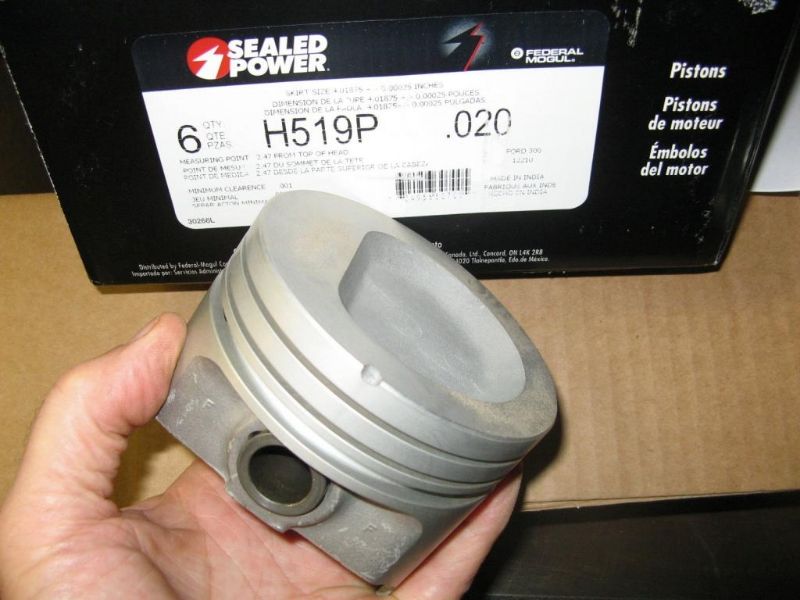
To the engineers' credit that engine is a very robust piece - reminds me of the WWII B-17 bombers that would soldier on despite being shot to pieces.
Compare those pistons with a new Modular V8 piston. The Mod V8 piston has almost no skirt by comparison. Maybe that's why it doesn't matter at all if the skirts are gone.

To the engineers' credit that engine is a very robust piece - reminds me of the WWII B-17 bombers that would soldier on despite being shot to pieces.
Compare those pistons with a new Modular V8 piston. The Mod V8 piston has almost no skirt by comparison. Maybe that's why it doesn't matter at all if the skirts are gone.
Thread Starter
|
Senior User
Joined: Jul 2012
Posts: 129
Likes: 1
From: Denver, Co
Cracked / broken piston skirts is a VERY common problem. Most hi-mileage engines I tear down have at least one cracked piston. Often the previous owner didn't even know something was amiss.
To the engineers' credit that engine is a very robust piece - reminds me of the WWII B-17 bombers that would soldier on despite being shot to pieces.
Compare those pistons with a new Modular V8 piston. The Mod V8 piston has almost no skirt by comparison. Maybe that's why it doesn't matter at all if the skirts are gone.
To the engineers' credit that engine is a very robust piece - reminds me of the WWII B-17 bombers that would soldier on despite being shot to pieces.
Compare those pistons with a new Modular V8 piston. The Mod V8 piston has almost no skirt by comparison. Maybe that's why it doesn't matter at all if the skirts are gone.
That's the model of piston I purchased so I'm feeling better about the direction I'm headed. 😁