When you click on links to various merchants on this site and make a purchase, this can result in this site earning a commission. Affiliate programs and affiliations include, but are not limited to, the eBay Partner Network.
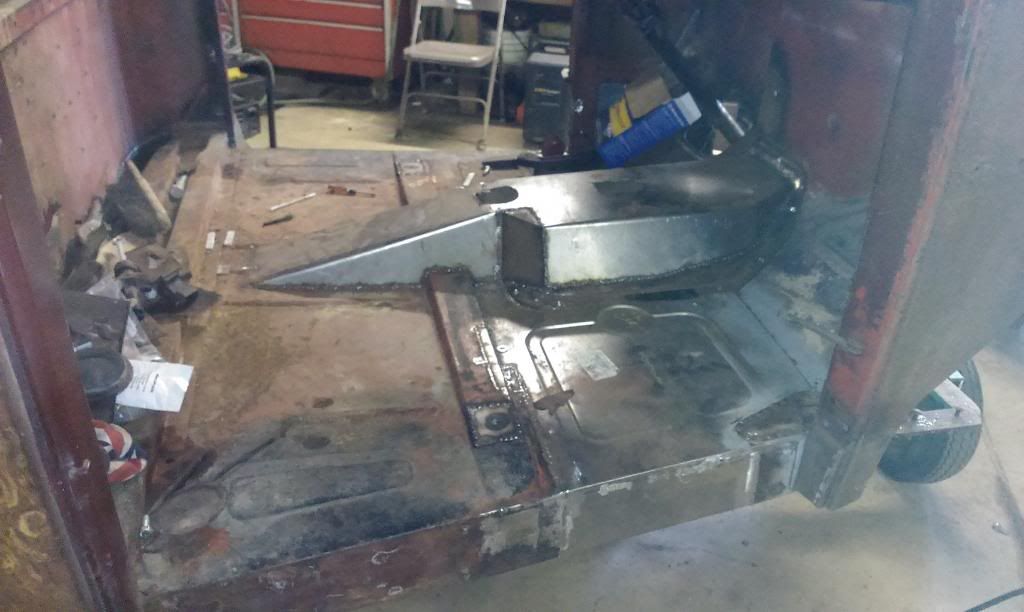
Although my project is far from stock, id like to keep my interior pretty close to stock. That includes the rubber floor mat. I know with my tunnel that there is no way that the stock floor mat is going to fit, plus i want the mat to go all the way to the back cab wall. Does anybody have experience with rubber/vinyl flooring? Could i somehow mold the flooring to fit over my tunnel? Would i have to make it in multiple pieces?
One option may be pond liner. Guys who install them have welders and could construct a custom-fit mat. Very durable but I don't know if it would lay down right, might need anchors (Christmas trees?).
It looks like you and I are in a similar state of restoration as regards the floor. LMC Truck sells the original mats. http://www.lmctruck.com/icatalog/fa/full.aspx?Page=59
You could cut them to fit then coat the new trans cover with spray on bed liner material in a color that matched the mat. This would also dampen some of the sound.
Nick, It's easy enough to use adhesive and mold something to fit the hard edges you've got there....BUT it's also easier in my opinion to cover a smooth radius. So I propose making something that is removable and covered separately. It would be heavy enough to not move around but would look like it was made in place. It could be metal to keep a low profile and sit just over your existing tunnel shape. I have no pics of this done with rubber but maybe these will give you an idea and may help you think of a way to do it....or you could be the FIRST!! Here are a couple covers.....
Molded cover.
Metal cover. Imagine this as a separate piece that you sit over what you have now.
Here is what it would look like as multiple pieces assembled together.
Not for the purists, but I had the floor and firewall sprayed with bedliner after all the holes were patched. Cut down the noise and heat quite a bit. It looked good with and w/o mats, but I went ahead and put in carpet when I upholstered it.
Thanks for the sugestions so far guys! Im starting the think i should have planned ahead and designed a trans cover that would be easier to cover. Keep the ideas coming if you have some!
Nick, It's easy enough to use adhesive and mold something to fit the hard edges you've got there....BUT it's also easier in my opinion to cover a smooth radius. So I propose making something that is removable and covered separately. It would be heavy enough to not move around but would look like it was made in place. It could be metal to keep a low profile and sit just over your existing tunnel shape. I have no pics of this done with rubber but maybe these will give you an idea and may help you think of a way to do it....or you could be the FIRST!! Here are a couple covers.....
Molded cover.
Metal cover. Imagine this as a separate piece that you sit over what you have now.
Here is what it would look like as multiple pieces assembled together.
And another look.
Thats a pretty good idea Wayne. The only limiting thing i can think of is that my current cover has less than an inch of clearance under my seat, so adding another cover on top might be problematic.
Hey Nick,
Looking for interior ideas. We also have a transmission hump like you have. We sprayed the interior with a Bedliner product "Toff" - it looks nice & then we went with large rubber floormats - It looks pretty period correct to 1950. Easy to clean - I just didn't want to worry about carpets.
Good luck over there. I like your plan on delaying the engine until next summer - we ordered our's early & it sat for 1.5 years.
Ben in Austin
1950 F1
(The Pic is a shot of our running boards with the Toff product so you can see what it looks like).
You could build a wood form the same shape as your tunnel to help form the vinyl material. Build the form, then laminate two sheets of vinyl or rubber material together, (two sheets with proper adhesive between them). Find a woodworker or sign maker with a vacuum bag or vacuum forming machine used for forming laminations or molded acrylic signs, and vacuum form it until the adhesive dries to where it will hold it’s shape.