


is undercharged a/c bad for compressor?

Thread Starter
|
Senior User
Joined: Jun 2002
Posts: 241
Likes: 0
From: Colorado Springs, CO
is undercharged a/c bad for compressor?
I think my A/C is undercharged. It gets warmer when going long distances. If I turn it off for a few minutes and then turn it back on, it becomes real cold again. Also, when I turn it off it leaks or condensates a whole bunch of water. Like a stream...
Is it bad to not have it recharged? It's the old type of freon, so I haven't called around yet. I think it's 60 bucks a can for that freon anyway.
Is it bad to not have it recharged? It's the old type of freon, so I haven't called around yet. I think it's 60 bucks a can for that freon anyway.

Elder User
Joined: Dec 2002
Posts: 550
Likes: 1
From: Effingham,IL USA
is undercharged a/c bad for compressor?
a lot of places arent dealing with r12 anymore. its gettin too expensive. most people change it over to r134. then you can go to wal mart and buy a can for 4 bucks and recharge it yourself. we have several cans of old r12 at work, they are 75 bucks each. but we dont do anything with r12 systems, except convert em. if you are low on refridgerent oil it can hurt the compressor. about the only way to check the oil is to take the compressor off and dump out the oil. since you still have r12 in your rig you might be able to strike a deal with an ac shop, give em your r12 in exchange for a break on a conversion.
Thread Starter
|
Senior User
Joined: Jun 2002
Posts: 241
Likes: 0
From: Colorado Springs, CO
is undercharged a/c bad for compressor?
i really just want to get it recharged. will it hurt it if it's not recharged? recharging is only for the freon right, not for the oil

Junior User
Joined: Jan 2003
Posts: 72
Likes: 1
From: Allegany, NY
is undercharged a/c bad for compressor?
yes running a system under charged will add wear and tear to the compressor . you should have it checked and topped off . a lot of shops will try and talk you in to a conversion to 134A they do make a bigger profit that way. if a shop dosent want to top off your R-12 system find another its leagel to leave it the way iyt is and if thats your desire they should support that.!

Post Fiend
Joined: Nov 2002
Posts: 9,987
Likes: 7
From: Memphis, TN
is undercharged a/c bad for compressor?
It's only legal for them to top-off a system they DON'T think is leaking. If they know it leaks, it's illegal for them to add anything more than it takes to find the leak.
If you need more than a few ounces of R-12 (assuming they'll sell you that little), it's usually cheaper to convert to R-134a anyway, so don't walk away just because they suggest it. It's certainly cheaper in the long run.
If you need more than a few ounces of R-12 (assuming they'll sell you that little), it's usually cheaper to convert to R-134a anyway, so don't walk away just because they suggest it. It's certainly cheaper in the long run.

Posting Guru

Joined: Feb 2001
Posts: 1,728
Likes: 0
From: Keweenaw Bay, MI

is undercharged a/c bad for compressor?
When a system is low on refrigerant it does shorten the life of the compressor because the compressor runs hotter. The compressor relies on the cool suction gas returning to the compressor to cool it.

Mountain Pass
Joined: Jun 2003
Posts: 208
Likes: 3
From: Norfolk VA
Trending Topics
Post Fiend
Joined: Nov 2002
Posts: 9,987
Likes: 7
From: Memphis, TN
is undercharged a/c bad for compressor?
It should be under $200 total, but might be as much as $300. Check the price on JUST the R-12 (no labor) and you'll see that you probably can't afford to keep it. Since you can legally buy R-134a, the gauges, and any other stuff for it, you can actually do the conversion yourself, but you should let a shop recover your R-12 before you start. If you do it yourself, it should be under $100.
FTE Stories
Ford Trucks for Ford Truck Enthusiasts

Top 10 Most Expensive Ford Trucks Ever Sold on Bring a Trailer
Joe Kucinski
2027 Ford Super Duty Buyer's Guide (Every Model, Engine, & Package)
Brett Foote
Top 10 Ford Truck Tragedies
Joe Kucinski
AEV FXL Super Duty - the Super Duty Raptor Ford Doesn't Make
Brett Foote
Lobo Vs Lobo: Proof the F-150 Lobo Should Be Even Lower!
Michael S. Palmer
Ford's 2001 Explorer Sportsman Concept Looks For a New Home
Verdad Gallardo
10 Best Ford Truck Engines We Miss the Most!
Joe Kucinski
2026 Shelby F-150 Off-Road: Better Than a Raptor R?
Brett Foote
2027 Super Duty Carhartt Package First Look: 12 Things You NEED to Know!
Michael S. Palmer
Posting Guru
Joined: Oct 2000
Posts: 1,577
Likes: 0
From: Southern MD
is undercharged a/c bad for compressor?
The compressor is lubricated by the oil in the system. This oil is transported thru the system via the freon. If no freon, no lube to compressor, thus compressor damage will result.

New User
Joined: Jul 2003
Posts: 4
Likes: 0
is undercharged a/c bad for compressor?
[QUOTE]Originally posted by yosemite
[B]. It gets warmer when going long distances. If I turn it off for a few minutes and then turn it back on, it becomes real cold again. Also, when I turn it off it leaks or condensates a whole bunch of water.
Sounds like your evaporater may be freezing.
[B]. It gets warmer when going long distances. If I turn it off for a few minutes and then turn it back on, it becomes real cold again. Also, when I turn it off it leaks or condensates a whole bunch of water.
Sounds like your evaporater may be freezing.

Junior User
Joined: Apr 2003
Posts: 84
Likes: 0
From: Oklahoma City
is undercharged a/c bad for compressor?
Sounds like a clogged Orifice tube. The bad thing is you have to break the system down to change the $2 part so you might as well change it over to R-134a. Steve83 has some great posts on doing the change, the only difference is I used Ester oil. You can do it yourself for around $100 just be sure you flush it and pull a vacuum or you'll be doing it twice!

New User
Joined: Jul 2003
Posts: 13
Likes: 1
is undercharged a/c bad for compressor?
dtaylor301 has it right. If it doesn't cool after it's been on a while, it's because your evaporator has become a big ice cube. Sounds like the cycle pressure switch (attached to the accumulator) has stuck open, or someone has jumped it so that it isn't cycling properly. Your system was designed for R-12 refrigerant, and if at all possible, that's the way you should stay. Have the switch tested (most places that deal with a/c can do this), or buy a new one as they are not very expensive and cost a lot less than a conversion to R-134a.
Post Fiend
Joined: Nov 2002
Posts: 9,987
Likes: 7
From: Memphis, TN
is undercharged a/c bad for compressor?
There's no reason to stay with the more expensive R-12. Ford made only 1 change to the system when they "designed" it to use R-134a, and that was the orifice tube. Everything else is functionally identical to the R-12 parts, so the coversion is easy, effective, and financially sensible.
The low-pressure switch is easily tested, and even has an adjusting screw inside between its terminals.
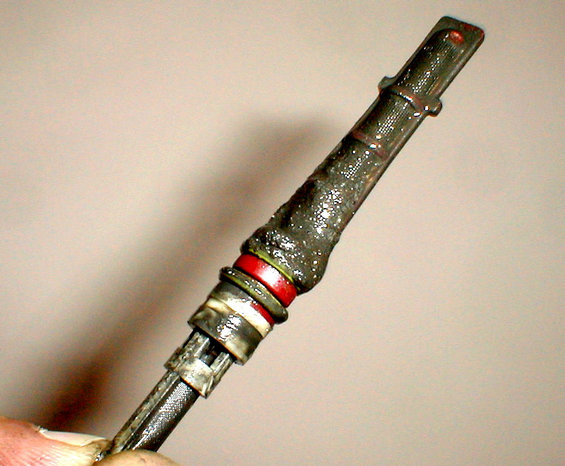
Ford recommends PAG-42 for all their compressors, and this is what happens when a compressor goes bad:
The low-pressure switch is easily tested, and even has an adjusting screw inside between its terminals.
Ford recommends PAG-42 for all their compressors, and this is what happens when a compressor goes bad:

Thread
Thread Starter
Forum
Replies
Last Post
jstihl
1999 - 2003 7.3L Power Stroke Diesel
27
May 18, 2017 03:38 PM
annaleigh
Cooling, Heating, Ventilation & A/C
20
Jul 19, 2016 10:19 AM
flashover604
Electrical Systems/Wiring
14
Jul 2, 2009 11:32 AM
1988, 2003, ac, compressor, conversion, diesel, diy, excursion, f150, ford, r12, r134a, system, undercharge, undercharged
