


Dad's Air Cleaner
Senior User
Joined: Nov 2013
Posts: 328
Likes: 0
From: Los Angeles
I think the idea is that at speed air is coming in to the engine bay cooling down the area. At idle I'm sure you can see absurdly high temps. They even hooked up the intake to an air conditioning type unit if I'm not mistaken.
Though on the other hand I've heard of sports cars being sluggish in the desert during the day and come to life at night. Though everything in that example is an extreme.
Very interesting to my feeble mind though. Always learning something
Though on the other hand I've heard of sports cars being sluggish in the desert during the day and come to life at night. Though everything in that example is an extreme.
Very interesting to my feeble mind though. Always learning something

Thread Starter
|
FTE Legend


Joined: Jul 2010
Posts: 32,875
Likes: 48
From: Northeast, OK
John - That episode doesn't apply here for several reasons:
Mavsprint - That's what I think I'll do - turn the thing upside down. And, there were two different pieces that went on the radiator support. Here they are:

- You can't trust anyone with an accent like that.

- The were testing a fuel injected engine which adjusts the air/fuel ratio for the air temp. Our carbs don't adjust and that's exactly why the factory tried to keep the inlet air temp to the carb at a set value.
- They were testing a vehicle with an intercooler, which cooled the air and kept the inlet air temp to the engine constant regardless of the air temp going into the cleaner. So, except for the minor change in the last test, the intercooler wasn't allowing the temp change to make it through. In the case of our trucks there is no intercooler and inlet air temps changes will be seen at the engine.
Mavsprint - That's what I think I'll do - turn the thing upside down. And, there were two different pieces that went on the radiator support. Here they are:

Elder User
Joined: Feb 2012
Posts: 709
Likes: 2
john?...
Who are you calling John?...
Oh well..maybe his name really is "John"...anyway, I didn't post the video, so, go ahead on..
(back to my afternoon nap)..
Oh well..maybe his name really is "John"...anyway, I didn't post the video, so, go ahead on..
(back to my afternoon nap)..
Thread Starter
|
FTE Legend
Joined: Jul 2010
Posts: 32,875
Likes: 48
From: Northeast, OK
Sorry, John. Should have said Charlie. Apologies to both of you.
Kinda funny - I read a book called Charlie The Ranch Dog to my grand kids, and he's always taking a nap. But it is John, that really isn't John, and not Charlie that naps in this case.
Kinda funny - I read a book called Charlie The Ranch Dog to my grand kids, and he's always taking a nap. But it is John, that really isn't John, and not Charlie that naps in this case.

Elder User
Joined: Sep 2013
Posts: 551
Likes: 2
You are dealing with 2 separate events,
1- cold air Induction. - as you know, the colder the air the higher the density (at sea level, altitude brings its own fun) with the objective to avoid hot under bonnet air temps. If both snorkels have the blocker / bypass valves working to grab warm air when needed then it's all good.
2- ram air effect. - taking advantage of a high pressure zone created by the vehicle travelling at speed to provide a level of forced induction overcoming vacuum in the intake tract. OEM's use 2 positions, at the base of the windshield (think cowl scoops and the Pontiac grabber scoop) and at the grille/ front bumper region. These bullnoses have a huge "bucket" behind the grille that would provide quite a high pressure zone, given the brick-like aerodynamics they posess.
Both events are to achieve the same end, more air in to increase the volumetric efficiency of the engine. At speed you will use less throttle input to create the same effort. My older Merc has a 4.2 L V8 with 2 large ram/cold air snorkels similar to what you are proposing coming off the rad support from the factory. Mercedes certainly don't do things without the engineering to ensure they are viable.
1- cold air Induction. - as you know, the colder the air the higher the density (at sea level, altitude brings its own fun) with the objective to avoid hot under bonnet air temps. If both snorkels have the blocker / bypass valves working to grab warm air when needed then it's all good.
2- ram air effect. - taking advantage of a high pressure zone created by the vehicle travelling at speed to provide a level of forced induction overcoming vacuum in the intake tract. OEM's use 2 positions, at the base of the windshield (think cowl scoops and the Pontiac grabber scoop) and at the grille/ front bumper region. These bullnoses have a huge "bucket" behind the grille that would provide quite a high pressure zone, given the brick-like aerodynamics they posess.
Both events are to achieve the same end, more air in to increase the volumetric efficiency of the engine. At speed you will use less throttle input to create the same effort. My older Merc has a 4.2 L V8 with 2 large ram/cold air snorkels similar to what you are proposing coming off the rad support from the factory. Mercedes certainly don't do things without the engineering to ensure they are viable.
Thread Starter
|
FTE Legend
Joined: Jul 2010
Posts: 32,875
Likes: 48
From: Northeast, OK
I agree with the two separate issues. And, both snorkels will have the valves operating, although only the passenger's side will have heat. The hot air opening on the driver's side snorkel will be closed off so that side won't allow any air at all, hot or cold, with the valve closed. Yes, that means that in a partially open position the driver's side will be providing all cold air, but hopefully the ACTS will be able to compensate.
As for there being two places the OEM's use to get ram air, I beg to differ - my '69 Super Bee is a case in point. Here's a picture of a similar one, which used hood-mounted scoops called, oddly enough, Ramcharger:

But, in reality the scoops weren't placed at a high pressure area so they weren't all that effective for ram air. However, they were effective in getting cold air to the carb as they didn't have long runners but dumped right into the carb.
On the other hand, you do have a valid point about our trucks - they are worse than a brick in that they have the grill set back from the leading edge. So that means the area ahead of the radiator support should be a high pressure area.
As for there being two places the OEM's use to get ram air, I beg to differ - my '69 Super Bee is a case in point. Here's a picture of a similar one, which used hood-mounted scoops called, oddly enough, Ramcharger:
But, in reality the scoops weren't placed at a high pressure area so they weren't all that effective for ram air. However, they were effective in getting cold air to the carb as they didn't have long runners but dumped right into the carb.
On the other hand, you do have a valid point about our trucks - they are worse than a brick in that they have the grill set back from the leading edge. So that means the area ahead of the radiator support should be a high pressure area.
Elder User
Joined: Sep 2013
Posts: 551
Likes: 2
Ah, so we could say the super bee has cold air induction, not ram air 
BTW- great classic muscle there, have you upgraded the handling at all? My limited experience with classic American muscle of that era is that they can posess the handling dynamics of a water balloon with a rocket strapped to it
BTW- great classic muscle there, have you upgraded the handling at all? My limited experience with classic American muscle of that era is that they can posess the handling dynamics of a water balloon with a rocket strapped to it
FTE Stories
Ford Trucks for Ford Truck Enthusiasts

3 Best / Worst Features Of The 2025+ Ford Expedition
Brett Foote
10 Ways Ford is LOSING to the Competition
Joe Kucinski
Top 6 Best Deals Available on New Fords & Lincolns Right Now
Brett Foote
This Hennessey Takes the Expedition Tremor's Off-Roading Capability to the Next Level
Verdad Gallardo
Top 10 Fords at 2026 Carlisle Ford Nationals
Joe Kucinski
3 Best / 3 Worst Parts of Modern Ford Ownership
Brett Foote
10 Amazing Upgrades That Solve Common Ford Truck Owner Headaches
Pouria Savadkouei
Every 2026 Ford Engine Explained
Brett Foote
10 Ugly Ford Trucks That We Still Kinda Love
Joe Kucinski
Thread Starter
|
FTE Legend
Joined: Jul 2010
Posts: 32,875
Likes: 48
From: Northeast, OK
No, I haven't upgraded anything as the Bee isn't drivable. Started into the resto years ago and got sidetracked. It is next after Dad's truck. And, it will need some help cornering and stopping so changes are in the offing.
But, it does have cold air induction. In fact, the handle on the cable inside that opens the doors to the scoops reads Cold Air and there's a light on the dash that reads the same. That was back before they worried about leaning out the AFR to get emissions down and economy up, so there was no heat to the un-silenced air cleaner. Boy, did they sound GOOD at full throttle!
But, it does have cold air induction. In fact, the handle on the cable inside that opens the doors to the scoops reads Cold Air and there's a light on the dash that reads the same. That was back before they worried about leaning out the AFR to get emissions down and economy up, so there was no heat to the un-silenced air cleaner. Boy, did they sound GOOD at full throttle!
Thread Starter
|
FTE Legend
Joined: Jul 2010
Posts: 32,875
Likes: 48
From: Northeast, OK
Time for an update. I mocked up both the engine and the air cleaner. Sure enough the HO-style snorkels are a problem due to their offset angle and droop.
Here's a shot of the engine with the air cleaner:

And here's how the passenger's side snorkel clears the valve cover by about 1/2":

Unfortunately, the driver's side doesn't clear with the HO snorkel:

But, with the standard-style snorkel it does clear:

And, there's the problem of the angle the HO snorkel makes as it leaves the air cleaner. Using two HO snorkels doesn't work if you center the air cleaner with the tabs on the carb. Note where the snorkels are with reference to the valve covers:
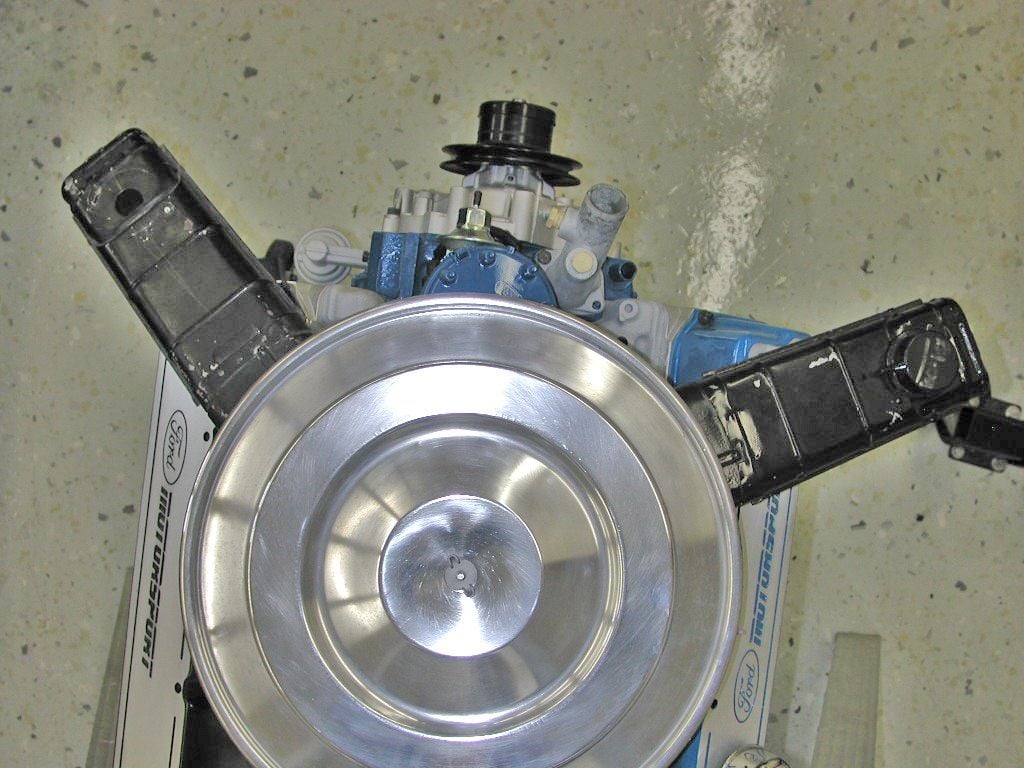
But, adding one standard style snorkel helps a lot:

Bottom Line: I'm going to use two standard snorkels, which will clear the valve covers better and will give the proper angles.
Here's a shot of the engine with the air cleaner:
And here's how the passenger's side snorkel clears the valve cover by about 1/2":
Unfortunately, the driver's side doesn't clear with the HO snorkel:
But, with the standard-style snorkel it does clear:
And, there's the problem of the angle the HO snorkel makes as it leaves the air cleaner. Using two HO snorkels doesn't work if you center the air cleaner with the tabs on the carb. Note where the snorkels are with reference to the valve covers:
But, adding one standard style snorkel helps a lot:
Bottom Line: I'm going to use two standard snorkels, which will clear the valve covers better and will give the proper angles.

Posting Guru
Joined: Jan 2014
Posts: 1,083
Likes: 0
From: Where the Army sends me
I disagree on this point. If you are using black for the front mount accessories, leave it a nice satin black. If going chrome, make it match either the accessories or the valve covers. Somewhere along the line the PO put one of these HO cleaners in mine, but most of the guts are missing from the snorkel.

Postmaster
Joined: Nov 2009
Posts: 4,575
Likes: 5
From: Broken Arrow , OK
I discussed that with Gary on the phone earlier. There is going to be a lot more black on the engine than what we are seeing. The pulley's, idlers, belts, bracketry as well as the AC compressor. So I am even reconsidering on the valve covers now because the black valve covers with the black air cleaner popped better. However, if he is going to go blue on the block then there needs to be some more blue somewhere to make it jive and not look like it stops the flow. So the black up front is going to dominate because the block isn't very visible when in the truck.
Thread Starter
|
FTE Legend
Joined: Jul 2010
Posts: 32,875
Likes: 48
From: Northeast, OK
Yes, we did talk about it. And, the blue block and pan are going to disappear when in the truck. There are a ton, almost literally, of brackets on these things. The A/C compressor has a bracket that is huge and is 1/4" thick. The current power steering brackets, plural, are a complex arrangement with a tensioning bolt that bends the bracket easily. (But I hope to change to a Saginaw pump and brackets, which are probably as complex if Ford designed them.) Fortunately I don't have a smog pump so I'll modify the alternator bracket to remove the goal posts. And then the pulleys, idler, and the massive A/C compressor - all of which are black.
In my mind's eye I'm seeing way too much black. Its sorta reminding me of 1966 all over again - http://en.wikipedia.org/wiki/Paint_It_Black. So, maybe the valve covers and air cleaner do need to be blue. But, I think the first step is to mock it up further and see what the brackets do to the look. And then, once I've seen BLACK I think I see another rattle-can giving up its life to coat an air cleaner and snorkels plus both valve covers in OFB.
In my mind's eye I'm seeing way too much black. Its sorta reminding me of 1966 all over again - http://en.wikipedia.org/wiki/Paint_It_Black. So, maybe the valve covers and air cleaner do need to be blue. But, I think the first step is to mock it up further and see what the brackets do to the look. And then, once I've seen BLACK I think I see another rattle-can giving up its life to coat an air cleaner and snorkels plus both valve covers in OFB.

Cargo Master

Joined: Dec 2004
Posts: 3,362
Likes: 22
From: Florence, SC
I am using the 1983 - 1985 Mustang GT "5.0 Liter 4V H.O." twin snorkel air cleaner on my own truck. My air cleaner clears the valve covers fine, but that's probably because my engine is a 5.0., which is what this air cleaner was designed for. I am also using a 1" carburetor spacer and stock 1985 Mustang GT "Powered By Ford" aluminum valve covers. For some reason, NONE of the stock 18" H.O. air cleaners (5.0. H.O., 5.8 H.O., and 460) used a check valve in the vacuum motor hoses like the trucks used.
And I agree with bruno; I painted the base of my own air cleaner Ford Blue to match the Ford Blue engine block and distributor cap and wires, but kept both of the snorkels black. I am still working on the driver's side plastic scoop that bolt to the radiator core support for the ducting to connect to.
Gary, are you going to have an underhood toolbox in the engine bay? I have one in mine, and the way the stock H.O. snorkel is lined up asymmetrical to the passenger's side works well to clear the toolbox. With the longer standard snorkel, I don't think it will clear. You also have to make sure it will clear the A/C compressor, if equipped. 1980 - 1982 used a different compressor and a different mounting bracket, and therefore is in a different position than the 1983 - 1986 models.
I also had to reverse the PCV valve and the oil breather cap locations on the valve covers when I switched to the H.O. air cleaner assembly. The stock location of the PCV valve was on the rear of passenger's side valve cover, and the oil breather cap was on the front of the driver's side valve cover. This arrangement worked fine with the stock air cleaner, but the H.O. air cleaner has the oil breather cap filter hole much closer on the passenger's side. Plus, if I left the oil breather cap on the front driver's side snorkel, I couldn't get to it to unscrew the cap because the snorkel runs right above it and it is too close to the A/C compressor. It wouldn't leave enough room to get your hand or an oil bottle there.
Last thing: From your pictures, it looks like you have a push-on oil breather cap. If that is the case, I would STRONGLY recommend you replace the valve covers with the screw-in type holes. I replaced a set of really nice aluminum "302 Powered By Ford" black wrinkle valve covers (with cheaper GM-style push on style breather cap holes) because the oil cap was constantly falling out!
And I agree with bruno; I painted the base of my own air cleaner Ford Blue to match the Ford Blue engine block and distributor cap and wires, but kept both of the snorkels black. I am still working on the driver's side plastic scoop that bolt to the radiator core support for the ducting to connect to.
Gary, are you going to have an underhood toolbox in the engine bay? I have one in mine, and the way the stock H.O. snorkel is lined up asymmetrical to the passenger's side works well to clear the toolbox. With the longer standard snorkel, I don't think it will clear. You also have to make sure it will clear the A/C compressor, if equipped. 1980 - 1982 used a different compressor and a different mounting bracket, and therefore is in a different position than the 1983 - 1986 models.
I also had to reverse the PCV valve and the oil breather cap locations on the valve covers when I switched to the H.O. air cleaner assembly. The stock location of the PCV valve was on the rear of passenger's side valve cover, and the oil breather cap was on the front of the driver's side valve cover. This arrangement worked fine with the stock air cleaner, but the H.O. air cleaner has the oil breather cap filter hole much closer on the passenger's side. Plus, if I left the oil breather cap on the front driver's side snorkel, I couldn't get to it to unscrew the cap because the snorkel runs right above it and it is too close to the A/C compressor. It wouldn't leave enough room to get your hand or an oil bottle there.
Last thing: From your pictures, it looks like you have a push-on oil breather cap. If that is the case, I would STRONGLY recommend you replace the valve covers with the screw-in type holes. I replaced a set of really nice aluminum "302 Powered By Ford" black wrinkle valve covers (with cheaper GM-style push on style breather cap holes) because the oil cap was constantly falling out!