


Tips and Tricks for Testing

Thread Starter
|
Hotshot


Joined: Jan 2011
Posts: 18,849
Likes: 179
From: Puget Sound
Tips and Tricks for Testing
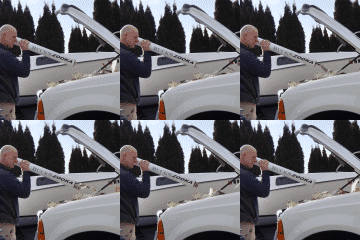
I've been reading where more than one person has suffered from Stuff Homogenizing In Tanks syndrome (I can't post the acronym here). Oil in coolant after seal service, fuel in coolant after cups, heaven forbid coolant goes the other direction.... I've done cups and seals to keep the fluids where they belong, but I didn't button up until I made sure the coolant system would pressurize to 15 PSI and stay there overnight. If the seals can hold 15 PSI of air, chances are good it can hold back higher-pressure fluids. This last test prevented wasted fluids, time, and antacid. I do have a proper radiator pressure test tool from Harbor Freight, but I've also used the redneck method to pressurize the cooling system short-term:
Find a pen with a sealed bottom. A normal Bic won't work, because air can leak through it like a straw. A bolt might work, but I am unsure of the size because I used a pen. Take the small hose of the top of the degas bottle and jam the pen into the hose, then use the clamp to hold it there. Now you have a single opening to puff up the coolant system, and the cap is in place to vent excess air pressure (it squeals loud). I have an air gun with a rubber tip on it to seal against the small tube on the degas bottle. It also works for puffing up a cylinder through the GP hole, just watch out for engine rotation:

Any body else have something to share to check your work before buttoning up... or tricks not in the book for troubleshooting a misbehaving truck?
Find a pen with a sealed bottom. A normal Bic won't work, because air can leak through it like a straw. A bolt might work, but I am unsure of the size because I used a pen. Take the small hose of the top of the degas bottle and jam the pen into the hose, then use the clamp to hold it there. Now you have a single opening to puff up the coolant system, and the cap is in place to vent excess air pressure (it squeals loud). I have an air gun with a rubber tip on it to seal against the small tube on the degas bottle. It also works for puffing up a cylinder through the GP hole, just watch out for engine rotation:
Any body else have something to share to check your work before buttoning up... or tricks not in the book for troubleshooting a misbehaving truck?

FTE Leadership Emeritus


Joined: May 2014
Posts: 27,355
Likes: 5,947
From: Lake Hartwell, GA

Just to make sure we are all on the same sheet of music here, I have a couple of questions.
1. Before hooking up your air supply to the coolant system, you have already drained the coolant out of the radiator and engine block as much as you can?
2. The silicone spray you recommend using for spraying into the cups and watching for air/leaks, is it something like this product?
3. Once you have the pen tube firmly clamped into the degas bottle rubber hose (comes from the driver side into the degas bottle), how do you connect the air supply to the tube?
1. Before hooking up your air supply to the coolant system, you have already drained the coolant out of the radiator and engine block as much as you can?
2. The silicone spray you recommend using for spraying into the cups and watching for air/leaks, is it something like this product?

3. Once you have the pen tube firmly clamped into the degas bottle rubber hose (comes from the driver side into the degas bottle), how do you connect the air supply to the tube?
Thread Starter
|
Hotshot
Joined: Jan 2011
Posts: 18,849
Likes: 179
From: Puget Sound
2. The silicone spray you recommend using for spraying into the cups and watching for air/leaks, is it something like this product? https://www.amazon.com/Permatex-8007.../dp/B000HBM5S2
One other thing: By performing this test, I now know what the degas cap sounds like when it vents. That way... when I'm towing up a hill on a hot day, I don't freak out when the cap screams - thinking I blew up my turbo. Think slow-mo boot bop... the skivvies get just as soiled.
FTE Leadership Emeritus
Joined: May 2014
Posts: 27,355
Likes: 5,947
From: Lake Hartwell, GA
I puff up the degas bottle with the rubber-tipped air gun, leaving the degas cap on. That hose came off an opening, and that's the opening I use for the air gun. Allowing the degas cap to vent when the pressure limit is reached serves two functions: Test the cap for proper operation, and don't blow up the cooling system. That last one can be a thing if you forget to turn the air compressor regulator down.
Now it makes sense as to why you said use a pen with a sealed bottom for the hose. You are simply capping the hose off and leaving the only means for the air to escape back up through the degas bottle cap.
Thanks Rich, we all appreciate the help. I am building my "specialty tools" kit which already consists of the Tugly Coolant system/cup tester and the ExPACamper Cody style tester.

Thread
Thread Starter
Forum
Replies
Last Post
kr98664
1980 - 1986 Bullnose F100, F150 & Larger F-Series Trucks
72
Feb 28, 2024 11:27 AM
fusioncom
1997 - 2006 Expedition & Navigator
7
Nov 2, 2011 05:19 PM
Robbgt
1994.5 - 1997 7.3L Power Stroke Diesel
6
Dec 8, 2006 12:20 PM
73Galaxie
335 Series- 5.8/351M, 6.6/400, 351 Cleveland
5
May 3, 2003 12:42 AM


