


New battery draining, draining, gone

Thread Starter
|
Laughing Gas
Joined: Oct 2001
Posts: 996
Likes: 5
From: Albany, Good Ol' USA
New battery draining, draining, gone
Hi gang, I know this topic has been beaten to death, sorry (the folks here are so helpful and knowledgable)
I've got a dual battery setup that's worked fine in 'Easy Bake' my '81 Ford panel van and neglectful of battery maintenance I let enough water gas out of the secondary battery to expose the plates (this battery was 11 years old) so I went down to Costco to get another Johnson Controls manufactured battery that I've had such good luck with over the years. I put it in the primary position and post charging did my dialy commute to work (11 miles one way) no problems even when returning home but overnight it seems the thing discharged at a fantastic rate. Firing up the alternator belts (2) squealed and I saw the ammeter jump far beyond where it normally rests. In recent days I've taken to removing the negative battery cable each time I park it and charge it each night. Could this be a defective battery? Any insights would be great as I'm still working 7 days a week and have little time for automotive repairs.
Thanks and a lift of the lynch lid.
Gus
I've got a dual battery setup that's worked fine in 'Easy Bake' my '81 Ford panel van and neglectful of battery maintenance I let enough water gas out of the secondary battery to expose the plates (this battery was 11 years old) so I went down to Costco to get another Johnson Controls manufactured battery that I've had such good luck with over the years. I put it in the primary position and post charging did my dialy commute to work (11 miles one way) no problems even when returning home but overnight it seems the thing discharged at a fantastic rate. Firing up the alternator belts (2) squealed and I saw the ammeter jump far beyond where it normally rests. In recent days I've taken to removing the negative battery cable each time I park it and charge it each night. Could this be a defective battery? Any insights would be great as I'm still working 7 days a week and have little time for automotive repairs.
Thanks and a lift of the lynch lid.
Gus

Moderator


Joined: Jan 2001
Posts: 56,984
Likes: 2,738
From: Virginia

Can you get to the alternator wire easily?(probably not). It could be when the other battery went dry, it smoked one of the diodes in the alternator(there are six). If one of them is shorted, it will drain the battery. If you could get to the alternator large terminal and take it off, you could see if it quit draining the battery. Be careful if you do this though, and take the negative battery cable off first, then mess with the alternator wire. One wrong move with the battery connected, and you could burn out the fusible link in that alternator wire. Once you take the negative battery cable off, you could take the alternator wires off, carefully sit them on a rag, and then hook the negative battery cable back up overnight and see if the battery stays up.
I guess you can get up a little early so you can hook everything back up and see if it will start. Just make sure to take that negative battery cable off AGAIN before messing with and putting back on the alternator wires.
I guess you can get up a little early so you can hook everything back up and see if it will start. Just make sure to take that negative battery cable off AGAIN before messing with and putting back on the alternator wires.
Thread Starter
|
Laughing Gas
Joined: Oct 2001
Posts: 996
Likes: 5
From: Albany, Good Ol' USA
 I guess you can get up a little early so you can hook everything back up...
To go to work I get up at 4:00am

That's a great thought, with GM alternators I've had diode failure, I had no idea there were 6 in Ford's. I'm hip about being cautious when working with this stuff. Not really knowing what I'm doing with this (ironic since I just did an electric fan conversion in my Jeep along with installing an underhood fuse/relay panel). As luck (perhaps) would have it before I found my test light searching for the source of the drain, I used my ohm meter and grounding to a bolt on the body I found continuity with the hot lead on the primary wiring from the batter to through the starter solenoid to the starter. I don't know if this is significant as my friend tells me it's only feedback from the brushes in the starter, what really cooked my noodle is the secondary batter shows no such continuity. I suppose it could be insulated by the old school battery isolator.
If'n I pull this alternator I imagine I can take it in for testing.
Moderator
Joined: Jan 2001
Posts: 56,984
Likes: 2,738
From: Virginia
GM alternators have six diodes also. A car alternator is actually generates a 3 phase AC voltage just like they have in the big factory's. Of course this would do no good in a car, so they use the diodes in an array to convert the 3 phase AC to a single DC output line.
If you have a testlight, you can use it to find the drain. A ohmmeter is no good for this, there are things on the battery all the time normally, and they are so small they do not drain the battery until months later, but your meter will pick them up.
Here's how to test for a drain.

If you have a testlight, you can use it to find the drain. A ohmmeter is no good for this, there are things on the battery all the time normally, and they are so small they do not drain the battery until months later, but your meter will pick them up.
Here's how to test for a drain.
Laughing Gas

Joined: Sep 2012
Posts: 1,100
Likes: 6
From: Georgia
If you have a dual battery setup and one is failed, and left that way for any length of time, it can shorten the life of the other one, depending on how they are connected.
If you then replace one and the other has been discharging a lot, it will drain your new one.
If you know the reserve capacity of your battery you can figure out how long it will take it to drain when fully charged by using a multimeter. Though you have to be careful as a high amperage drain can blow your meter.
You can also use one of these to see what the actual drain is. I use the 30A version
It works well also for seeing if the drain exceeds your multimeter capacity.

If you then replace one and the other has been discharging a lot, it will drain your new one.
If you know the reserve capacity of your battery you can figure out how long it will take it to drain when fully charged by using a multimeter. Though you have to be careful as a high amperage drain can blow your meter.
You can also use one of these to see what the actual drain is. I use the 30A version
It works well also for seeing if the drain exceeds your multimeter capacity.
Thread Starter
|
Laughing Gas
Joined: Oct 2001
Posts: 996
Likes: 5
From: Albany, Good Ol' USA
Trending Topics
Thread Starter
|
Laughing Gas
Joined: Oct 2001
Posts: 996
Likes: 5
From: Albany, Good Ol' USA
Okay, as it turns out the engine compartment light (somes on when hood is in the open position) was what was giving me the reading with the test light. Once disconnected the test light was off.
So, as it's not a drain as it turns out, I'm now mentally struggling with what could be causing the new symptoms.
Prior to any of these issues 'Easy Bake' ran out fine, winter and summer without any electrical anomolies and even at fast idle no belt squeal. It's only been for a couple of weeks now when I fire up in the morning there's a 15amp jump shown by the ammeter and the dual pulley/dual belts squeal like a banshee. That is, until the charging system catches up 3-5 seconds later.
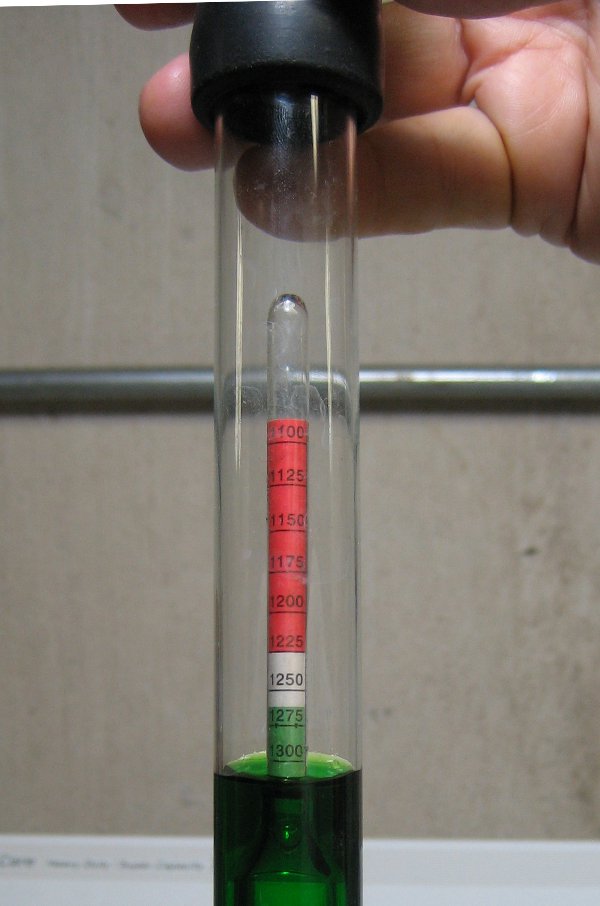
I ran a hydrometer test and all cells are normal save one on the end shows recharge 1225 (red area or hydrometer) specific gravity all others are running between 1250 and 1300 (white to green area on hydrometer) on this new (last weekend) battery. I reckon I should return and immediately test the replacement eh?
So, as it's not a drain as it turns out, I'm now mentally struggling with what could be causing the new symptoms.
Prior to any of these issues 'Easy Bake' ran out fine, winter and summer without any electrical anomolies and even at fast idle no belt squeal. It's only been for a couple of weeks now when I fire up in the morning there's a 15amp jump shown by the ammeter and the dual pulley/dual belts squeal like a banshee. That is, until the charging system catches up 3-5 seconds later.
I ran a hydrometer test and all cells are normal save one on the end shows recharge 1225 (red area or hydrometer) specific gravity all others are running between 1250 and 1300 (white to green area on hydrometer) on this new (last weekend) battery. I reckon I should return and immediately test the replacement eh?
FTE Stories
Ford Trucks for Ford Truck Enthusiasts

10 Things Every Truck Owner NEEDS (2026 Edition)
Michael S. Palmer
Rezvani's Latest Post-Apocalytic Monster Is a Ford F-150 Raptor Underneath
Verdad Gallardo
Top 10 Most Expensive Ford Trucks Ever Sold on Bring a Trailer
Joe Kucinski
2027 Ford Super Duty Buyer's Guide (Every Model, Engine, & Package)
Brett Foote
Top 10 Ford Truck Tragedies
Joe Kucinski
AEV FXL Super Duty - the Super Duty Raptor Ford Doesn't Make
Brett Foote
Lobo Vs Lobo: Proof the F-150 Lobo Should Be Even Lower!
Michael S. Palmer
Ford's 2001 Explorer Sportsman Concept Looks For a New Home
Verdad Gallardo
10 Best Ford Truck Engines We Miss the Most!
Joe Kucinski
Thread
Thread Starter
Forum
Replies
Last Post
GT40NUT
1987 - 1996 F150 & Larger F-Series Trucks
32
Aug 30, 2014 05:40 PM