


Porting, chamber work questions

Thread Starter
|
Lead Driver


Joined: Mar 2008
Posts: 7,193
Likes: 387
From: Near Los Angeles
Porting, chamber work questions
This engine has been a learning session for me. I knew nothing about head work or porting when I began it and paid $300 to have the bowls cleaned up and the runners gasket matched. At that time I also had larger valves installed.
At that time I was told there were ridges in the chambers that shrouded the valves. These are Ford's quick burn system, I have learned. Now I want to remove the ridges to increase flow, allowing the cam (valve lift) and larger valves to work as they should, allowing max flow. I'm also going to clean up the runners and polish the chambers.
I have photos to guide me, but was hoping to get some advice/guidance here. I'm posting a photo below of the ridges. Thanks in advance. k
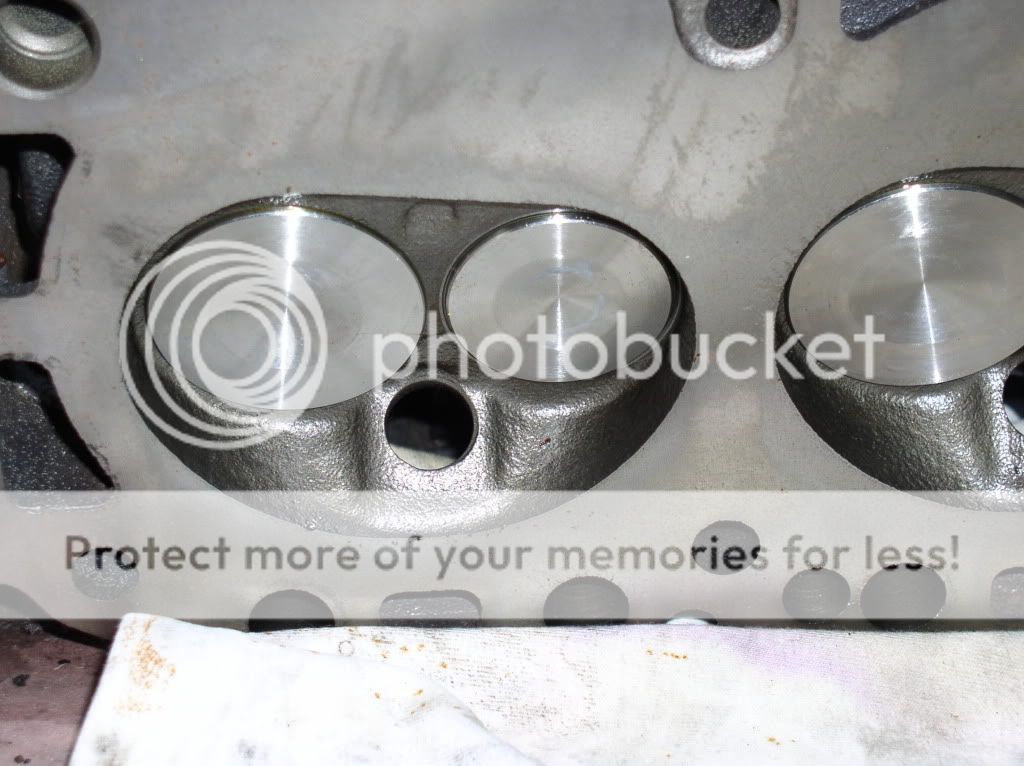
(I know that in the photo above there appears to be a crack between the valves, but it is not a crack.) Below is a 300 chamber w/o the ridges (kindly disregard the different shape chambers, one kidney bean shape, one normal shape):

I guess what I am wondering is should I have this done by a pro. It seems that in the kidney bean shaped chamber there is a 'wall' where the chamber meets the gasket mounting surface, almost 90* to the mounting surface. Should I try to duplicate that, or am I simply trying to deshroud by creating a .125-.250 groove of free space around the valves where the ridges are, and then reduce the height of the ridge a bit.
How does one control, standardize, make sure each chamber is the same volume?
At that time I was told there were ridges in the chambers that shrouded the valves. These are Ford's quick burn system, I have learned. Now I want to remove the ridges to increase flow, allowing the cam (valve lift) and larger valves to work as they should, allowing max flow. I'm also going to clean up the runners and polish the chambers.
I have photos to guide me, but was hoping to get some advice/guidance here. I'm posting a photo below of the ridges. Thanks in advance. k

(I know that in the photo above there appears to be a crack between the valves, but it is not a crack.) Below is a 300 chamber w/o the ridges (kindly disregard the different shape chambers, one kidney bean shape, one normal shape):

I guess what I am wondering is should I have this done by a pro. It seems that in the kidney bean shaped chamber there is a 'wall' where the chamber meets the gasket mounting surface, almost 90* to the mounting surface. Should I try to duplicate that, or am I simply trying to deshroud by creating a .125-.250 groove of free space around the valves where the ridges are, and then reduce the height of the ridge a bit.
How does one control, standardize, make sure each chamber is the same volume?



Fleet Owner
Joined: Dec 2009
Posts: 20,678
Likes: 83
From: NorCal
...........
I guess what I am wondering is should I have this done by a pro. It seems that in the kidney bean shaped chamber there is a 'wall' where the chamber meets the gasket mounting surface, almost 90* to the mounting surface. Should I try to duplicate that, or am I simply trying to deshroud by creating a .125-.250 groove of free space around the valves where the ridges are, and then reduce the height of the ridge a bit.
How does one control, standardize, make sure each chamber is the same volume?
I guess what I am wondering is should I have this done by a pro. It seems that in the kidney bean shaped chamber there is a 'wall' where the chamber meets the gasket mounting surface, almost 90* to the mounting surface. Should I try to duplicate that, or am I simply trying to deshroud by creating a .125-.250 groove of free space around the valves where the ridges are, and then reduce the height of the ridge a bit.
How does one control, standardize, make sure each chamber is the same volume?
BUT for your education, cleaning up the chambers should have been done prior to or with the port work and before the valves were installed. Typically, old valves are inserted to reduce the chance of nicking the seats with a carbide burr and rolled cloths.
Cylinder head volume is done my measuring its displacement using a burrette, colored alcohol, a plexiglass plate, and a graduated cylinder (a scientific beaker). The methodology is too long to write up so take a ride over to YouTube.

Thread
Thread Starter
Forum
Replies
Last Post
F-250 restorer
Performance & General Engine Building
6
Nov 5, 2010 07:51 AM
terilynn
Ford Inline Six, 200, 250, 4.9L / 300
3
Mar 14, 2005 01:22 PM


