


Head porting question
Thread Starter
|
Lead Driver


Joined: Mar 2008
Posts: 7,195
Likes: 387
From: Near Los Angeles
Head porting question
I had larger valves installed in a Ford 300 head. This is not an EFI head, but a 1981 head. In the Combustion chambers are 'fast burn swirl ridges' that shroud my valves quite a bit (see photo).
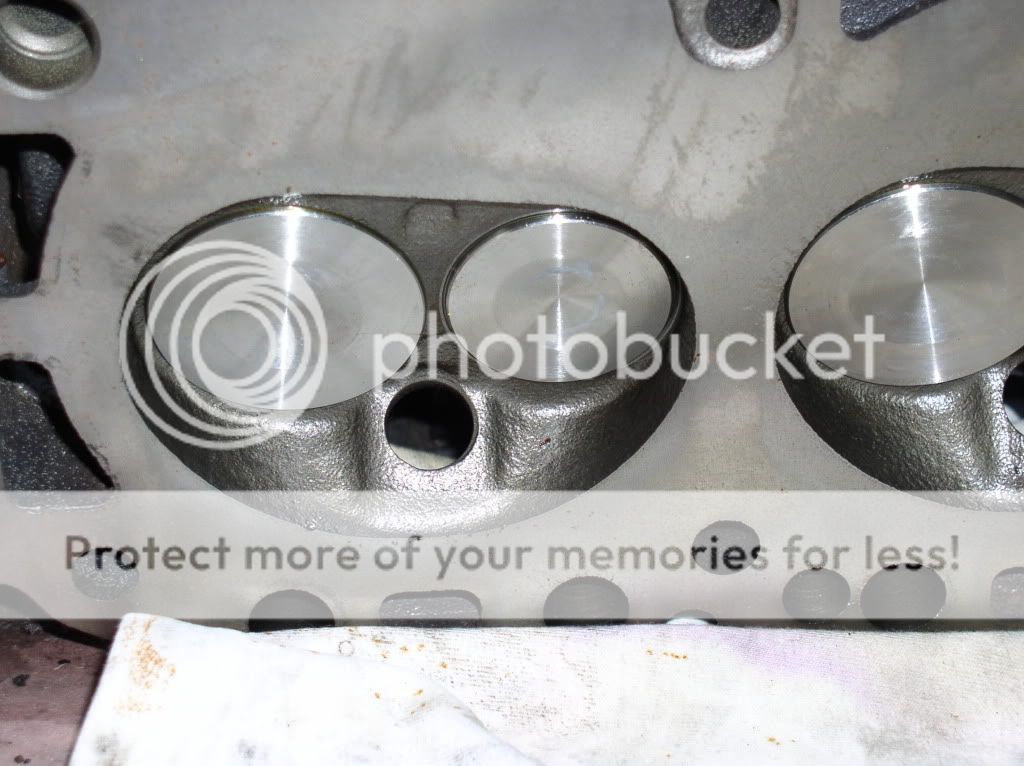
I am planning on removing the ridges, and polishing the chambers. Is it worth doing? Would I feel/notice a difference?
BTW: I know it looks like a crack between the valves in the photo, but it is not. Thanks.
I am planning on removing the ridges, and polishing the chambers. Is it worth doing? Would I feel/notice a difference?
BTW: I know it looks like a crack between the valves in the photo, but it is not. Thanks.

Elder User
Joined: Dec 2010
Posts: 600
Likes: 1
From: New Carlisle, Ohio
You can unshroud them and clean up the chamber a bit. It doesn't need to be mirror finsh some cartidge rolls would clean it up. Make sure there is no burs as this will create a hot spot which would cause pre-ignition. Also becareful with how much matarial you take out as this makes the chamber bigger dropping compression.
I'm on my phone so I can't see the picture very well but did they cut the valves seats for the bigger valves? The valve cutters we have at work unshrouds the valve some when it cuts so that's why I asked.
Are you going to throat it, bowl blend and port it?
I'm on my phone so I can't see the picture very well but did they cut the valves seats for the bigger valves? The valve cutters we have at work unshrouds the valve some when it cuts so that's why I asked.
Are you going to throat it, bowl blend and port it?
Thread Starter
|
Lead Driver
Joined: Mar 2008
Posts: 7,195
Likes: 387
From: Near Los Angeles
Thanks for the reply. For some reason--swirl--ford put ridges in the chambers, from like 4 o'clock on the exhaust, to about 8 o'clock on the intake. Yes, machinist cut and installed new larger seats. With the new valves the ridges become a factor b/c they are closer to the edge of the valves.
I just wondered it I would get a noticeable power improvement, or would it be minimal.
Thanks.
I just wondered it I would get a noticeable power improvement, or would it be minimal.
Thanks.
Elder User
Joined: Dec 2010
Posts: 600
Likes: 1
From: New Carlisle, Ohio
Chamber wise it would be minimal on a normal v8 so I would think it would be even less. A good bowl blend and some smoothing of the port can pick up around 25ish horse for a couple hours of work.
If you feel it will cause a problem then I would smooth the ridges out.
If you feel it will cause a problem then I would smooth the ridges out.

Fleet Owner
Joined: Dec 2009
Posts: 20,678
Likes: 83
From: NorCal
You'll get better value (bang for the buck, input-output) by port matching the intake and exhaust ports.
On the chambers, just remove any sharp ridges to avoid detonation.
Btw, porting and cleaning up the combustion chambers should have been done before rebuilding the heads. Be careful with that grinder... don't touch the valves or valve seats!
On the chambers, just remove any sharp ridges to avoid detonation.
Btw, porting and cleaning up the combustion chambers should have been done before rebuilding the heads. Be careful with that grinder... don't touch the valves or valve seats!
Elder User
Joined: Dec 2010
Posts: 600
Likes: 1
From: New Carlisle, Ohio
A little trick I used on doing chamber work when I'm porting at work is get an old valve and drop it in to protect the seat or put electrical tape around the valve head. becareful with the tool you use. Less is more in port work don't dig.
Also if you go to port matching route only take it about an inch in so it doesn't slow down the inital velocity of the port. Port matching the intake, smoothing the port, paying special attention to the short side radius and the bowl with a good throat can put up some serious number.
Also if you go to port matching route only take it about an inch in so it doesn't slow down the inital velocity of the port. Port matching the intake, smoothing the port, paying special attention to the short side radius and the bowl with a good throat can put up some serious number.
Trending Topics
Thread Starter
|
Lead Driver
Joined: Mar 2008
Posts: 7,195
Likes: 387
From: Near Los Angeles
Thanks for the replies. Before I had the larger valves installed I paid to have the bowl work done, $300. But now I want to remove those ridges and polish the chambers, as well as smooth the runners with 60 grit cones.
I'm hoping to feel a difference once the ridges are gone.
I'm hoping to feel a difference once the ridges are gone.
FTE Stories
Ford Trucks for Ford Truck Enthusiasts

Top 6 Best Deals Available on New Fords & Lincolns Right Now
Brett Foote
This Hennessey Takes the Expedition Tremor's Off-Roading Capability to the Next Level
Verdad Gallardo
Top 10 Fords at 2026 Carlisle Ford Nationals
Joe Kucinski
3 Best / 3 Worst Parts of Modern Ford Ownership
Brett Foote
10 Amazing Upgrades That Solve Common Ford Truck Owner Headaches
Pouria Savadkouei
Every 2026 Ford Engine Explained
Brett Foote
10 Ugly Ford Trucks That We Still Kinda Love
Joe Kucinski
10 Things Every Truck Owner NEEDS (2026 Edition)
Michael S. Palmer
Rezvani's Latest Post-Apocalyptic Monster Is a Ford F-150 Raptor Underneath
Verdad Gallardo

Lead Driver

Joined: Mar 2004
Posts: 8,924
Likes: 153
I'm not into 6 bangers but was there a factory head made with a better chamber to start with ? There just isn't a whole lot you can do with that design to start with. You will have to be careful there because if you take too much off of it you will never be able to get the spark plug out after it gets a little carbon built up on the threads.
Thread Starter
|
Lead Driver
Joined: Mar 2008
Posts: 7,195
Likes: 387
From: Near Los Angeles
I'm not into 6 bangers but was there a factory head made with a better chamber to start with ? There just isn't a whole lot you can do with that design to start with. You will have to be careful there because if you take too much off of it you will never be able to get the spark plug out after it gets a little carbon built up on the threads.


Thread
Thread Starter
Forum
Replies
Last Post
F-250 restorer
Performance & General Engine Building
6
Nov 5, 2010 07:51 AM
terilynn
Ford Inline Six, 200, 250, 4.9L / 300
3
Mar 14, 2005 01:22 PM