


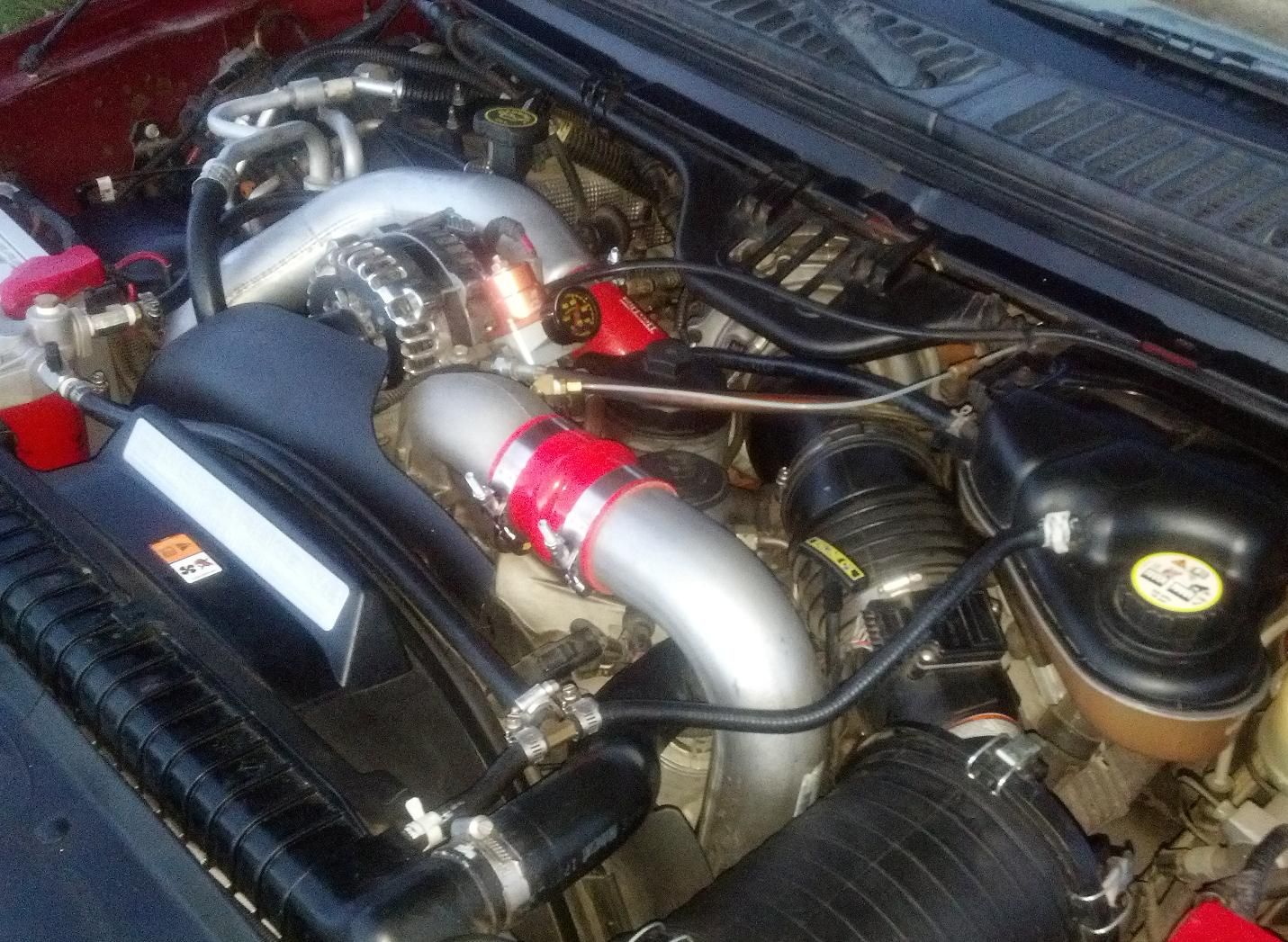

Intercooler boot failure.

Posting Guru
Joined: Jun 2006
Posts: 1,590
Likes: 0
I hear that quite often "It's there for a reason"... I don't always believe that to be true. There are some aftermarket manufacturers who build superior products to OEM. But in this instance, I think I agree with you. I won't be doing any CCV mods until I can research more...
Posting Guru
Joined: Jun 2006
Posts: 1,590
Likes: 0
Looks clean! Is that the Original degas cap?

Senior User
Joined: Jul 2013
Posts: 302
Likes: 0
From: California
Really? How does the CCV, as originally designed, make the engine run better? If you have some info, I'd like to hear it.
That oil mist certainly isn't good for silicon hoses. Mfg of silicon hoses/boots even state they are not designed for use with petroleum products. That is why Ford had to change their boots with a different inner layer that resist oil.
To mod the CCV, you have two choices. The first is to vent to open air, which is what most people do. The second is to plump a catch can into the system. The catch can is supposed to 'catch' the oil keeping it out of the intake tract. With the catch can type system, the air, less the oil, still goes into the intake.
That oil mist certainly isn't good for silicon hoses. Mfg of silicon hoses/boots even state they are not designed for use with petroleum products. That is why Ford had to change their boots with a different inner layer that resist oil.
To mod the CCV, you have two choices. The first is to vent to open air, which is what most people do. The second is to plump a catch can into the system. The catch can is supposed to 'catch' the oil keeping it out of the intake tract. With the catch can type system, the air, less the oil, still goes into the intake.

Senior User
Joined: Aug 2007
Posts: 245
Likes: 0
From: Clearwater, Florida
I've had my CCV "rerouted" for the last 70k miles (4 years) with no trouble. Back on topic, I replaced my boots with stock ones at the same time. How long should expect them to last? I tow heavy, but not in the mountains.
Senior User
Joined: Jul 2013
Posts: 302
Likes: 0
From: California
I had the updated oem boots (ones with the oil resistant inner layer) on for the approx. 110K miles. It might have been longer (120K?) but it was at least 110K. IIRC, I got those boots in 2005 (?) when they first became available. If someone remembers when the updated boots came out, that would be helpful.
I just recently went to the Riffraff boots while going through the truck doing all the 150K mile services. Lower pricing is why I went Riffraff instead of oem again.
I just recently went to the Riffraff boots while going through the truck doing all the 150K mile services. Lower pricing is why I went Riffraff instead of oem again.
Posting Guru
Joined: Jun 2006
Posts: 1,590
Likes: 0
To mod the CCV, you have two choices. The first is to vent to open air, which is what most people do. The second is to plump a catch can into the system. The catch can is supposed to 'catch' the oil keeping it out of the intake tract. With the catch can type system, the air, less the oil, still goes into the intake.
FTE Stories
Ford Trucks for Ford Truck Enthusiasts

3 Best / 3 Worst Parts of Modern Ford Ownership
Brett Foote
10 Amazing Upgrades That Solve Common Ford Truck Owner Headaches
Pouria Savadkouei
Every 2026 Ford Engine Explained
Brett Foote
10 Ugly Ford Trucks That We Still Kinda Love
Joe Kucinski
10 Things Every Truck Owner NEEDS (2026 Edition)
Michael S. Palmer
Rezvani's Latest Post-Apocalyptic Monster Is a Ford F-150 Raptor Underneath
Verdad Gallardo
Top 10 Most Expensive Ford Trucks Ever Sold on Bring a Trailer
Joe Kucinski
2027 Ford Super Duty Buyer's Guide (Every Model, Engine, & Package)
Brett Foote
Top 10 Ford Truck Tragedies
Joe Kucinski
Fleet Mechanic


Joined: Nov 2012
Posts: 1,348
Likes: 110
From: Lakeland, Fl
Really? How does the CCV, as originally designed, make the engine run better? If you have some info, I'd like to hear it.
That oil mist certainly isn't good for silicon hoses. Mfg of silicon hoses/boots even state they are not designed for use with petroleum products. That is why Ford had to change their boots with a different inner layer that resist oil.
To mod the CCV, you have two choices. The first is to vent to open air, which is what most people do. The second is to plump a catch can into the system. The catch can is supposed to 'catch' the oil keeping it out of the intake tract. With the catch can type system, the air, less the oil, still goes into the intake.
That oil mist certainly isn't good for silicon hoses. Mfg of silicon hoses/boots even state they are not designed for use with petroleum products. That is why Ford had to change their boots with a different inner layer that resist oil.
To mod the CCV, you have two choices. The first is to vent to open air, which is what most people do. The second is to plump a catch can into the system. The catch can is supposed to 'catch' the oil keeping it out of the intake tract. With the catch can type system, the air, less the oil, still goes into the intake.

Certified Thread Hijacker


Joined: Aug 2001
Posts: 14,441
Likes: 60

To mod the CCV, you have two choices. The first is to vent to open air, which is what most people do. The second is to plump a catch can into the system. The catch can is supposed to 'catch' the oil keeping it out of the intake tract. With the catch can type system, the air, less the oil, still goes into the intake.
Josh
Senior User
Joined: Jul 2013
Posts: 302
Likes: 0
From: California
To which you responded, "Ford. It's there for a reason and it's not just for emissions."
So what's the reason? Seriously, I'd like to know.
I'm not a engineer but it seems to me the way the fitting is oriented the intake actually is pressurizing the crankcase. I was under the impression that a slight negative pressure would be better for boosted applications.
I also know that, in theory, a lot of blowby would be pushing oil out. My line doesn't appear to drip. Been parking my truck in the same spot for 9 years. I do know that it 'breathes' as I can smell the oil if I lean down by the exit.
So what's the reason? Seriously, I'd like to know.
I'm not a engineer but it seems to me the way the fitting is oriented the intake actually is pressurizing the crankcase. I was under the impression that a slight negative pressure would be better for boosted applications.
I also know that, in theory, a lot of blowby would be pushing oil out. My line doesn't appear to drip. Been parking my truck in the same spot for 9 years. I do know that it 'breathes' as I can smell the oil if I lean down by the exit.

Thread Starter
|
Freshman User
Joined: Aug 2013
Posts: 32
Likes: 0
Okay replaced the boots but I'm hearing the same noise when towing under load. Here is a video of the sound. It starts around second 29 sounds kind of like a tea kettle. I'm thinking bad degas cap. http://s1313.photobucket.com/user/ca...ea2f0.mp4.html

Thread Starter
|
Freshman User
Joined: Aug 2013
Posts: 32
Likes: 0

Posting Guru
Joined: Oct 2012
Posts: 1,777
Likes: 4
From: Des Moines, IA
I've done the road draft tube CCV mod on most of my vehicles. The ones you'll notice the most difference is on turbocharged vehicles. I had a small oil leak on one of my Audi's that I wasn't going to get to until I pulled the motor for bigger turbos. Went and did the road draf tube setup for the CCV and the oil leak nearly stopped. Also, when I pulled the lower hoses from my intercoolers they had almost no oil in them, just a very light film. With the factory system in place the bottom of the intercooler would be full up to the hose outlet.

Thread
Thread Starter
Forum
Replies
Last Post
snaponprofile
Pre-Power Stroke Diesel (7.3L IDI & 6.9L)
49
Sep 20, 2011 12:12 AM
60RatRod
1999 - 2003 7.3L Power Stroke Diesel
85
Jul 4, 2010 06:19 PM
PaysonPSD
1999 - 2003 7.3L Power Stroke Diesel
32
Jun 29, 2010 10:35 PM