


Casting Urethane Mounts?


Thread Starter
|
Posting Guru
Joined: Sep 2012
Posts: 1,314
Likes: 1
 Casting Urethane Mounts?
I'm thinking of casting some urethane motor mount bushings (shock pads) to replace the worn mount pads under the Y block in Albatross. I was wondering if any of us has experience with casting urethane or urethane in general. What hardness should I shoot for? My best guess is at least 85A. Constructive comments and suggestions, such as "You're stinkin' drunk this early in the morning?  That'll never work!", are more than welcome.
That'll never work!", are more than welcome.

Fleet Owner


Joined: Jul 2004
Posts: 27,299
Likes: 1,059
From: NM
Why? New pads appear to be available in stock rubber. Urethane has some endearing qualities, but it actually does pretty poorly in many applications. I used to have a SAAB which were notorious for alternator mount bushings (rubber sleeve type) failing after 15 years. A real PITA to change out. So someone started offering them in urethane. They lasted less than a year for most people. I've heard similar stories on Twin I-Beam bushings and various other components. It seems counter-intuitive.
Thread Starter
|
Posting Guru
Joined: Sep 2012
Posts: 1,314
Likes: 1
It sounds like that alternator bushing missed the appropriate hardness. That's why I'm asking the question.
As for why do it, I'm reading of reproduction rubber products that don't stand up to a couple of years on the shelf (out of the sun!) without rotting. I don't desire to lift the engine and transmission every couple of years. I want something that will outlast the motor. I may not get it, but, I hope to.
As for why do it, I'm reading of reproduction rubber products that don't stand up to a couple of years on the shelf (out of the sun!) without rotting. I don't desire to lift the engine and transmission every couple of years. I want something that will outlast the motor. I may not get it, but, I hope to.

Hotshot


Joined: Jan 2001
Posts: 16,887
Likes: 3,130
From: SE Wisc. (the Rust Belt)
I am currently working on a '37 Buick, everything involved with this car is 3-4 as expensive and if you think finding parts for our trucks is hard, try a pre-war car. One of the reasons the costs are higher is because there aren't as many parts vendors for the pre-war cars, at least not the Buick, so I've had to make a lot of my own parts like patch panels and also motor mounts. There are a couple of places that vulcanize motor mounts but they're expensive and I'd have to send my cores across the country so I decided to redo them myself.
I did a search of the net and found the ricer guys have problems with their stock motor mounts on their Hondas. They build super powerful engine and none of the motor mounts can handle the extra torque so they recast their own mounts. This is the stuff they use:
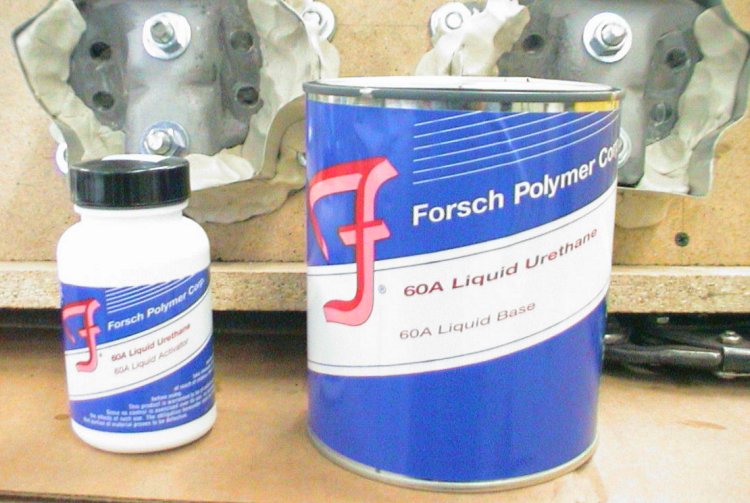
Information on this product:
http://www.fatfenderedtrucks.com/casting_product.html
Before buying this product I called the manufacturer and gave them a very detailed explanation of exactly what I wanted to do and their tech told me they sell this product for this exact use all of the time.
Here is the page showing how I did the mounts for the Buick:
http://www.fatfenderedtrucks.com/mot...t_rebuild.html
I used MDF board to make the forms for the round puck mounts I made. Worked great. Just follow their instructions. The stuff I used set up pretty fast but it will ooze out of any little opening until it hardens, I think in about 12 minutes from the time you mix the two parts together.
I haven't had the car running yet so I don't know for 100% sure how well it holds together under stress, I am depending on what I read on the ricer websites and the assurance of the manufacturer.
I did a search of the net and found the ricer guys have problems with their stock motor mounts on their Hondas. They build super powerful engine and none of the motor mounts can handle the extra torque so they recast their own mounts. This is the stuff they use:
Information on this product:
http://www.fatfenderedtrucks.com/casting_product.html
Before buying this product I called the manufacturer and gave them a very detailed explanation of exactly what I wanted to do and their tech told me they sell this product for this exact use all of the time.
Here is the page showing how I did the mounts for the Buick:
http://www.fatfenderedtrucks.com/mot...t_rebuild.html
I used MDF board to make the forms for the round puck mounts I made. Worked great. Just follow their instructions. The stuff I used set up pretty fast but it will ooze out of any little opening until it hardens, I think in about 12 minutes from the time you mix the two parts together.
I haven't had the car running yet so I don't know for 100% sure how well it holds together under stress, I am depending on what I read on the ricer websites and the assurance of the manufacturer.
Hotshot
Joined: Jan 2001
Posts: 16,887
Likes: 3,130
From: SE Wisc. (the Rust Belt)
It sounds like that alternator bushing missed the appropriate hardness. That's why I'm asking the question.
As for why do it, I'm reading of reproduction rubber products that don't stand up to a couple of years on the shelf (out of the sun!) without rotting. I don't desire to lift the engine and transmission every couple of years. I want something that will outlast the motor. I may not get it, but, I hope to.
As for why do it, I'm reading of reproduction rubber products that don't stand up to a couple of years on the shelf (out of the sun!) without rotting. I don't desire to lift the engine and transmission every couple of years. I want something that will outlast the motor. I may not get it, but, I hope to.
Thread Starter
|
Posting Guru
Joined: Sep 2012
Posts: 1,314
Likes: 1
Thanks, Bob. Man, the Internet can be cool. Anyway, I'm thinking that a TDI-polyether compound would best fit my compression application but, truth be told, an MDI polyester would probably work fine. The temp doesn't exceed the 160 degree C recommended limit for polyurethanes. A 60A shore hardness is in line with tennis shoe soles and tire tread so that may be about right. I'll look that goop up and go about making some test coupons.

Thread
Thread Starter
Forum
Replies
Last Post
genscripter
Pre-Power Stroke Diesel (7.3L IDI & 6.9L)
3
Jan 7, 2017 11:39 AM
jammeyer
1967 - 1972 F-100 & Larger F-Series Trucks
4
Nov 19, 2013 02:48 PM
TexasGuy001
1987 - 1996 F150 & Larger F-Series Trucks
8
May 30, 2013 01:23 AM


