




Power steering fluid vs. ATF
Thread Starter
|
Junior User
Joined: Jan 2012
Posts: 71
Likes: 0
From: Largo, FL
 Power steering fluid vs. ATF
Hi, I have a '92 Aerostar. I just replaced the rack & pinion, tie rod ends and power steering pump. The manual says i have to use ATF type F but my local auto part store told me to use power steering fluid. Since my rack had a leak i decided to use ATF since it was cheaper. But now that I have brand new parts i want to use the right stuff.
Unfortunately, i think the new pump i just installed is defective because the steering wheel kinda shakes when i turn it even with tires off the ground. Anyway, this is the 3rd time in 14 years with the van that i have to replace the power steering pump and the first time it came out defective and i had to replace it twice in one day. So, i guess its happening again. Unless this time the defective part is the rack & pinion. Anyway, when i finally get it right i want to make sure i fill it up with the right fluid.
I will appreciate any info. Thanks!
Unfortunately, i think the new pump i just installed is defective because the steering wheel kinda shakes when i turn it even with tires off the ground. Anyway, this is the 3rd time in 14 years with the van that i have to replace the power steering pump and the first time it came out defective and i had to replace it twice in one day. So, i guess its happening again. Unless this time the defective part is the rack & pinion. Anyway, when i finally get it right i want to make sure i fill it up with the right fluid.
I will appreciate any info. Thanks!

Lead Driver


Joined: Sep 2003
Posts: 7,015
Likes: 208
From: SoCal

If the manual says Type-F ATF, that's probably what you should use.
This may be obvious, but I'll ask anyway. When you started the engine the first time after replacing the rack, did you turn the wheel to its limits on both sides? You may need to do this with the van on the ground to put a load on the steering system to fully purge the system of air. Trapped air will cause the wheel to shake and the pump to whine.
But, it's entirely possible to have gotten a badly rebuilt rack. At least one member of this forum has had that experience.
This may be obvious, but I'll ask anyway. When you started the engine the first time after replacing the rack, did you turn the wheel to its limits on both sides? You may need to do this with the van on the ground to put a load on the steering system to fully purge the system of air. Trapped air will cause the wheel to shake and the pump to whine.
But, it's entirely possible to have gotten a badly rebuilt rack. At least one member of this forum has had that experience.
Thread Starter
|
Junior User
Joined: Jan 2012
Posts: 71
Likes: 0
From: Largo, FL
Hi, yes, I did turned the wheel to both ends (left and right) many times with the tires up in the air and also on the ground. Also took her for a few test drives and still the steering wheel shakes when i turn. Not sure what to replace again first: PS pump or R&P. I was going to do the pump today but its raining. So i guess i have one more day to do my research and decide which one to replace first.  Any ideas? Thank you and have a nice day!
Any ideas? Thank you and have a nice day!

Postmaster
Joined: Oct 2009
Posts: 3,432
Likes: 7
My experience with rebuilt PS pumps is that most of them are garbage. How is a rebuilder supposed to rebuild a pump and restore it to its original specs when those specs are proprietary? Sure you can replace seals, and other parts, but how do you know when a part is acceptable to reuse or reject when you don't know what the actual allowable tolerances are? This is the position that most the rebuilders are in.
So my experience with remanufactured power steering pumps? Don't waste you money on anything less than a genuine Motorcraft brand rebuilt unless you are willing to live with doing the job over and over again and dealing with the same problems you replaced it for in the first place.
I installed a Motorcraft reman unit in my '97. You literally cannot hear it from inside the van. You can hear it a little from outside, but just barely. Its that quiet.
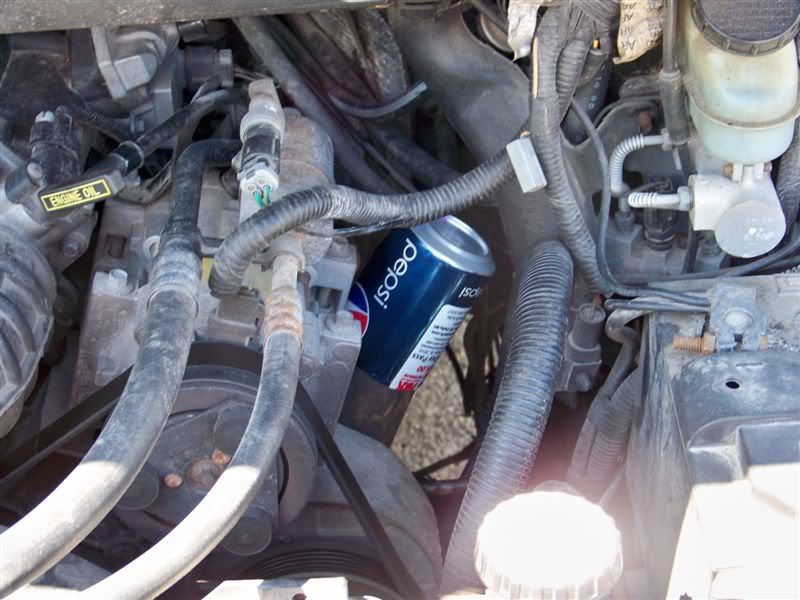
Several important things to remember with a PS pump. First, fill with the right type of fluid. Ford specs Mercon ATF (use Mercon V now) because it is the fluid they designed their pump to use. It has detergents, friction modifiers, and thermal carriers that make it well suited to the high pressures and temperatures it is exposed to. Regular PS fluid is nothing more that hydraulic fluid. Secondly, replace it regularly. The PS system lacks any kind of filter, so your only protection is to replace the old fluid. You could add a filter, but that is still not an excuse to leave old fluid in for too long. Replace it whenever you service your transmission, every 20,000 - 30,000 miles. Thats easy since it since same type of fluid. Thirdly keep water out. The cap is vented, and if water leaks onto the cap, it can get into the system. A shape and simple fix is a soda can cut in half slid over the top of the reservoir. A more attractive and permanent fix is to replace that pointless drain which plugs with dirt and leaves with a piece of radiator hose. Any hose of the right diameter will work great, so long as you let it route water way from and down past the reservoir. Then secure it with a hose clamp. The larger hose doesn't clog. The OE design only leaks on the PS pump when it is clogged, so prevent the clog, protect the pump. A good hose to use is the same type as the upper radiator hose. Just cut it to a more appropriate length, remember all you need to do is let it drain down past the level of the pump and away from the engine.
So my experience with remanufactured power steering pumps? Don't waste you money on anything less than a genuine Motorcraft brand rebuilt unless you are willing to live with doing the job over and over again and dealing with the same problems you replaced it for in the first place.
I installed a Motorcraft reman unit in my '97. You literally cannot hear it from inside the van. You can hear it a little from outside, but just barely. Its that quiet.
Several important things to remember with a PS pump. First, fill with the right type of fluid. Ford specs Mercon ATF (use Mercon V now) because it is the fluid they designed their pump to use. It has detergents, friction modifiers, and thermal carriers that make it well suited to the high pressures and temperatures it is exposed to. Regular PS fluid is nothing more that hydraulic fluid. Secondly, replace it regularly. The PS system lacks any kind of filter, so your only protection is to replace the old fluid. You could add a filter, but that is still not an excuse to leave old fluid in for too long. Replace it whenever you service your transmission, every 20,000 - 30,000 miles. Thats easy since it since same type of fluid. Thirdly keep water out. The cap is vented, and if water leaks onto the cap, it can get into the system. A shape and simple fix is a soda can cut in half slid over the top of the reservoir. A more attractive and permanent fix is to replace that pointless drain which plugs with dirt and leaves with a piece of radiator hose. Any hose of the right diameter will work great, so long as you let it route water way from and down past the reservoir. Then secure it with a hose clamp. The larger hose doesn't clog. The OE design only leaks on the PS pump when it is clogged, so prevent the clog, protect the pump. A good hose to use is the same type as the upper radiator hose. Just cut it to a more appropriate length, remember all you need to do is let it drain down past the level of the pump and away from the engine.
Thread Starter
|
Junior User
Joined: Jan 2012
Posts: 71
Likes: 0
From: Largo, FL
Thank a lot KhanTyranitar for your great info. After hrs messing with the new steering system i discovered that the belt wasn't tight enough and that was why i was feeling that vibration/pulse when turning the steering wheel , duh! I even got a new belt. For now i guess i will deal with the rebuilt pump but next time i will definitely instal e genuine pump. Tomorrow i will drain the PS fluid i already put in it, flush it and fill it up with Mercon V as you suggested. The soda can cut in half is a great idea also for now till i have the time to do it with the hose. I really appreciate your info. Have a nice day!

Fleet Mechanic
Joined: Mar 2004
Posts: 1,529
Likes: 35
From: Kansas
My experience with rebuilt PS pumps is that most of them are garbage. How is a rebuilder supposed to rebuild a pump and restore it to its original specs when those specs are proprietary? Sure you can replace seals, and other parts, but how do you know when a part is acceptable to reuse or reject when you don't know what the actual allowable tolerances are? This is the position that most the rebuilders are in.
Where I disagree with your post is when you say that the aftermarket cannot manufacture a good pump because they don't know what the tolerances are. They can reverse-engineer a good, quiet pump if they want to. They can spend money to test different designs for pressure and noise if they want to. They have all kinds of test facilities at their disposal. Heck, years ago I even saw in a Ford-issued pamphlet why the Ford pumps are quiet and the aftermarket pumps are noisy. (Maybe I should have saved it and sent it to the rebuilders so they could have read it) But the aftermarket rebuilders have to rebuild them as cheap as possible.
It boils down to this: Ford pumps are quiet because they are used in repairs where the customer puts a higher emphasis on performance and quietness over the cost of the repair. On the aftermarket side, people put a higher emphasis on how cheap they can buy the replacement.
I have, on occasion, purchased parts on how much it cost. I know a lot of people who will save a couple of bucks to drive halfway across town to get a cheaper part than what they can get next door. The rebuilders know this and they have to get them out the door as cheap as they possibly can.
Trending Topics
Lead Driver
Joined: Sep 2003
Posts: 7,015
Likes: 208
From: SoCal
A lot of rebuilt parts really are junk. I think someone on this forum (Aerocolorado?) had to replace his rebuilt steering racks three times due to repeated leaks. I've had to replace rebuilt starter motors a couple of times on a couple of cars before.
Just my data point about PS pumps; I'm still using the original equipment pumps on both my 1987 Mustang and 1990 Aerostar, and they were both noisy from the first day I got them. I got the Aerostar used in 1994, and it sounded just like the 1987 Mustang; a little whining that gets loud when I put load on it. If I turn it back and forth very fast, like driving it through a slalom, it runs out of power after 3 or 4 turns. But I did notice that that they run quieter on type-F, even though I think the owner's manual may specify Mercon. I had Mobil-1 in there for a while, but the noise was the same as original.
Just my data point about PS pumps; I'm still using the original equipment pumps on both my 1987 Mustang and 1990 Aerostar, and they were both noisy from the first day I got them. I got the Aerostar used in 1994, and it sounded just like the 1987 Mustang; a little whining that gets loud when I put load on it. If I turn it back and forth very fast, like driving it through a slalom, it runs out of power after 3 or 4 turns. But I did notice that that they run quieter on type-F, even though I think the owner's manual may specify Mercon. I had Mobil-1 in there for a while, but the noise was the same as original.
FTE Stories
Ford Trucks for Ford Truck Enthusiasts

10 Things Every Truck Owner NEEDS (2026 Edition)
Michael S. Palmer
Rezvani's Latest Post-Apocalyptic Monster Is a Ford F-150 Raptor Underneath
Verdad Gallardo
Top 10 Most Expensive Ford Trucks Ever Sold on Bring a Trailer
Joe Kucinski
2027 Ford Super Duty Buyer's Guide (Every Model, Engine, & Package)
Brett Foote
Top 10 Ford Truck Tragedies
Joe Kucinski
AEV FXL Super Duty - the Super Duty Raptor Ford Doesn't Make
Brett Foote
Lobo Vs Lobo: Proof the F-150 Lobo Should Be Even Lower!
Michael S. Palmer
Ford's 2001 Explorer Sportsman Concept Looks For a New Home
Verdad Gallardo
10 Best Ford Truck Engines We Miss the Most!
Joe Kucinski
Thread Starter
|
Junior User
Joined: Jan 2012
Posts: 71
Likes: 0
From: Largo, FL
Thanks a lot to all for the replies. Type F it is then  Next time i have to replace a PS pump i will give Motorcraft a try. Thanks MFJ for the pic. Next time i drink a soda or beer i will save the can to do this, for now, until i can do something that looks a little better Have a nice weekend you all!
Next time i have to replace a PS pump i will give Motorcraft a try. Thanks MFJ for the pic. Next time i drink a soda or beer i will save the can to do this, for now, until i can do something that looks a little better Have a nice weekend you all!
Fleet Mechanic
Joined: Mar 2004
Posts: 1,529
Likes: 35
From: Kansas
True story: About two years ago, a co-worker of mine had his car starter fail on a Saturday. (A GM product, but it really doesn't matter) He called around for one and the nearest one he could find was about 45 minutes away. He drove to the national chain store, (to remain nameless here) purchased it and he kept the core at home knowing that he would return it later. When he got home and compared the old starter to the new one, he noticed that both starters were the same except that the nose cone on the rebuilt starter had a different bolt configuration and wouldn't work. He called the store and explained it to them and they asked him if he could remove the nose cone of the rebuilt starter and reuse the old one. He was okay with that, but here's where it gets interesting. When he removed the nose cone of his freshly painted, rebuilt starter, he noticed that nothing had been replaced in the "rebuilt" starter. The brushes were old and about 1/4 of the brush material was gone. The armature hadn't been trued up and the mica hadn't been undercut. The bushings on the cone and the back cover hadn't been replaced. Even the starter drive had old grease on the motor side of it that wasn't visible from the outside. The rebuilder had simply cleaned up a starter on the outside, shot some paint on it with a new sticker, reboxed it and sent it to the store. I wouldn't have put up with it, but he installed it and the starter worked great.
I guess I'm just saying that the quality of aftermarket parts has, IMO, taken a nose-dive the last few years.

Thread
Thread Starter
Forum
Replies
Last Post
Punisher29073
1999 - 2003 7.3L Power Stroke Diesel
7
Jan 29, 2016 02:33 PM
Island Time
1987 - 1996 F150 & Larger F-Series Trucks
3
Dec 15, 2014 02:49 PM
Bruce R Leech
1987 - 1996 F150 & Larger F-Series Trucks
8
Apr 8, 2007 12:07 PM
92 Red F150
Brakes, Steering, Suspension, Tires, & Wheels
4
Feb 8, 2005 12:39 AM
