



Water tight Welds
Thread Starter
|
Lead Driver


Joined: Mar 2008
Posts: 7,182
Likes: 380
From: Near Los Angeles
Water tight Welds
I'm welding some coolant exchange manifolds for aftermarket I6 intakes, and having a bear of a time getting out pen holes in my welds. I know the problem is several things, but I'm wondering if any welders can steer me in the right direction. I'm using a little 11o v. wire feed. I start out with a nice bead, but by the time I pressure test and re-weld the leaks, it looks like amateur hour, just big old blobs that make me feel horrible. I am grinding everything clean where it's to be welded, grinding off galv. finish on the fittings too.
Here's a photo:
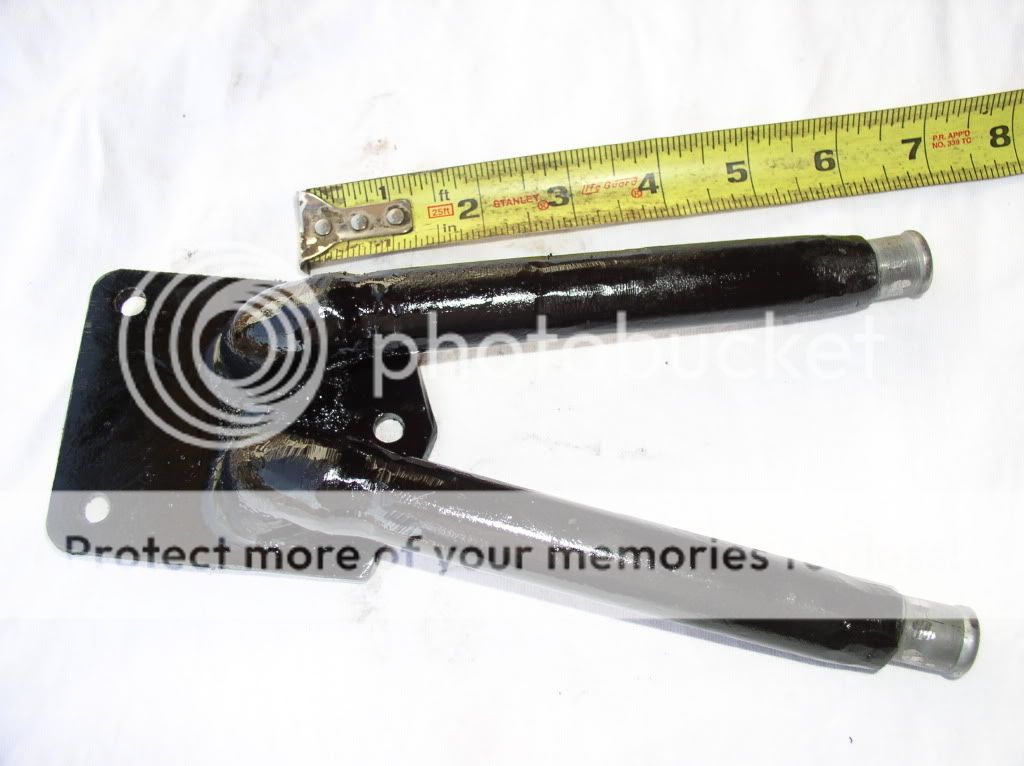
I'm thinking I'll have to convert to TIG.
Here's a photo:
I'm thinking I'll have to convert to TIG.
Thread Starter
|
Lead Driver
Joined: Mar 2008
Posts: 7,182
Likes: 380
From: Near Los Angeles

Post Fiend
Joined: Mar 2011
Posts: 8,501
Likes: 4
From: Lynchburg, VA
If your stopping a starting, are you cleaning the weld before continuing?

Senior User
Joined: Apr 2011
Posts: 164
Likes: 0
From: DOWN UNDER!!
Either TIG those fittings, or Braze them. stopping and starting like you have to with a MIG welder is a pain in the neck and results in pinholes... as you're finding out. The only other way you might have luck on a gasless MIG is to poke the pipe through that plate and weld the other side of it as well

Senior User
Joined: Feb 2011
Posts: 192
Likes: 0
Galvenized is the problem, can't weld that. It must all be ground off inside and out anywhere near the weld or it will contaminate the weld. You don't need a tig for water tight welds. Most pipefitters use sticks much like your flux core in theory.
Trending Topics

Hotshot
Joined: Mar 2007
Posts: 10,101
Likes: 40
From: Pa
He said hes grinding off the galv on the outside so I highly doubt the galv is the problem. The galv on the inside may be a problem for tig though if your getting the underside molten. I've mig welded through galv already with no prep inside or out.(Note: galv fumes arn't good so you should remove it before welding)
Your problem (IMO) is the flux core. Those 110v welders and flux core are a bad combo. Combine that with the stopping starting your probably doing and your getting porosity. I'd invest in a 40cf tank of 75/25 mix and some .023"-025" solid wire for your mig welder. You will notice much nicer welds, better penetration and a more stabil arc.
Your problem (IMO) is the flux core. Those 110v welders and flux core are a bad combo. Combine that with the stopping starting your probably doing and your getting porosity. I'd invest in a 40cf tank of 75/25 mix and some .023"-025" solid wire for your mig welder. You will notice much nicer welds, better penetration and a more stabil arc.
FTE Stories
Ford Trucks for Ford Truck Enthusiasts

Rezvani's Latest Post-Apocalytic Monster Is a Ford F-150 Raptor Underneath
Verdad Gallardo
Top 10 Most Expensive Ford Trucks Ever Sold on Bring a Trailer
Joe Kucinski
2027 Ford Super Duty Buyer's Guide (Every Model, Engine, & Package)
Brett Foote
Top 10 Ford Truck Tragedies
Joe Kucinski
AEV FXL Super Duty - the Super Duty Raptor Ford Doesn't Make
Brett Foote
Lobo Vs Lobo: Proof the F-150 Lobo Should Be Even Lower!
Michael S. Palmer
Ford's 2001 Explorer Sportsman Concept Looks For a New Home
Verdad Gallardo
10 Best Ford Truck Engines We Miss the Most!
Joe Kucinski
2026 Shelby F-150 Off-Road: Better Than a Raptor R?
Brett Foote
Senior User
Joined: Feb 2011
Posts: 192
Likes: 0
Welding galvanized steel will contaminate the weld, grinding the outside only will still leave the inside to contaminate the weld.
The reason for pin holes in a weld are usually due to shielding gas (to much or not enough, letting contaminates into the weld), contaminated metal, or contaminated filler metal.
A 110 volt welder will give you a water tight weld if prepped correctly.
Using a flux core wire will actually allow you higher penetration then using gas shielded wire. Especially with a small or under powered welder.
lastly the elbows look to me like cast iron which is even harder to weld.
The reason for pin holes in a weld are usually due to shielding gas (to much or not enough, letting contaminates into the weld), contaminated metal, or contaminated filler metal.
A 110 volt welder will give you a water tight weld if prepped correctly.
Using a flux core wire will actually allow you higher penetration then using gas shielded wire. Especially with a small or under powered welder.
lastly the elbows look to me like cast iron which is even harder to weld.

Moderator


Joined: Jul 2011
Posts: 6,509
Likes: 662
From: Sioux Falls Area

I know this is a "do it yourself-er" thing .... i get that, really, i get it ...
but in my world, an hour's worth of welding shop time makes the problem go away. Depending on the shop, usually 60 or 70 bucks/hr gets it done.
Figgure how much time you've spent and figgure your time is worth *something* and it don't take long to pay someone a few bucks to just get it done and done right.
just my thoughts.
but in my world, an hour's worth of welding shop time makes the problem go away. Depending on the shop, usually 60 or 70 bucks/hr gets it done.
Figgure how much time you've spent and figgure your time is worth *something* and it don't take long to pay someone a few bucks to just get it done and done right.
just my thoughts.

Senior User
Joined: Nov 2006
Posts: 409
Likes: 0
the problem is heat. if your going to do it over when ever you stop you should use a wire brush on a drill or gridnder you really need to clean the contaminets off since your limited to the flux and a 110 volt welder .the next thing to do is turn your heat all the way up slow down your wire down alittle more and take your soldering torch and pre heat before you weld again.. taking a grinding disk will provide yourself more work..

Postmaster
Joined: Oct 2005
Posts: 3,083
Likes: 4
From: Victoria , BC
K for starters grinding galvanized with a stone wheel only works for a sec then it gums up and dies nothing. Best results is use a 60 grit sanding wheel! I've done tons of galvanized welding. Sand off as much as you can and your best result would be to use a small 3/32 , 7018 rod IF the steel is thick enough. It would have to be about 1/8" thick to take the heat. If it's thinner than that your best bet will be probably a .030 solid wire with argon gas. Your " fluxcore" your all talking about is gasless wire which is known as an innersheild wire that is actually hollow and needs no gas. It's not the best for stuff like this. Also this gassless wire requires you to run the machine in reverse polarity meaning your gun/whip will be on the - post on the inside and the ground on the + stud. If it's a machine with no fittings for gas and made for gassless it will already be set. With wire on reverse polarity it will run smoother and have less spatter!
Honestly mig welding thin steel is tricky especially when you add water tight and galvanized into it. Can you just take one piece and bend it at a 90? Then do as mentioned weld on both sides of plate.
It's funny you mention water tight welds as I was transferred to our ship yard division for a short while and the past 2 weeks all I've done was cut out scrap haul bottom and weld x ray water tight welds. It's very specific in weld sequence and type. I hold many CWB certificates for this stuff..
Honestly mig welding thin steel is tricky especially when you add water tight and galvanized into it. Can you just take one piece and bend it at a 90? Then do as mentioned weld on both sides of plate.
It's funny you mention water tight welds as I was transferred to our ship yard division for a short while and the past 2 weeks all I've done was cut out scrap haul bottom and weld x ray water tight welds. It's very specific in weld sequence and type. I hold many CWB certificates for this stuff..
Postmaster
Joined: Oct 2005
Posts: 3,083
Likes: 4
From: Victoria , BC
This is a weird coincidence but just after I posted earlier I went out and got a new adapter fitting for my dishwasher that snapped off. Problem was that the threads stripped in faucet making it a total fail until I thought I'd weld it. I then sanded it down seeing it was brass and busted out the little mapp gas torch bottle and soldered with lead the fitting directly to faucet. Adapter is now no more and it's a permanent fix with $100 left in my pocket and I had all the tools. This could be an option here as well but with steel, brazing might be a better option.
Post Fiend
Joined: Mar 2011
Posts: 8,501
Likes: 4
From: Lynchburg, VA
This is a weird coincidence but just after I posted earlier I went out and got a new adapter fitting for my dishwasher that snapped off. Problem was that the threads stripped in faucet making it a total fail until I thought I'd weld it. I then sanded it down seeing it was brass and busted out the little mapp gas torch bottle and soldered with lead the fitting directly to faucet. Adapter is now no more and it's a permanent fix with $100 left in my pocket and I had all the tools. This could be an option here as well but with steel, brazing might be a better option.
