


Novice mistake...need advice!

Thread Starter
|
Senior User
Joined: Jul 2009
Posts: 370
Likes: 0
From: Stony Plain,AB Canada
Novice mistake...need advice!
I was dealing with some oil canning on the back of my 55 F100 cab and wasn't getting great results using dollie and hammer. i applied some heat and worked the area and had it with in an 1/8" without any oil canning. Tried to get it a little better using more heat and it took off. 
I have about 3/8" force dent now and it will not come out.
My thoughts are to cross cut this area to relieve the stress and then reweld...is this going to work or is there a better way?

I have about 3/8" force dent now and it will not come out.
My thoughts are to cross cut this area to relieve the stress and then reweld...is this going to work or is there a better way?

Mountain Pass
Joined: Oct 2006
Posts: 237
Likes: 0
From: Niles, MI
I have never had quite that problem, and I am in no way an expert, but I have done a pretty fair amount of metal work (both personal & professionally) and my first thought would be to try the "quench" method;
Reheat a larger area, and try to work the bad spot outwith a hammer and dolly, then quench the area with a large rag soaked in cold water...
I am sure there are others out there with more experience than me, they will be along before too long to correct me if I gave bad advice (for which, i appologize in advance)
I am dealing with some oilcanning on the back wall of my cab too (56) over a buch broader area, but I need to get a full floor and firewall in before I start bending the back.
GOOD LUCK
Reheat a larger area, and try to work the bad spot outwith a hammer and dolly, then quench the area with a large rag soaked in cold water...
I am sure there are others out there with more experience than me, they will be along before too long to correct me if I gave bad advice (for which, i appologize in advance)
I am dealing with some oilcanning on the back wall of my cab too (56) over a buch broader area, but I need to get a full floor and firewall in before I start bending the back.
GOOD LUCK

Hotshot


Joined: Nov 2000
Posts: 11,591
Likes: 14
From: Pflugerville, tx

Sam
Lead Driver


Joined: Aug 2006
Posts: 8,093
Likes: 653
From: Brentwood, TN

Metal can be over-worked. Many novices are unaware of the distinction between "on-dolly" and "off-dolly" hammer techniques. I can't presume to know if you fall into this category but suffice it to say that if you hammer "on-dolly" you will stretch the metal. Heat will only shrink the metal so far and should only be used as a last resort to pull in the smallest areas. Once you have used heat on an area you are for all intents and purposes done.
I have attended workshops with Ron Covell and watched him beat a huge dent into a sheet of steel and then work it back out again. It was impressive but as he cautioned, the sheet he was using was not connected to any other body panels so there was no restriction on how much he could "move" the metal. Over-worked metal is thinner than it was when it was manfactured...there is not much you can do to pull it back in, especially if it is a large area.
If I were in your position (and I HAVE been in the past) I would fill the low area of the panel and move on. That section of the cab is hidden by the bed on the outside and behind the seat (and usually a layer of insulation/upholstery) on the inside.
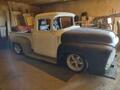
Here is the cab that I am currently building, as you can see there is a large area between the embossed strengtheners that has been filled. These areas of the cab are notorious for being low and/or warped. The decision is yours as to how crazy you want to get with working the metal before you prep for paint. Good luck...
I have attended workshops with Ron Covell and watched him beat a huge dent into a sheet of steel and then work it back out again. It was impressive but as he cautioned, the sheet he was using was not connected to any other body panels so there was no restriction on how much he could "move" the metal. Over-worked metal is thinner than it was when it was manfactured...there is not much you can do to pull it back in, especially if it is a large area.
If I were in your position (and I HAVE been in the past) I would fill the low area of the panel and move on. That section of the cab is hidden by the bed on the outside and behind the seat (and usually a layer of insulation/upholstery) on the inside.
Here is the cab that I am currently building, as you can see there is a large area between the embossed strengtheners that has been filled. These areas of the cab are notorious for being low and/or warped. The decision is yours as to how crazy you want to get with working the metal before you prep for paint. Good luck...

Fleet Owner

Joined: Jul 2004
Posts: 27,294
Likes: 1,055
From: NM
I don't think you want to be hammering on hot metal, it will only stretch it as Charlie pointed out. Heating should be for quenching, to shrink. Then when it's cool, work it if needed. If you can weld, just cut that whole section out.
Hotshot
Joined: Nov 2000
Posts: 11,591
Likes: 14
From: Pflugerville, tx
Metal can be over-worked. Many novices are unaware of the distinction between "on-dolly" and "off-dolly" hammer techniques. I can't presume to know if you fall into this category but suffice it to say that if you hammer "on-dolly" you will stretch the metal. Heat will only shrink the metal so far and should only be used as a last resort to pull in the smallest areas. Once you have used heat on an area you are for all intents and purposes done.
I have attended workshops with Ron Covell and watched him beat a huge dent into a sheet of steel and then work it back out again. It was impressive but as he cautioned, the sheet he was using was not connected to any other body panels so there was no restriction on how much he could "move" the metal. Over-worked metal is thinner than it was when it was manfactured...there is not much you can do to pull it back in, especially if it is a large area.
If I were in your position (and I HAVE been in the past) I would fill the low area of the panel and move on. That section of the cab is hidden by the bed on the outside and behind the seat (and usually a layer of insulation/upholstery) on the inside.
Here is the cab that I am currently building, as you can see there is a large area between the embossed strengtheners that has been filled. These areas of the cab are notorious for being low and/or warped. The decision is yours as to how crazy you want to get with working the metal before you prep for paint. Good luck...
I have attended workshops with Ron Covell and watched him beat a huge dent into a sheet of steel and then work it back out again. It was impressive but as he cautioned, the sheet he was using was not connected to any other body panels so there was no restriction on how much he could "move" the metal. Over-worked metal is thinner than it was when it was manfactured...there is not much you can do to pull it back in, especially if it is a large area.
If I were in your position (and I HAVE been in the past) I would fill the low area of the panel and move on. That section of the cab is hidden by the bed on the outside and behind the seat (and usually a layer of insulation/upholstery) on the inside.
Here is the cab that I am currently building, as you can see there is a large area between the embossed strengtheners that has been filled. These areas of the cab are notorious for being low and/or warped. The decision is yours as to how crazy you want to get with working the metal before you prep for paint. Good luck...
Sam
Trending Topics
Thread Starter
|
Senior User
Joined: Jul 2009
Posts: 370
Likes: 0
From: Stony Plain,AB Canada
I know I'm in a bad place, but 3/8" filler is way too much for me. I know it's behind the box and it doesen't have to be perfect but.... It's a funny thing on how people deal with shrinking with heat, some say to just heat and quench, working with this metal when cool. Some have told me to get it cherry red and make intent in the middle and work the metal to the center while hot then quench. Using both of these methods has me in this position. The metal is now harder than the surrounding metal so its impossible to work.
If i was to remove the metal should it be just hardened portion or more? Secondly by cutting and x in the metal work then weld would this not work?
Still mad at myself!!!
If i was to remove the metal should it be just hardened portion or more? Secondly by cutting and x in the metal work then weld would this not work?
Still mad at myself!!!
FTE Stories
Ford Trucks for Ford Truck Enthusiasts

10 Things Every Truck Owner NEEDS (2026 Edition)
Michael S. Palmer
Rezvani's Latest Post-Apocalytic Monster Is a Ford F-150 Raptor Underneath
Verdad Gallardo
Top 10 Most Expensive Ford Trucks Ever Sold on Bring a Trailer
Joe Kucinski
2027 Ford Super Duty Buyer's Guide (Every Model, Engine, & Package)
Brett Foote
Top 10 Ford Truck Tragedies
Joe Kucinski
AEV FXL Super Duty - the Super Duty Raptor Ford Doesn't Make
Brett Foote
Lobo Vs Lobo: Proof the F-150 Lobo Should Be Even Lower!
Michael S. Palmer
Ford's 2001 Explorer Sportsman Concept Looks For a New Home
Verdad Gallardo
10 Best Ford Truck Engines We Miss the Most!
Joe Kucinski
Lead Driver
Joined: Aug 2006
Posts: 8,093
Likes: 653
From: Brentwood, TN
If it is bothering you that much ***** then what I would suggest is that you cut out the offending area and make a filler panel to weld in. I would suggest that you educate yourself on a technique called "hammer welding"...you may already know of this technique, it involves gas welding a seam and then hammer & dollying the weld joint to spread it back out and compensate for the normally occuring shrinkage. You cannot do this with a MIG because the MIG bead becomes brittle when hammered and will fail. Here is a photo I took of Gene Winfield at a workshop that I attended in Austin, TX...he is hammer welding a panel into the top of a 35 Pontiac that we just chopped. When done correctly there is very little filler needed and the seam is virtually invisible after light sanding. This is an art that is not mastered in a few minutes but if you have the stomach for it then it is worth the effort to learn.
Thread Starter
|
Senior User
Joined: Jul 2009
Posts: 370
Likes: 0
From: Stony Plain,AB Canada
Thanks for the tips Charlie but I don't have access to any gas welding equipment here. I will try and remove the stress on the panel by cross cutting and if that dosen't do it, I will cut out the area and weld in a patch VERY carefully and take my time. 
I think I may have gotten in a hurry to get the back of the cab done as all the rest of the truck are new pieces and kinda anxious to bolt them on ....it's be along time coming.
I think I may have gotten in a hurry to get the back of the cab done as all the rest of the truck are new pieces and kinda anxious to bolt them on ....it's be along time coming.
Cargo Master
Joined: Sep 2004
Posts: 2,906
Likes: 82
From: Oregon
If you need a rear wall section, I have a junk cab here that I can take a slice out of. Keep us posted on your progress, and PM me if you need a panel sliced. I don't cut 'em out with a torch, I use a cut off wheel, so I just need a rough measurement.
Thread Starter
|
Senior User
Joined: Jul 2009
Posts: 370
Likes: 0
From: Stony Plain,AB Canada
Dumb question here, is it possible that I have shrunk this area too much causing the greater deflection?
Lead Driver
Joined: Aug 2006
Posts: 8,093
Likes: 653
From: Brentwood, TN
It's not that you have shrunk it too much, the metal has been stretched too much.
This is why I posed the question earlier about on-dolly vs off-dolly techniques. Everytime you hit the metal with the dolly directly behind where the hammer makes contact you are compressing the metal...it is no longer as thick, so it wants to stretch out. Get a picture in your mind of a pizza guy rolling out dough, he starts out with a small ball and keeps compressing it til it becomes a large disk. Metal is not as malleable as pizza dough but it works on the same principle.
Heat will cause to metal to shrink somewhat but you can never add enough heat to shrink compressed metal back to its original state. Furthermore, adding heat causes the metal to transform on a molecular level causing it to become brittle and lose its ability to "move".
There are many videos available that demonstrate these principles much better than I can in a short post...Ron Covell has a line of metalworking DVDs that cover everything from the basics to the most advanced. I find that for me I am more successful when I understand all the "whys" before I have to ask the WTFs so I rely considerably on the how-to videos.
This is why I posed the question earlier about on-dolly vs off-dolly techniques. Everytime you hit the metal with the dolly directly behind where the hammer makes contact you are compressing the metal...it is no longer as thick, so it wants to stretch out. Get a picture in your mind of a pizza guy rolling out dough, he starts out with a small ball and keeps compressing it til it becomes a large disk. Metal is not as malleable as pizza dough but it works on the same principle.
Heat will cause to metal to shrink somewhat but you can never add enough heat to shrink compressed metal back to its original state. Furthermore, adding heat causes the metal to transform on a molecular level causing it to become brittle and lose its ability to "move".
There are many videos available that demonstrate these principles much better than I can in a short post...Ron Covell has a line of metalworking DVDs that cover everything from the basics to the most advanced. I find that for me I am more successful when I understand all the "whys" before I have to ask the WTFs so I rely considerably on the how-to videos.


Thread
Thread Starter
Forum
Replies
Last Post
