



Oil Pump Clearance Test
Thread Starter
|
Laughing Gas

Joined: Aug 2008
Posts: 840
Likes: 8
Oil Pump Clearance Test
This is just a little tidbit of info that I find interesting. I recently had my oil pan off and decided to mix and match parts in my oil pump to see what would happen.
As you can see from the chart below, I went from a loose tolerance pump (#1) and went to a tighter tolerance pump (#2) by using different gerotor parts, but the same housing and relief valve.
Also, Pump 1 had some scratches and scuffing on the lobes of the rotors. Pump 2 did not.
I did a test drive, and once the oil was up to temp, I checked the oil pressure at idle, at 2000 rpm and at max pressure. In all cases, the oil pressure was exactly the same with Pump 2 as it was with Pump 1.
My conclusion is an oil pump can wear a bit, or even get minor scratches from debris, yet still provide oil pressure as usual.
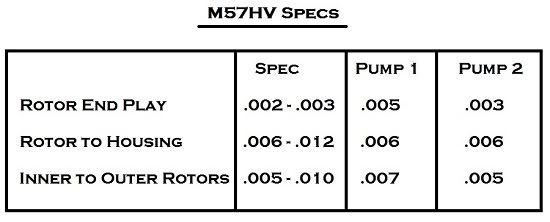
As you can see from the chart below, I went from a loose tolerance pump (#1) and went to a tighter tolerance pump (#2) by using different gerotor parts, but the same housing and relief valve.
Also, Pump 1 had some scratches and scuffing on the lobes of the rotors. Pump 2 did not.
I did a test drive, and once the oil was up to temp, I checked the oil pressure at idle, at 2000 rpm and at max pressure. In all cases, the oil pressure was exactly the same with Pump 2 as it was with Pump 1.
My conclusion is an oil pump can wear a bit, or even get minor scratches from debris, yet still provide oil pressure as usual.

FTE Leadership Emeritus


Joined: Jul 2002
Posts: 42,562
Likes: 423
From: Long Island USA


Good info though. The pump is usually NOT the issue with pressure, it's the bearing clearances AND rocker shaft clearances that all add up to a big gaping hole.
And, pushing the oil through the filter doesn't help pressure neither.
Thread Starter
|
Laughing Gas
Joined: Aug 2008
Posts: 840
Likes: 8
LOL. Yep, me and experimentation!
First of all, it is a HV pump, and I have done some oiling mods which include opening the passage from the pump to the filter, alignment of some of the main bearing holes, plugging off the lifter galleries (am running solid lifters) and restrcting oil to the rocker shafts. I am also running 0.0025" main and rod bearing clearances.
My engine yields the following (hot) oil pressures:
800 rpm idle 13 psi
2000 rpm 43 psi
max pressure when relief valve opens 85 psi
I can get about 2 psi more when I use my System 1 oil filter compared to the M301 I am currently using. By the way, the M301 is the least restrictive paper oil filter I've found to date.
My experiment was to see if I could reduce the little dip (red-line) that occurs at lower rpms in hte chart below, thus raising the oil pressure at idle a little bit, but there was no change.

Sort of makes me wonder what good blueprinting an oil pump does, other than changing the relief spring. All that end play clearance adjustment and de-burring they do... perhaps the deburring helps keep the oil from becoming aerated, but so far, it seems spending money on a blue-printed pump isn't worthwhile.
First of all, it is a HV pump, and I have done some oiling mods which include opening the passage from the pump to the filter, alignment of some of the main bearing holes, plugging off the lifter galleries (am running solid lifters) and restrcting oil to the rocker shafts. I am also running 0.0025" main and rod bearing clearances.
My engine yields the following (hot) oil pressures:
800 rpm idle 13 psi
2000 rpm 43 psi
max pressure when relief valve opens 85 psi
I can get about 2 psi more when I use my System 1 oil filter compared to the M301 I am currently using. By the way, the M301 is the least restrictive paper oil filter I've found to date.
My experiment was to see if I could reduce the little dip (red-line) that occurs at lower rpms in hte chart below, thus raising the oil pressure at idle a little bit, but there was no change.
Sort of makes me wonder what good blueprinting an oil pump does, other than changing the relief spring. All that end play clearance adjustment and de-burring they do... perhaps the deburring helps keep the oil from becoming aerated, but so far, it seems spending money on a blue-printed pump isn't worthwhile.
Thread Starter
|
Laughing Gas
Joined: Aug 2008
Posts: 840
Likes: 8
Top end uses Crane adj rockers (non-roller), Harland Sharpe single hole rocker shafts and FPP center and end support stands. Only about 5500 miles on all parts.
If by clearance, you mean rocker shaft to rocker arm clearance, I never checked it, but they arn't loose and seem to fit appropriately.
This is my 3rd engine, all with the same oil pressure. First block cracked, second engine destroyed a piston (I adjusted timing IAW a slipped balancer. $$$ mistake).
I've used both home-made 0.090" restrictors and am currently using FPP restrictors. No difference that I can recall.
I've never run the engine with a valve cover off as it's quite messy. During a moment of ruthlessness, I threw out some old valve covers I could have used by cutting a section out of the top so I could see, yet most oil would stay contained.
Over the years, I've been checking around various forums and find quite a number of people have similiar oil pressure as I do. Yet many others have higher hot idle oil pressure.
But there's so many variables. Some cams require an idle of 1000 rpms or higher, so their idle oil pressure is higher. Some check the hot idle oil pressure before the engine is truly up to temp (it takes longer for the oil temp to rise than the water temp, so for those going by a water temp gauge, they could get higher readings). And viscosity and type of oil plays a small part. I can get a few more psi with 20W50 dino oil than with 15W50 Mobil 1.
However, I think my pressure is almost entirely due to bearing clearances. If a customer doesn't specify, I have no doubt many engines are rebuilt to stock specs, which have a wide range and can allow for very tight clearances.
Anyway, I thought it interesting enough to post my results. Might be of interest to others.
If by clearance, you mean rocker shaft to rocker arm clearance, I never checked it, but they arn't loose and seem to fit appropriately.
This is my 3rd engine, all with the same oil pressure. First block cracked, second engine destroyed a piston (I adjusted timing IAW a slipped balancer. $$$ mistake).
I've used both home-made 0.090" restrictors and am currently using FPP restrictors. No difference that I can recall.
I've never run the engine with a valve cover off as it's quite messy. During a moment of ruthlessness, I threw out some old valve covers I could have used by cutting a section out of the top so I could see, yet most oil would stay contained.
Over the years, I've been checking around various forums and find quite a number of people have similiar oil pressure as I do. Yet many others have higher hot idle oil pressure.
But there's so many variables. Some cams require an idle of 1000 rpms or higher, so their idle oil pressure is higher. Some check the hot idle oil pressure before the engine is truly up to temp (it takes longer for the oil temp to rise than the water temp, so for those going by a water temp gauge, they could get higher readings). And viscosity and type of oil plays a small part. I can get a few more psi with 20W50 dino oil than with 15W50 Mobil 1.
However, I think my pressure is almost entirely due to bearing clearances. If a customer doesn't specify, I have no doubt many engines are rebuilt to stock specs, which have a wide range and can allow for very tight clearances.
Anyway, I thought it interesting enough to post my results. Might be of interest to others.
FTE Leadership Emeritus
Joined: Jul 2002
Posts: 42,562
Likes: 423
From: Long Island USA
Trending Topics
Posting Guru
Joined: Dec 2009
Posts: 2,134
Likes: 1
From: Mississippi
My stock 360 with 20w-50 idles hot about 25 psi, at speed around 55-60 psi. With 15w-40 was like 10 psi and 35 psi. I'm not sure if this is a good thing or not, it make you feel good looking at the guages but not so sure if I'm really getting any benefit or even if there may be some detriment to the engine.....
FTE Stories
Ford Trucks for Ford Truck Enthusiasts

Top 6 Best Deals Available on New Fords & Lincolns Right Now
Brett Foote
This Hennessey Takes the Expedition Tremor's Off-Roading Capability to the Next Level
Verdad Gallardo
Top 10 Fords at 2026 Carlisle Ford Nationals
Joe Kucinski
3 Best / 3 Worst Parts of Modern Ford Ownership
Brett Foote
10 Amazing Upgrades That Solve Common Ford Truck Owner Headaches
Pouria Savadkouei
Every 2026 Ford Engine Explained
Brett Foote
10 Ugly Ford Trucks That We Still Kinda Love
Joe Kucinski
10 Things Every Truck Owner NEEDS (2026 Edition)
Michael S. Palmer
Rezvani's Latest Post-Apocalyptic Monster Is a Ford F-150 Raptor Underneath
Verdad Gallardo
Fleet Mechanic
Joined: Nov 2010
Posts: 1,501
Likes: 1
From: Axtell, TX
Interesting results. I would think you would have a little higher hot idle psi than 13 even with .0025 clearance with the HV pump. I haven't put one together that loose though so it's interesting to me to see the difference between the two.
The 445ci is at .0015, restricted w/#80 jets, opening up filter to pump to 7/16th, lining up bearing holes, with the HV pump, and I get a hot idle (850rpm) of 45psi and about 60-70psi at cruise (2000-2400rpm). A max of 80psi (bypass) at high rpm. This is with a thinner 10w30 oil too. Quite the difference between the two! Good info.
The 445ci is at .0015, restricted w/#80 jets, opening up filter to pump to 7/16th, lining up bearing holes, with the HV pump, and I get a hot idle (850rpm) of 45psi and about 60-70psi at cruise (2000-2400rpm). A max of 80psi (bypass) at high rpm. This is with a thinner 10w30 oil too. Quite the difference between the two! Good info.

Thread
Thread Starter
Forum
Replies
Last Post
Argess
FE & FT Big Block V8 (332, 352, 360, 390, 406, 410, 427, 428)
14
Aug 23, 2008 07:42 PM
houlis
1980 - 1986 Bullnose F100, F150 & Larger F-Series Trucks
2
Oct 24, 2005 02:31 PM
