


Electrical problem

Thread Starter
|
Lead Driver


Joined: Mar 2004
Posts: 8,922
Likes: 153
Electrical problem
I have a wierd electrical problem in my girl friends mobile home. The digital alarm clock in her bedroom runs fast when it's pluged into this one outlet behind the bed. It gains about 2 or 3 minutes a day. I plugged the clock into a different outlet and it doesn't gain any time but just to be sure she bought another one and it runs fast too plugged into that outlet. I put a new receptacle in and it still doe's it. Any ideas ?

Hotshot
Joined: Apr 2006
Posts: 11,794
Likes: 0
From: Kansas City, KS
I just read about something similar occurring elsewhere...check the voltage of the outlet for variation. Apparently, if the AC isn't "clean" enough, the Alternating Current will have an effect on digital clocks.
Assuming that you find too much variance in just THAT ONE outlet, I wouldn't worry about it, just plug in the clock elsewhere.
If you find an entire circuit varying too greatly, you might want to consider calling an electrician.
Good luck.
Assuming that you find too much variance in just THAT ONE outlet, I wouldn't worry about it, just plug in the clock elsewhere.
If you find an entire circuit varying too greatly, you might want to consider calling an electrician.
Good luck.

Lead Driver
Joined: Aug 2006
Posts: 5,259
Likes: 17
From: Gambrills

I know the hertz can reek havoc on digital clocks but it is wierd that it is only on one circuit. I would try to tighten the wire in the breakerbox and see if that helped. If you bring a "American" clock to Eroupe and plug it in to a transformer (220 to 110v) it will run slow b/c they use 50 htz and we use 60 htz. In this case it sounds like it is churning out more than 60 (if that is the problem). Is there a switch on the clock to switch from 220v 50htz to 110v 60 htz?

FTE Legend


Joined: Jul 2005
Posts: 65,938
Likes: 1,432
From: Millersville, MD
He put two different clocks in that one outlet...both ran fast......
You need to go to the breaker panel and put a freq counter on the different in lines.... a lot of inexpensive multimeters now have frequency on them. I know Radio Shack does....
I agree that it's really weird that only ONE leg circuit in the house does this!
You need to go to the breaker panel and put a freq counter on the different in lines.... a lot of inexpensive multimeters now have frequency on them. I know Radio Shack does....
I agree that it's really weird that only ONE leg circuit in the house does this!

Postmaster
Joined: Mar 2001
Posts: 4,968
Likes: 3
From: So Cal
Could also be something on that circuit that generates noise. If you had an oscilloscope you could probably track it down. Or cheapman's method would be to unplug everything on that circuit and see if it goes away, then see what appliance makes it come back.
Another method to find noise would be to plug in a cheap AM radio using a powercord. Usually they will buzz on noisy circuits.
If you don't find any particular appliance making the noise, then I would suspect some dirty connection somewhere between the junction box and the plug. This could be a problem since dirty connections can overheat and cause other problems, like fire. I would try to track this one down.
Be sure you really know what plugs go where. Not directly related to your problem but worth considering for the future... Some of the modern homes have wiring that is bizzare to say the least. Our 2004 home has one circuit that goes into the garage, into the upstairs laundry room, two bedrooms, a bathroom, a plug in the hallway and I think the socket on the back porch. Always fun trying to figure out which plug caused the breaker to trip. There are one or two other circuits that go to strange places in the house often on opposited sides. It is a PITA, but it may be worthwhile to trace each and every plug to the breaker that controls it and make a map. This will save you tons of irritation in the future. Ditto the Ground fault Interruptors, what a PITA.
Interesting that the newer digital clocks are affected by noise. Back in the "old days" I think they had crystal oscillators or at least a stable oscillator circuit to generate the time pulses. You could use the Ac frequency on the line as a cheap time reference as long as it was stable(maybe not in the future according to news reports) and noise free.
Just my thoughts.
Jim Henderson
Another method to find noise would be to plug in a cheap AM radio using a powercord. Usually they will buzz on noisy circuits.
If you don't find any particular appliance making the noise, then I would suspect some dirty connection somewhere between the junction box and the plug. This could be a problem since dirty connections can overheat and cause other problems, like fire. I would try to track this one down.
Be sure you really know what plugs go where. Not directly related to your problem but worth considering for the future... Some of the modern homes have wiring that is bizzare to say the least. Our 2004 home has one circuit that goes into the garage, into the upstairs laundry room, two bedrooms, a bathroom, a plug in the hallway and I think the socket on the back porch. Always fun trying to figure out which plug caused the breaker to trip. There are one or two other circuits that go to strange places in the house often on opposited sides. It is a PITA, but it may be worthwhile to trace each and every plug to the breaker that controls it and make a map. This will save you tons of irritation in the future. Ditto the Ground fault Interruptors, what a PITA.
Interesting that the newer digital clocks are affected by noise. Back in the "old days" I think they had crystal oscillators or at least a stable oscillator circuit to generate the time pulses. You could use the Ac frequency on the line as a cheap time reference as long as it was stable(maybe not in the future according to news reports) and noise free.
Just my thoughts.
Jim Henderson

Hotshot
Joined: Feb 2003
Posts: 11,537
Likes: 27
From: Long Beach, Ms.
Amazon.com: TRC AECM20020-3-012 Electra Check Digital Monitor for all AC Power Sources, Black with White Face: Home Improvement
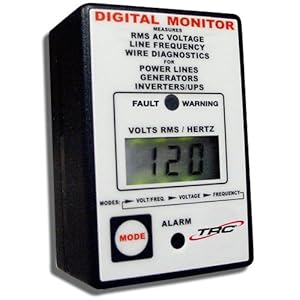
One of these will tell you what is going on with the electric supply.
I have one for use at campgrounds where I take my RV.
Poor power will kill the electronics (TVs, Computers, refrigerator).
You simply plug it into an outlet to see the voltage or frequency.
One of these will tell you what is going on with the electric supply.
I have one for use at campgrounds where I take my RV.
Poor power will kill the electronics (TVs, Computers, refrigerator).
You simply plug it into an outlet to see the voltage or frequency.
Thread Starter
|
Lead Driver
Joined: Mar 2004
Posts: 8,922
Likes: 153
Thanks, I'll try finding everything on that circut and unplug anything on there and see what happens next. What does that meter cost ?
Trending Topics

Cargo Master

Joined: Apr 2003
Posts: 3,476
Likes: 224
From: Frequently frozen MN
It is more than likely noise that's getting into that line. It might be from some kind of an electric heater or an air conditioner. So, you might not find it by unplugging.
You could plug an am radio into that outlet and tune it between stations. See if it sounds noisier than it does on other outlets.
It is worth taking a careful look at the circuit breakers, just to make sure that there are no loose connections. Again, please be careful. 110 volts has killed a lot of people.
If everything else in the trailer works OK, it might be more trouble to fix than it's worth. If it's not convenient to use another outlet, there are a lot of battery powered alarm clocks. Since they generally use crystal oscillators, they're pretty accurate.
Good Luck,
hj
You could plug an am radio into that outlet and tune it between stations. See if it sounds noisier than it does on other outlets.
It is worth taking a careful look at the circuit breakers, just to make sure that there are no loose connections. Again, please be careful. 110 volts has killed a lot of people.
If everything else in the trailer works OK, it might be more trouble to fix than it's worth. If it's not convenient to use another outlet, there are a lot of battery powered alarm clocks. Since they generally use crystal oscillators, they're pretty accurate.
Good Luck,
hj
FTE Stories
Ford Trucks for Ford Truck Enthusiasts

3 Best / 3 Worst Parts of Modern Ford Ownership
Brett Foote
10 Amazing Upgrades That Solve Common Ford Truck Owner Headaches
Pouria Savadkouei
Every 2026 Ford Engine Explained
Brett Foote
10 Ugly Ford Trucks That We Still Kinda Love
Joe Kucinski
10 Things Every Truck Owner NEEDS (2026 Edition)
Michael S. Palmer
Rezvani's Latest Post-Apocalyptic Monster Is a Ford F-150 Raptor Underneath
Verdad Gallardo
Top 10 Most Expensive Ford Trucks Ever Sold on Bring a Trailer
Joe Kucinski
2027 Ford Super Duty Buyer's Guide (Every Model, Engine, & Package)
Brett Foote
Top 10 Ford Truck Tragedies
Joe Kucinski
Fleet Owner
Joined: Aug 2001
Posts: 29,941
Likes: 46
From: Drummonds, TN USA
What I want to know is where that circuit gets it's power
What junction boxes are along that line - and does a clock connected farther back along it have problems?
HOW is it different than the other outlets, does it come from a different line at the power panel?
I too pack a voltage and freq meter like that - it was mainly for checking generator hookups because they can get out of phase and play all kinds of havoc.
On a Winnebago recently I spotted a circuit that read "Phase Inverted" (different but similar bug) which meant the phase and neutral of an outlet were reversed, right?
So I rewired the main shoreplug, swapping the two wires one for one. Guess what? It still read the same... (& we put the plug back like it was)
Many RV power supplies (inverters and convertors) have phase and cycle control circuits that can not only be adjusted, but also get miswired or just plain out of whack
They also contain noise filter circuits. To turn A/C into DC is simple, to turn DC into A/C you have to have an oscillator circuit to drive a set of power transistors. THAT can set up a wierd harmonic in nearby wiring, especially if the phase of the inverter is slightly off from local line voltage.
There should be several outlets from it, each with its own noise filter. Maybe that's what failed, one of the output filters.
But should it be running when plugged into shore? Can you shut down your invertor when plugged into local power, or does it manage it automatically?
OR does it just RUN all the time because it was simpler to build it that way...
*Many systems automatically detect the presense of 115 A/C or that the coach is stationary (in park, legs extended, automatic steps extended, awning out, etc...)
See, in most systems, the invertor runs off the house batteries. The CONvertor not only supplies 12VDC everywhere - it charges up those very same batteries.
Except for interference between local line, and the invertor output, there's no reason really to shut it down except to save it.
~So it could easily be running any time the house batteries are turned on unless the breaker for it is cut off.
What junction boxes are along that line - and does a clock connected farther back along it have problems?
HOW is it different than the other outlets, does it come from a different line at the power panel?
I too pack a voltage and freq meter like that - it was mainly for checking generator hookups because they can get out of phase and play all kinds of havoc.
On a Winnebago recently I spotted a circuit that read "Phase Inverted" (different but similar bug) which meant the phase and neutral of an outlet were reversed, right?
So I rewired the main shoreplug, swapping the two wires one for one. Guess what? It still read the same... (& we put the plug back like it was)
Many RV power supplies (inverters and convertors) have phase and cycle control circuits that can not only be adjusted, but also get miswired or just plain out of whack
They also contain noise filter circuits. To turn A/C into DC is simple, to turn DC into A/C you have to have an oscillator circuit to drive a set of power transistors. THAT can set up a wierd harmonic in nearby wiring, especially if the phase of the inverter is slightly off from local line voltage.
There should be several outlets from it, each with its own noise filter. Maybe that's what failed, one of the output filters.
But should it be running when plugged into shore? Can you shut down your invertor when plugged into local power, or does it manage it automatically?
OR does it just RUN all the time because it was simpler to build it that way...
*Many systems automatically detect the presense of 115 A/C or that the coach is stationary (in park, legs extended, automatic steps extended, awning out, etc...)
See, in most systems, the invertor runs off the house batteries. The CONvertor not only supplies 12VDC everywhere - it charges up those very same batteries.
Except for interference between local line, and the invertor output, there's no reason really to shut it down except to save it.
~So it could easily be running any time the house batteries are turned on unless the breaker for it is cut off.
Fleet Owner
Joined: Aug 2001
Posts: 29,941
Likes: 46
From: Drummonds, TN USA
(accidental double post - so I might as well use it)
The same Mini-Winny had an outlet the owner couldn't figure out. It never had power on it...
I traced it through three junction boxes to the far side of the coach. In a compartment by the house door, there was a rolled up fifty foot plain old extension cord next to a J-box with a pigtail and a regular household extension cord plug on the end of it...
No breakers, no nada. You never KNOW what you will find in an RV, because people do all kinds of stuff to them constantly
*and some of it ain't recommended
The general rule of thumb is: if it's older than ten years, a wiring diagram would be useless anyway. TRUST only what you see for yourself
PS: Come to think of it, it's a lot like working on an AWACs bird...
The same Mini-Winny had an outlet the owner couldn't figure out. It never had power on it...
I traced it through three junction boxes to the far side of the coach. In a compartment by the house door, there was a rolled up fifty foot plain old extension cord next to a J-box with a pigtail and a regular household extension cord plug on the end of it...
No breakers, no nada. You never KNOW what you will find in an RV, because people do all kinds of stuff to them constantly
*and some of it ain't recommended
The general rule of thumb is: if it's older than ten years, a wiring diagram would be useless anyway. TRUST only what you see for yourself
PS: Come to think of it, it's a lot like working on an AWACs bird...

FTE Legend
Joined: May 2008
Posts: 56,542
Likes: 0
From: In my own world
some mobile homes have aluminum wire. check that the connections on the outlet and breaker are both tight, the aluminum wire comes loose after a while, and makes things act all crazy. Mine eventually caught fire because of it, and burned to the ground while I was at work
Fleet Owner
Joined: Aug 2001
Posts: 29,941
Likes: 46
From: Drummonds, TN USA
You don't want aluminum wire in anything - it has too high an incidence of thermal runaway - which is what causes a lot of fires with it.
Homes in California do not pass local code if they have it in them. It's a recognised fire safety issue in older homes from the sixties when aluminum first became popular.
Of course, the other notion I had was that if time slows down in your bed...
WHAT THE HELL ARE YOU COMPLAINING ABOUT???
Homes in California do not pass local code if they have it in them. It's a recognised fire safety issue in older homes from the sixties when aluminum first became popular.
Of course, the other notion I had was that if time slows down in your bed...
WHAT THE HELL ARE YOU COMPLAINING ABOUT???
Thread Starter
|
Lead Driver
Joined: Mar 2004
Posts: 8,922
Likes: 153
I haven't came across any aluminum wire in it and her and I pretty much rebuilt the whole trailer, put 12 sheets of plywood in the flooring. Why they don't use 3/4 plywood in the floors I can't figure and it's been a real pain to fix because it's all 7/8 press board. We had to shim up every piece we put down. They should also use treated in the bathrooms but I guess that would be asking for too much. It's a 2 bed room 2 full bath '85 Windsor 14x70 with a 8x20 pull out. I did find a cable staple drove right through a wire in the roof of the pull out, how it didn't hit the hot wire inside the cable was nothing short of amazing.

Thread
Thread Starter
Forum
Replies
Last Post
e1p1
General NON-Automotive Conversation
10
Apr 13, 2006 08:53 PM
sierraben
General NON-Automotive Conversation
11
Jul 4, 2005 03:52 PM
