


MPG and setups?
Senior User
Joined: Apr 2010
Posts: 368
Likes: 3
From: Loganville, Ga
Megasquirt is a system that you can get prebuilt or you can assemble. The computer is blank meaning you have to program it yourself. Now there are forums out there with people who share their programs so you can get one without starting from scratch. You have to set and adjust everything.
Powerjection is a ready to go system that "looks" like a 4bbl carb. Everything is contained in the throttle body. It's meant for folks who want an EFI system for an older vehicle but want it to look stock. The injectors are hidden inside the fuel bowls. The computer is preprogramed and on the side of the unit. It is also a learning computer. You answer a few questions with your laptop PC plugged in and that's all. It learns your driving habbits and adjust itself.
With both systems you have to install 2 or 3 sensors but that's easy. And the fuel pump and lines wasn't to hard either. I have heard good things about both systems. My problem was the DUI distributor. The Prowerjection computer needs a Tach signal to fire the injectors, but the DUI does not put out a Tach signal until a couple of seconds after the engine starts. In fairness Performance Distributors can fix the DUI by replacing a module. But I had to pull the unit and ship it back to them. It was $220 plus round trip shipping. So I decided to return the EFI system and go carb for now.
Powerjection is a ready to go system that "looks" like a 4bbl carb. Everything is contained in the throttle body. It's meant for folks who want an EFI system for an older vehicle but want it to look stock. The injectors are hidden inside the fuel bowls. The computer is preprogramed and on the side of the unit. It is also a learning computer. You answer a few questions with your laptop PC plugged in and that's all. It learns your driving habbits and adjust itself.
With both systems you have to install 2 or 3 sensors but that's easy. And the fuel pump and lines wasn't to hard either. I have heard good things about both systems. My problem was the DUI distributor. The Prowerjection computer needs a Tach signal to fire the injectors, but the DUI does not put out a Tach signal until a couple of seconds after the engine starts. In fairness Performance Distributors can fix the DUI by replacing a module. But I had to pull the unit and ship it back to them. It was $220 plus round trip shipping. So I decided to return the EFI system and go carb for now.

Postmaster
Joined: Mar 2005
Posts: 2,949
Likes: 6
From: Earth
Nobody believes me when I say it, but carb size is not that big a deal. A 390cfm carb isn't necessarily going to get better mileage or have less power than a 750cfm. Especially if you're talking about vacuum secondaries. With time and the right tools just about any carb can be made to run fine on a 300. Get a wideband O2 sensor, vacuum gauge, and tach then get someone to log data while you drive.
I'd also wager a lot of carb problems would get better once a pro put the distributor on a Sun machine and dialed in the curve.
Thread Starter
|
Lead Driver


Joined: Mar 2008
Posts: 7,182
Likes: 380
From: Near Los Angeles
[quote=BaronVonAutomatc;10866850]There really shouldn't be any "kick" when the rods come up or the secondaries come on, if there is you're too lean on the primary side.
Technically that would apply to any vacuum secondary Holley derivative or Edelbrock carb as well.
[quote=BaronVonAutomatc;10866850]There really shouldn't be any "kick" when the rods come up or the secondaries come on, if there is you're too lean on the primary side.
What I mean by kick is you can feel an increase in power, as in every car I've ever driven. If you know the feel of your vehicle/engine, no matter how smooth the transition, you will always feel the power increase, lean, perfect or indifferent on the primaries.
Technically that would apply to any vacuum secondary Holley derivative or Edelbrock carb as well. To a point. However, the Eddy secondary flap is not adjustable, nor are there secondary metering rods. With the QJ everything is adjustable. Not only are there s. m.rods, but the cam which raises them can be changed, as the rod size can. Also, the s. air flap tension can be dialed in to any engine, depending on the size.
Technically that would apply to any vacuum secondary Holley derivative or Edelbrock carb as well.
[quote=BaronVonAutomatc;10866850]There really shouldn't be any "kick" when the rods come up or the secondaries come on, if there is you're too lean on the primary side.
What I mean by kick is you can feel an increase in power, as in every car I've ever driven. If you know the feel of your vehicle/engine, no matter how smooth the transition, you will always feel the power increase, lean, perfect or indifferent on the primaries.
Technically that would apply to any vacuum secondary Holley derivative or Edelbrock carb as well. To a point. However, the Eddy secondary flap is not adjustable, nor are there secondary metering rods. With the QJ everything is adjustable. Not only are there s. m.rods, but the cam which raises them can be changed, as the rod size can. Also, the s. air flap tension can be dialed in to any engine, depending on the size.
Postmaster
Joined: Mar 2005
Posts: 2,949
Likes: 6
From: Earth
Well when you get that Q-jet up and running I'll make you the same offer I made AB - you can borrow my wideband O2 sensor to help map some data and get it dialed in. Let me know if/when you're interested.

Post Fiend
Joined: Oct 2009
Posts: 8,674
Likes: 0
From: town of less than 200 ppl
1995 F150 4x4 supercab/shortbox. 4.9l I6/m5od trans. with 3.55 gears&285/75r16 tires on aftermarket aluminum 16" rims. When I was driving ~28 miles one-way to school I was getting 15-16 mpg, now that I only drive ~5 miles a day in town I am getting about 11-12 mpg.
Post Fiend
Joined: Oct 2009
Posts: 8,674
Likes: 0
From: town of less than 200 ppl
Also forgot to add that I have a 4 inch suspension lift kit by Rough Country on the truck.
Senior User
Joined: Mar 2010
Posts: 231
Likes: 0
From: Lakeland
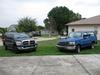
1992 Bronco Custom
EFI
M5OD
3.08 gears
Factory original with 235 tires on factory 15" rims
I get about 13-14mpg with it. That being said, I'm in the process of replacing the entire exhaust system on it including the O2 sensor since it had sat in the garage for the better part of 3 years, the OEM system began to rust a bit and fill with holes. I also suspect I need to go through and clean the rest of the emissions controls. I also need to have the clutch replaced and have the transmission gone through during that time. It's a little hard to shift at times and the Trans guy I took it too said it felt more like a clutch than a gear issue.
My FIL, who was the Original owner said he always got about 20mpg's with it but I've never been able to get that close no matter how I drove it, I always got the same thing.
EFI
M5OD
3.08 gears
Factory original with 235 tires on factory 15" rims
I get about 13-14mpg with it. That being said, I'm in the process of replacing the entire exhaust system on it including the O2 sensor since it had sat in the garage for the better part of 3 years, the OEM system began to rust a bit and fill with holes. I also suspect I need to go through and clean the rest of the emissions controls. I also need to have the clutch replaced and have the transmission gone through during that time. It's a little hard to shift at times and the Trans guy I took it too said it felt more like a clutch than a gear issue.
My FIL, who was the Original owner said he always got about 20mpg's with it but I've never been able to get that close no matter how I drove it, I always got the same thing.
FTE Stories
Ford Trucks for Ford Truck Enthusiasts

2027 Ford Super Duty Buyer's Guide (Every Model, Engine, & Package)
Brett Foote
Top 10 Ford Truck Tragedies
Joe Kucinski
AEV FXL Super Duty - the Super Duty Raptor Ford Doesn't Make
Brett Foote
Lobo Vs Lobo: Proof the F-150 Lobo Should Be Even Lower!
Michael S. Palmer
Ford's 2001 Explorer Sportsman Concept Looks For a New Home
Verdad Gallardo
10 Best Ford Truck Engines We Miss the Most!
Joe Kucinski
2026 Shelby F-150 Off-Road: Better Than a Raptor R?
Brett Foote
2027 Super Duty Carhartt Package First Look: 12 Things You NEED to Know!
Michael S. Palmer
10 Most Surprising 2026 Ford Truck Features!
Joe Kucinski

Thread
Thread Starter
Forum
Replies
Last Post
jtruck618
2015 - 2020 F150
8
Jul 31, 2016 10:38 AM
