


working truck(s)

Thread Starter
|
Fleet Mechanic
Joined: May 2005
Posts: 1,575
Likes: 11
From: Puyallup, WA
working truck(s)
Just got the truck out of the shop - after three weeks! The old PTO hydralic pump finally gave up the ghost - Good to have "babe" back! (as in the blue ox)
Thats just over 13k of 2-4" quary spalls in the box, max I have had back therre is 17,100 lbs, although normally it ranges from 12 to 14k.
41 years and still working hard!
David
<a href="http://s638.photobucket.com/albums/uu107/dmanlyr/?action=view&current=babeatwork.jpg" target="_blank"><img src="http://i638.photobucket.com/albums/uu107/dmanlyr/babeatwork.jpg" border="0" alt="Photobucket"></a>
Thats just over 13k of 2-4" quary spalls in the box, max I have had back therre is 17,100 lbs, although normally it ranges from 12 to 14k.
41 years and still working hard!
David
<a href="http://s638.photobucket.com/albums/uu107/dmanlyr/?action=view&current=babeatwork.jpg" target="_blank"><img src="http://i638.photobucket.com/albums/uu107/dmanlyr/babeatwork.jpg" border="0" alt="Photobucket"></a>
Thread Starter
|
Fleet Mechanic
Joined: May 2005
Posts: 1,575
Likes: 11
From: Puyallup, WA
It has always been a dump as far as I know - it is a old Seattle city light truck, there is yellow paint under the blue! Here is a front.
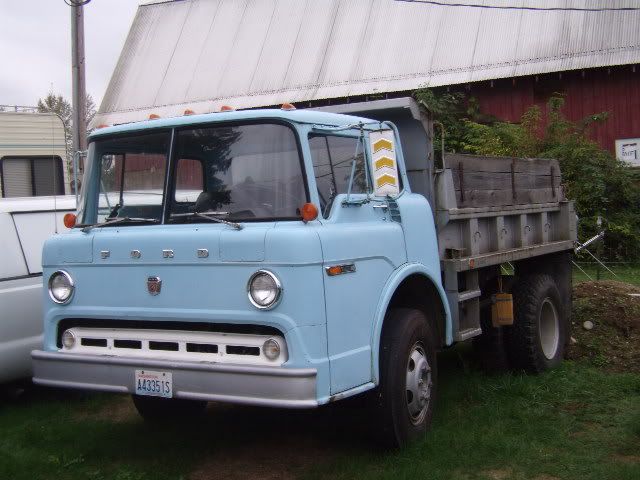
And the other side
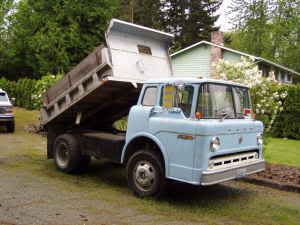
The second photo is when I bought it. Thats the for sale sign in it. David
And the other side
The second photo is when I bought it. Thats the for sale sign in it. David
Thread Starter
|
Fleet Mechanic
Joined: May 2005
Posts: 1,575
Likes: 11
From: Puyallup, WA
Thank you Krewat. Other than faded paint and the chew on the driverside lower part, it is pretty straight. Here is a picture of the drivers floor - no rust!

David
David

Posting Guru
Joined: Jan 2003
Posts: 2,181
Likes: 3
From: Eastern CT.
We had a 71' C-750 back in the early eighty's,,,,,391 engine,,,5/2, air brakes,,24 k GVW (I think),,,,man that truck RAN !! We would stack 3 cords + on her,,,take on any hill around here 3rd L,,,just pulling,,,,or 2 crushed cars on it,,,and Just toy with an International 1700 with its 401, or 4xx whatever it was,,,,I could pass him on the Highway,,,,,backoff,,,let him catch up,,,and pull away,,,was GREAT HAA !!
The Bad was the shifter went from the Dashboard to the seat when shifting it lol, No power steering,,,But I do miss that ole Girl,,,,,Memories,,,,,Them 391's Ran !!
The Bad was the shifter went from the Dashboard to the seat when shifting it lol, No power steering,,,But I do miss that ole Girl,,,,,Memories,,,,,Them 391's Ran !!
Trending Topics
Post Fiend
Joined: Jan 2007
Posts: 7,021
Likes: 5
From: Almost Heaven
David, love the truck, she looks different but I would love to drive it. What engine motivates this BEAST?
FTE Stories
Ford Trucks for Ford Truck Enthusiasts

Top 10 Most Expensive Ford Trucks Ever Sold on Bring a Trailer
Joe Kucinski
2027 Ford Super Duty Buyer's Guide (Every Model, Engine, & Package)
Brett Foote
Top 10 Ford Truck Tragedies
Joe Kucinski
AEV FXL Super Duty - the Super Duty Raptor Ford Doesn't Make
Brett Foote
Lobo Vs Lobo: Proof the F-150 Lobo Should Be Even Lower!
Michael S. Palmer
Ford's 2001 Explorer Sportsman Concept Looks For a New Home
Verdad Gallardo
10 Best Ford Truck Engines We Miss the Most!
Joe Kucinski
2026 Shelby F-150 Off-Road: Better Than a Raptor R?
Brett Foote
2027 Super Duty Carhartt Package First Look: 12 Things You NEED to Know!
Michael S. Palmer
Thread Starter
|
Fleet Mechanic
Joined: May 2005
Posts: 1,575
Likes: 11
From: Puyallup, WA
Of course that 111" wheelbase and p/s does make tight areas more comfortable.
David
Post Fiend
Joined: Jan 2007
Posts: 7,021
Likes: 5
From: Almost Heaven
I never really heard of a 330 (aside from the 5.4L modular). Can you tell me more about this engine? Bore, stroke? What power at what RPM?
If you don't I completely understand, I'm just a freak about this stuff.
- Bill
Thread Starter
|
Fleet Mechanic
Joined: May 2005
Posts: 1,575
Likes: 11
From: Puyallup, WA
Hello Bill,
It is a FT engine, same basic engines as the 361's and 391's. Off shoot of the FE engines
The 330's were available in two versions, regular and HD. The 361's & 391's were all HD
the 330's have a smaller bore than the 361, same stroke. The 361's and 391's share the same bore, but the 391's are a longer stroke.
330's were 2 barrels, 361's were either two or four barrel and the 391's were all four barrel.
As to FT & FE differences - The heads, intake manifold and exhaust manifolds are unique to the FT versions, the FT's also have a larger crank snout / balancer. The FT engines also are set up with a considerably lower compression ratio to be able to slog fully loaded up a hill without detonation/knocking/pinging. There are more differences, but these are the highlights.
According the my 1970 factory manual, the FT engines are also set up to run richer (13:1) from the factory in comparison to say the 390 at closer to a 14.5:1 air fuel ratio.
You may already know this, so hopefully I am not being too long winded - I am a nut for specs, and figuring out why the factory builds/engineeres things the way they do! Especially when it comes to medium trucks, where the duty cycle is at a much higher continuous load than the average light truck.
FYI - I have a mid 70's brochure of 18 pages on the "XD" engines that these "HD" engines morphed into, very imformative right down to the different types of piston rings used in the different size and rated engines!
Thank for asking, David - EDIT! Next post I will post hp and rpm's / bore & stroke - I reread what you posted and realized I had not answered that!
If anyone is interested in the rest of the publication - I can scan it, as long as I am not breaking any copyright laws!

It is a FT engine, same basic engines as the 361's and 391's. Off shoot of the FE engines
The 330's were available in two versions, regular and HD. The 361's & 391's were all HD
the 330's have a smaller bore than the 361, same stroke. The 361's and 391's share the same bore, but the 391's are a longer stroke.
330's were 2 barrels, 361's were either two or four barrel and the 391's were all four barrel.
As to FT & FE differences - The heads, intake manifold and exhaust manifolds are unique to the FT versions, the FT's also have a larger crank snout / balancer. The FT engines also are set up with a considerably lower compression ratio to be able to slog fully loaded up a hill without detonation/knocking/pinging. There are more differences, but these are the highlights.
According the my 1970 factory manual, the FT engines are also set up to run richer (13:1) from the factory in comparison to say the 390 at closer to a 14.5:1 air fuel ratio.
You may already know this, so hopefully I am not being too long winded - I am a nut for specs, and figuring out why the factory builds/engineeres things the way they do! Especially when it comes to medium trucks, where the duty cycle is at a much higher continuous load than the average light truck.
FYI - I have a mid 70's brochure of 18 pages on the "XD" engines that these "HD" engines morphed into, very imformative right down to the different types of piston rings used in the different size and rated engines!
Thank for asking, David - EDIT! Next post I will post hp and rpm's / bore & stroke - I reread what you posted and realized I had not answered that!
If anyone is interested in the rest of the publication - I can scan it, as long as I am not breaking any copyright laws!
Post Fiend
Joined: Jan 2007
Posts: 7,021
Likes: 5
From: Almost Heaven
Thanks David!
I'm really glad to know you're a nut for specs too. I'm the same way. I just recently purchased a large automobile book that has cars back from the 20's to the 2000's I think. It lists bore and stroke, copression ratio, RPM's, all the good stuff us spec nuts love to take in to see what makes an engine do what it does!
I would love to see the brochoure (sp). If it isn't too much trouble, by all means post it!
By the way, I guess I've been left out. I never heard of a 361 or 391. I know of the beloved 360 and workhorse 390. I guess because I've never had any experience with the HEAVY heavy duty trucks I've been missing out on a whole new slew of powerplants to learn about.
You know, I'm very surprised. I had no idea such a relitively small engine could move so much weight. Honestly I thought trucks your size absolutely had to have BIG diesel engines.
- Bill
I'm really glad to know you're a nut for specs too. I'm the same way. I just recently purchased a large automobile book that has cars back from the 20's to the 2000's I think. It lists bore and stroke, copression ratio, RPM's, all the good stuff us spec nuts love to take in to see what makes an engine do what it does!
I would love to see the brochoure (sp). If it isn't too much trouble, by all means post it!
By the way, I guess I've been left out. I never heard of a 361 or 391. I know of the beloved 360 and workhorse 390. I guess because I've never had any experience with the HEAVY heavy duty trucks I've been missing out on a whole new slew of powerplants to learn about.
You know, I'm very surprised. I had no idea such a relitively small engine could move so much weight. Honestly I thought trucks your size absolutely had to have BIG diesel engines.
- Bill
FTE Leadership Emeritus
Joined: Jul 2002
Posts: 42,561
Likes: 423
From: Long Island USA

Nice floor, can't believe the shape it's in.
As for the 330 MD vs. HD, the 330MD had the FE-size crank snout, and I think used the standard cast crank, while the 330HD had the FT size crank snout and steel crank.
As for the 330 MD vs. HD, the 330MD had the FE-size crank snout, and I think used the standard cast crank, while the 330HD had the FT size crank snout and steel crank.
Thread Starter
|
Fleet Mechanic
Joined: May 2005
Posts: 1,575
Likes: 11
From: Puyallup, WA
Hey guys, been real busy at work, had a couple of emergencies crop up. All been busy new vehicle buying - I bought a 2011 Transit Connect wagon yesterday to convert to a whellchair van so I can haul my mother around easier. It took forever to get the deal done, I was at the dealership for for most of the afternoon!
Now I have to go over to the transit connect section, and ask a few questions, but not until I get the XD book scanned and posted!
Now I have to go over to the transit connect section, and ask a few questions, but not until I get the XD book scanned and posted!

Laughing Gas
Joined: Nov 2003
Posts: 898
Likes: 1
From: southeren Oh
The 300HD six which as you might guess is a offshoot of the usual 300 six found in pickups.
I am unsure if they came in anything bigger.