


decel throttle kicker

Thread Starter
|
Senior User
Joined: Dec 2010
Posts: 184
Likes: 1
From: Strasburg, Va.
decel throttle kicker
my holley 4180 on my 351 HO in my 84 f150 has a decel throttle kicker that has no vac hose attached to it. I'm not to good at deciphering vac diagrams, and was hoping somebody might be able to tell me where I would hook it up at. I do have a hose from the area of the carb just above and slightly forward of the choke coming out of the main body at an angle that isn't connected to anything, should I just put that on and see what happens? I also see attached to the very rear of the carb I have some kind of round thing about 3 1/2-4" in diameter that has a 1/2" little stem looking thing sticking out of it with no hose attached. is there supposed to be one? only reason I am fiddling with it is truck idles fine in park, and drives fine, but at stoplights/signs the rpms drop way down, and when I warm it up, I have to give the gas a little punch as soon as placed in gear or sometimes will stall out. also when coming out of turns if I gas it too quick, she stalls for a second then kicks right back in and thrust forward from the gas that didn't burn during the sort of stall.

Posting Guru
Joined: Oct 2010
Posts: 1,199
Likes: 1
From: Missouri
Connect any accessories to the vacuum "tree" that plugs into the back of the intake, i'm assuming you need full manifold vacuum.
The only port on the 4180 that offers full manifold vacuum all the time is the large PCV port at the base. The long skinnny one next to it is a ported source, which only offers vacuum above idle for the vacuum advance. The small gold/silvery/brass/shiny looking port by the choke on the passenger side of the carb is for the EGR from what I have read, it does not provide vacuum at idle either as I hooked a vacuum guage up to it and blipping the throttle would only put it up to 5" of vacuum. You may also have a silver/alluminum port on the side of the carb directly over the choke, this never provides vacuum. If you do have it then it is supposed to be "looped" over to a port on the choke housing.. basically under the secondary diapragm housing.
Here is a picture of them for reference:
http://image.mustang50magazine.com/f...craft_tags.jpg
The thing you are refering to that is coming out of the back of the carb leads into the float bowl to vent out fuel vapors when the engine is not running. Therefore, plugging it would be the correct thing to do; as airflow is not allowed though it with the factory setup; when the engine is running. If it is not plugged then you are letting air into it unlike the factory setup.. or any other holley that doesn't have that port period.
The only port on the 4180 that offers full manifold vacuum all the time is the large PCV port at the base. The long skinnny one next to it is a ported source, which only offers vacuum above idle for the vacuum advance. The small gold/silvery/brass/shiny looking port by the choke on the passenger side of the carb is for the EGR from what I have read, it does not provide vacuum at idle either as I hooked a vacuum guage up to it and blipping the throttle would only put it up to 5" of vacuum. You may also have a silver/alluminum port on the side of the carb directly over the choke, this never provides vacuum. If you do have it then it is supposed to be "looped" over to a port on the choke housing.. basically under the secondary diapragm housing.
Here is a picture of them for reference:
http://image.mustang50magazine.com/f...craft_tags.jpg
The thing you are refering to that is coming out of the back of the carb leads into the float bowl to vent out fuel vapors when the engine is not running. Therefore, plugging it would be the correct thing to do; as airflow is not allowed though it with the factory setup; when the engine is running. If it is not plugged then you are letting air into it unlike the factory setup.. or any other holley that doesn't have that port period.
Thread Starter
|
Senior User
Joined: Dec 2010
Posts: 184
Likes: 1
From: Strasburg, Va.
Connect any accessories to the vacuum "tree" that plugs into the back of the intake, i'm assuming you need full manifold vacuum.
The only port on the 4180 that offers full manifold vacuum all the time is the large PCV port at the base. The long skinnny one next to it is a ported source, which only offers vacuum above idle for the vacuum advance. The small gold/silvery/brass/shiny looking port by the choke on the passenger side of the carb is for the EGR from what I have read, it does not provide vacuum at idle either as I hooked a vacuum guage up to it and blipping the throttle would only put it up to 5" of vacuum. You may also have a silver/alluminum port on the side of the carb directly over the choke, this never provides vacuum. If you do have it then it is supposed to be "looped" over to a port on the choke housing.. basically under the secondary diapragm housing.
Here is a picture of them for reference:
http://image.mustang50magazine.com/f...craft_tags.jpg
The thing you are refering to that is coming out of the back of the carb leads into the float bowl to vent out fuel vapors when the engine is not running. Therefore, plugging it would be the correct thing to do; as airflow is not allowed though it with the factory setup; when the engine is running. If it is not plugged then you are letting air into it unlike the factory setup.. or any other holley that doesn't have that port period.
The only port on the 4180 that offers full manifold vacuum all the time is the large PCV port at the base. The long skinnny one next to it is a ported source, which only offers vacuum above idle for the vacuum advance. The small gold/silvery/brass/shiny looking port by the choke on the passenger side of the carb is for the EGR from what I have read, it does not provide vacuum at idle either as I hooked a vacuum guage up to it and blipping the throttle would only put it up to 5" of vacuum. You may also have a silver/alluminum port on the side of the carb directly over the choke, this never provides vacuum. If you do have it then it is supposed to be "looped" over to a port on the choke housing.. basically under the secondary diapragm housing.
Here is a picture of them for reference:
http://image.mustang50magazine.com/f...craft_tags.jpg
The thing you are refering to that is coming out of the back of the carb leads into the float bowl to vent out fuel vapors when the engine is not running. Therefore, plugging it would be the correct thing to do; as airflow is not allowed though it with the factory setup; when the engine is running. If it is not plugged then you are letting air into it unlike the factory setup.. or any other holley that doesn't have that port period.
when I get a chance, I will try to get a pic to show y'all what I'm saying. but again, the decel throttle kicker has no hose on it, so I don't even know if it's doing anything, if ti is, then I guess I'll need to mess with something else to try to raise the "stopped in gear" idle a little. I've adjusted the idle when in park to about 700rpm, and would like to get it to idle in gear at the same. thanks for the responses guys
Posting Guru
Joined: Oct 2010
Posts: 1,199
Likes: 1
From: Missouri
You should plug it, it shouldn't affect your idle but it would be a vacuum leak when driving around. You can get an assortment of vacuum port caps at autozone cheap if needed
About the decel throttle kicker, mine has never been hooked up. My truck didn't come with this carb and I never hooked up the throttle kicker but I may try it one of these days to see if it does anything. I'm not exactly sure how it goes.
My truck has the same problem with the idle at a stop and when putting it in gear. I have not been able to figure it out. My only guess is that it has something to do with the idle circuit since idle is the only time it has the problem. I have heard of fouled sparkplugs causing it though, not providing enough spark at idle after the rpm drop from putting it under the load of the torque converter....
About the decel throttle kicker, mine has never been hooked up. My truck didn't come with this carb and I never hooked up the throttle kicker but I may try it one of these days to see if it does anything. I'm not exactly sure how it goes.
My truck has the same problem with the idle at a stop and when putting it in gear. I have not been able to figure it out. My only guess is that it has something to do with the idle circuit since idle is the only time it has the problem. I have heard of fouled sparkplugs causing it though, not providing enough spark at idle after the rpm drop from putting it under the load of the torque converter....

Moderator


Joined: Nov 2007
Posts: 22,415
Likes: 92
From: Denver Metro Area, CO

First off....
Bejeezus, buddy, nobody will ever accuse you of making your pictures too small.
I don't know how that decel thing fits into the system and your vacuum hose routing pic
is too blurry for me to be able to read, but...
Looks like somebody's disabled some of the smog controls.
This is your EGR valve, it looks to be disconnected.
How does the engine run?
The yellow thing is a VCV on that diagram which is a Vacuum Control Valve, used to
control vacuum to smog- & engine-control devices (EGR valve in particular).
At this point, it doesn't matter if it's plugged or not.
Bejeezus, buddy, nobody will ever accuse you of making your pictures too small.
I don't know how that decel thing fits into the system and your vacuum hose routing pic
is too blurry for me to be able to read, but...
Looks like somebody's disabled some of the smog controls.
This is your EGR valve, it looks to be disconnected.
How does the engine run?
The yellow thing is a VCV on that diagram which is a Vacuum Control Valve, used to
control vacuum to smog- & engine-control devices (EGR valve in particular).
At this point, it doesn't matter if it's plugged or not.
Trending Topics

pedant
Joined: Jan 2008
Posts: 23,576
Likes: 40
From: EXTREME southwest CT

The 4180 has a DASHPOT, not a vacuum kickdown.
There was never a line attached to it.
It just keeps the throttle from slamming shut.
There was never a line attached to it.
It just keeps the throttle from slamming shut.
FTE Stories
Ford Trucks for Ford Truck Enthusiasts

3 Best / 3 Worst Parts of Modern Ford Ownership
Brett Foote
10 Amazing Upgrades That Solve Common Ford Truck Owner Headaches
Pouria Savadkouei
Every 2026 Ford Engine Explained
Brett Foote
10 Ugly Ford Trucks That We Still Kinda Love
Joe Kucinski
10 Things Every Truck Owner NEEDS (2026 Edition)
Michael S. Palmer
Rezvani's Latest Post-Apocalyptic Monster Is a Ford F-150 Raptor Underneath
Verdad Gallardo
Top 10 Most Expensive Ford Trucks Ever Sold on Bring a Trailer
Joe Kucinski
2027 Ford Super Duty Buyer's Guide (Every Model, Engine, & Package)
Brett Foote
Top 10 Ford Truck Tragedies
Joe Kucinski
Thread Starter
|
Senior User
Joined: Dec 2010
Posts: 184
Likes: 1
From: Strasburg, Va.
lets try this one more time.
the first arrow is where the hose I'm holding is coming from, what connects to arrow 2
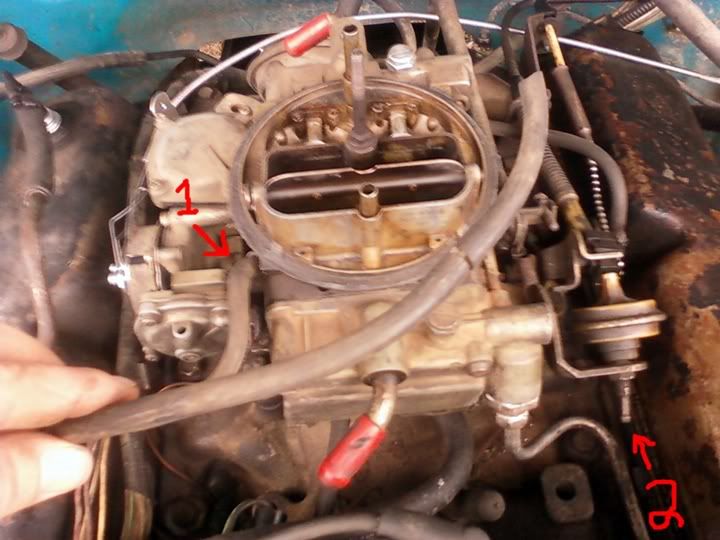
should something connect here?

should these be connected somewhere or plugged?

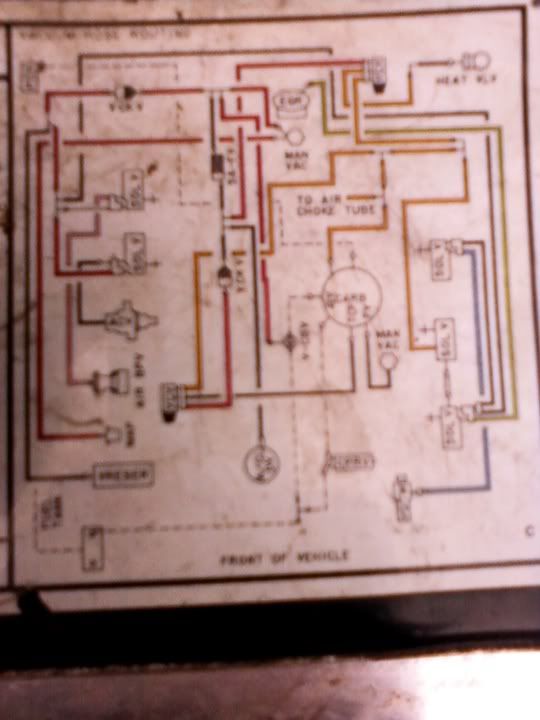
kinda hard to read, but this is the sticker of vac diagram
the first arrow is where the hose I'm holding is coming from, what connects to arrow 2
should something connect here?
should these be connected somewhere or plugged?
kinda hard to read, but this is the sticker of vac diagram
pedant
Joined: Jan 2008
Posts: 23,576
Likes: 40
From: EXTREME southwest CT
Nothing connects to arrow number 2
In your second photo the EGR should connect to the three way connection in the lower left of your vacuum diagram.
In your third photo the center port of the VCV should connect to timed (or ported) vacuum, and rest I can't make out because the....
Fourth photo is too blurry to read. Even when zoomed in.
There is a sticky explaining what all the vacuum acronyms mean.
Ford Truck Enthusiasts Forums - View Single Post - Vacuum Diagram Acronyms
Looks like someone really hacked your vacuum system. Sorry...
In your second photo the EGR should connect to the three way connection in the lower left of your vacuum diagram.
In your third photo the center port of the VCV should connect to timed (or ported) vacuum, and rest I can't make out because the....
Fourth photo is too blurry to read. Even when zoomed in.
There is a sticky explaining what all the vacuum acronyms mean.
Ford Truck Enthusiasts Forums - View Single Post - Vacuum Diagram Acronyms
Looks like someone really hacked your vacuum system. Sorry...
Thread Starter
|
Senior User
Joined: Dec 2010
Posts: 184
Likes: 1
From: Strasburg, Va.
well guys, I went ahead and plugged the hose and all three ports of the yellow thing, still have no idea about what connects to arrow 2 in pic one or to the shiny thing on the disk behind the carb in pic two in above pics, but plugging these things has dramatically improved the performance of the truck. She doesn't hesitate coming out of turns or starting from dead stops, and while it didn't raise the rpms when idling in gear, it didn't stall on me either when putting into gear after warmup. I believe that there is a screw somewhere on the carb to adjust for that idle, but not sure which one, if anyone has a pic of where it is on thiers that would help alot. anyway, thanks for the help guys, I'm sure I'll find something else for y'all to help me figure out.

Cargo Master


Joined: Jun 2013
Posts: 3,182
Likes: 15
From: Somewhere n North America
Yes, your decel throttle control modulator should be connected up to full vacuum.

2nd Gear
Joined: Sep 2016
Posts: 2
Likes: 0
Vacuum throttle kicker for AC
my holley 4180 on my 351 HO in my 84 f150 has a decel throttle kicker that has no vac hose attached to it. I'm not to good at deciphering vac diagrams, and was hoping somebody might be able to tell me where I would hook it up at. I do have a hose from the area of the carb just above and slightly forward of the choke coming out of the main body at an angle that isn't connected to anything, should I just put that on and see what happens? I also see attached to the very rear of the carb I have some kind of round thing about 3 1/2-4" in diameter that has a 1/2" little stem looking thing sticking out of it with no hose attached. is there supposed to be one? only reason I am fiddling with it is truck idles fine in park, and drives fine, but at stoplights/signs the rpms drop way down, and when I warm it up, I have to give the gas a little punch as soon as placed in gear or sometimes will stall out. also when coming out of turns if I gas it too quick, she stalls for a second then kicks right back in and thrust forward from the gas that didn't burn during the sort of stall.

Thread
Thread Starter
Forum
Replies
Last Post
Andrew Baldwin
1980 - 1986 Bullnose F100, F150 & Larger F-Series Trucks
45
Apr 15, 2022 05:15 PM
ghostshark
1980 - 1986 Bullnose F100, F150 & Larger F-Series Trucks
17
Sep 18, 2016 01:23 AM
1Austin112
1987 - 1996 F150 & Larger F-Series Trucks
5
Sep 17, 2016 01:47 AM
