
Ford CEO: Large Trucks and SUVs Are ‘Really Bad in Full Electrification’

Ford’s first EVs were ‘good for customers,’ but unprofitable. Going forward, expect Ford to make smaller model EVs and to partially electrify larger trucks and SUVs (hybrids).
A few years ago, Ford – along with pretty much every other automotive manufacturer on earth – announced ambitious electrification plans that included investing billions not only in new EV models, but also, the raw materials and production plants needed to support them, much of which stemmed from increasingly strict emissions regulations across the globe. At first, things got off to a good start, as consumer demand outweighed Ford’s ability to produce EVs by a long shot, but in recent months, that demand has waned considerably – though sales continue to grow.
In response, Ford has scaled back its EV ambitions in a big way, delaying the production start dates of its North American Ford Explorer EV and the next-generation F-150 EV, reducing the size of its under-construction plants, and pivoting to hybrids and cheaper all-electric vehicles. In a recent interview with Matt Farah of The Smoking Tire, Ford CEO Jim Farley discussed how the automaker has pivoted away from its desire to electrify everything – especially after realizing that current battery technology isn’t viable in some larger vehicles – and will now instead focus on offering customers a variety of powertrain options.

“America is not one kind of thing. It’s a complex market with lots of submarkets,” Farley said. “It’s a very important topic because, regardless of where your politics are, or what kind of driving duty cycle you have, the reality is that, around the world, the regulators have picked pure electrification as their bet for carbon reduction in our industry. So whether we like it or not, whether it’s the EPA, EU or China, any of the big three markets that make up 80% of the global car industry. The regulators there are saying, ‘hey, we need to decarbonize passenger cars, and we’re going to do it with, OEMs have to meet tailpipe emissions that are tied completely to full electrification.’ Not E-revs, not plug-ins, not hybrids, but pure electrification.”
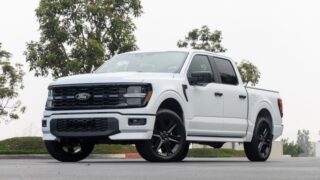
Now, with those regulations easing across the globe, Ford has chosen to instead focus on offering a full array of powertrains across its lineup, adding a hybrid option to every model by 2030, all while continuing to develop new ICE and EV models. This is particularly notable given the fact that, as Farley notes here, the F-150 is the second highest revenue consumer product in the world behind only the Apple iPhone, but the powertrain customers choose in the popular pickup varies greatly by geographic region. In California, 85 percent of F-150 sales consist of either the hybrid PowerBoost of the all-electric Lightning, in fact, though those same two models only account for 15 percent of overall F-150 sales in Texas.

This isn’t to say that Farley doesn’t still believe in EVs, and he states that 20-50 percent of U.S. consumers would likely save money over owning an ICE vehicle if they can charge at home. Farley believes that 20 percent of Americans will soon find EVs attractive, compared to 12 percent today, but notes that those customers tend to gravitate toward smaller vehicles and don’t take very many long road trips. As such, it’s pretty clear that coupled with current battery technology, this makes pure electrification a poor fit for larger vehicles. Instead, he believes that partial electrification like hybrids, PHEVs, and extended-range hybrids (E-rev) – such as the 2025 Ram 1500 Ramcharger, which is like a PHEV, but has a bigger battery and over 100 miles of pure electric range coupled with a gas engine – are a better choice for now.
“We feel like partial electrification for heavier vehicles, like pickup trucks like the F-150, especially if you tow like we do with the F-150 and the Expedition and the Explorer,” Farley said. “Those vehicles are really bad in full electrification. Or even E-rev that goes 120 miles and has a combustion engine to power the batteries and has no traditional transmission. These E-revs are the fastest growing part of the global electric industry.”

“We believe partial electric solutions for America, where we tend to have bigger vehicles like pickups and large [3-row SUVs], we think those are going to be very popular in the transition,” Farley added. “And maybe stay around for 20+ years. We believe the hybrid market will diversify. We believe electrification is part of the future. We never bet the farm on it. That’s why we invested in hybrids three years ago. We believe there will be new electrification solutions.”
For Ford, this is an important pivot, given the fact that it currently has a better than 50 percent market share in the commercial vehicle business. But while fleet customers are gravitating toward the F-150 Lightning Pro and E-Transit, their needs are very different from retail consumers in that they don’t typically cover too many miles in a given day, can charge at home or on the job site, and are more concerned with reducing operating costs. This is precisely why Ford began working on a low-cost EV platform for a future $25k EV crossover two years ago.

“Yes, yes, and not only is it required by the EPA, but as we said a couple times at Ford, we started a skunkworks group almost two years ago in the west coast, separate from Ford, to work on this use case of an affordable EV platform to compete against BYD and Tesla too,” Farley noted. “And they’re not part of Ford. They were from part of that Apple and Tesla, and they have a completely different approach to the development of that platform. Because we believe, after our Gen 1 products like Mach-E and Lightning that were great to the customer, but not profitable for [Ford].”
“We needed a radical approach to engineering and supply chain and manufacturing that was outside of the prejudice of traditional auto companies. And we believe that that platform is gonna be the core of our future pure-electric solutions. And they’ll tend to be smaller vehicles. And they’ll tend to be a really good interior package (size), a class above. So a Camry interior inside a Corolla. But it won’t be those kind of generic segments. We’re still going to make them emotional. I do not like generic cars and trucks; I sold them most of my life and I don’t want to do that anymore. I don’t think Ford should be a company that sells generic product. So even with affordable vehicles, they’re not going to look like a lot of the compliance vehicles and small toasters, appliance-like vehicles that are commodities. For the larger vehicles, we think partial electrification is the right bet.”
Join the Ford Truck Enthusiasts forums now!

You must be logged in to post a comment.