




Map OK

FOREIGN GURU
Joined: Jul 2006
Posts: 7,655
Likes: 7
From: Celaya, Gto. MX


Jose, I was in a hurry and got it at:Your Premiere Source for Ford Truck Parts and Accessories. Funny thing is I paid less, $180 shipped. I know I could have done better else where but I was in a hurry.
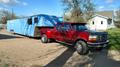
A little story, Today I ended up in Rapid City, SD with our final destination being in the southern Black Hills for the day. I started south out of Rapid and my wife started protecting that I better go around to the east side of the Black Hills to Hot Springs, then over. I, being stubborn said we would be OK. OH MY GOD, what a pull. It felt like I went uphill for 70 miles. I was starting to smell stuff and I'm thinking that it was my up pipe exhaust leak, I hope. Half way up the first hill, low and behold, that old EGT gauge started working. I was happy about that. I'll be where I am now for a couple of days, maybe I'll order one if they deliver to a camp site, LOL!
A little story, Today I ended up in Rapid City, SD with our final destination being in the southern Black Hills for the day. I started south out of Rapid and my wife started protecting that I better go around to the east side of the Black Hills to Hot Springs, then over. I, being stubborn said we would be OK. OH MY GOD, what a pull. It felt like I went uphill for 70 miles. I was starting to smell stuff and I'm thinking that it was my up pipe exhaust leak, I hope. Half way up the first hill, low and behold, that old EGT gauge started working. I was happy about that. I'll be where I am now for a couple of days, maybe I'll order one if they deliver to a camp site, LOL!

Hotshot


Joined: Feb 2009
Posts: 10,410
Likes: 77
From: Plankinton, SD
There are some nice good hills to pull there Glenn, I'd have done the same thing, can't listen to the wife or passenger, just go. At least you got nice weather for october there today. It's supposed to be close to 90* today here! HOT!

Thread Starter
|
Fleet Owner


Joined: Aug 2004
Posts: 20,419
Likes: 197
From: AZ
Darin, yes, HOT for this time of year, that's for sure. I really don't know what it is but that little trailer behind my 5th wheel seems to make a big difference. Maybe its rolling resistance, I don't know. I am not bringing it again on a trip. I swear that triple axle 42 footer pulled easier and it weighted more then my camper. I sort of wish my 5th wheel camper had triple axles, I'm starting to become a believer that they pull easier! I got the upgraded axles with bigger brakes-bearings and 14 ply tires now but I wonder how much trouble it would be to upgrade to three axles?? I don't want to upgrade to another camper after I've got this one the way I like it complete with internet so I can bug you guys, LOL!!!

Last edited by oldbird1965; Oct 8, 2010 at 06:02 PM. Reason: wording
Hotshot
Joined: Feb 2009
Posts: 10,410
Likes: 77
From: Plankinton, SD
Ya, I agree on the axle deal. When I got my first race car trailer (one I traded for this one) I ordered it with 3 axles instead of two. It was just a 30 footer (bumper pull) but I felt better with the extra axle under there. It pulled way better than any I saw with two axles. I saw guys with two axle trailers with sway bars and whatever they can to make it trail straighter. Mine with the three would just go straight, no swaying at all and no anti sway device on there either.
FOREIGN GURU
Joined: Jul 2006
Posts: 7,655
Likes: 7
From: Celaya, Gto. MX
The performance was OK but it probably would be better after I get the up pipe leak fixed. The smell I was wondering about, after thinking about it, was probably my CCV mod. If it wasn't for the new Map I probably would have turned around and gone around the Black Hills. My EGT's were high because I was pushing it to the limit. Had to or I would not have made it. I saw upwards of 1,400* and had to back off, hate that! Even though I have a IC I'm still thinking about the water injection to help keep the EGT's down. MPG, I don't even want to think about that. I used a half tank going 70 miles, not good.
Travis do you think that with the up pipes fixed the high EGTs will not be problem anymore?
FOREIGN GURU
Joined: Jul 2006
Posts: 7,655
Likes: 7
From: Celaya, Gto. MX

FTE Stories
Ford Trucks for Ford Truck Enthusiasts

3 Best / 3 Worst Parts of Modern Ford Ownership
Brett Foote
10 Amazing Upgrades That Solve Common Ford Truck Owner Headaches
Pouria Savadkouei
Every 2026 Ford Engine Explained
Brett Foote
10 Ugly Ford Trucks That We Still Kinda Love
Joe Kucinski
10 Things Every Truck Owner NEEDS (2026 Edition)
Michael S. Palmer
Rezvani's Latest Post-Apocalyptic Monster Is a Ford F-150 Raptor Underneath
Verdad Gallardo
Top 10 Most Expensive Ford Trucks Ever Sold on Bring a Trailer
Joe Kucinski
2027 Ford Super Duty Buyer's Guide (Every Model, Engine, & Package)
Brett Foote
Top 10 Ford Truck Tragedies
Joe Kucinski
Thread Starter
|
Fleet Owner
Joined: Aug 2004
Posts: 20,419
Likes: 197
From: AZ
The map wasn't a 'outstanding' improvement but I should try to explain a little better. Before I wasn't getting hardly any boost at low rpm's and lots of black smoke. With the new map I now have less smoke (unless I'm really into it) and a little more boost. In the Black Hills here when I had to 'back off' because of high EGT's at least I had some boost to help keep me moving. I'm confident that the bellow uppipes will help even more, I hope anyway. Travis, I'm in a lot of hills and mountains with this rig and my axillary fuel tank hardly ever gets used because its so hard to fill and we usually stop for fuel to take a break anyway. That's what happens when you get old, you have to stretch your legs and let the dog shi'''. Anyway, I could use that 40 gallon tank for water, think that would be enough??? LOL
FOREIGN GURU
Joined: Jul 2006
Posts: 7,655
Likes: 7
From: Celaya, Gto. MX

Glenn, One question: does your new MAP has the "correct" number written in it?, because I ordered mine and got this answer: F4TF9S480AA is the ID number, it crosses over to part number F4TZ9F479A they are the same part. advise.
Thats the reason Im asking.
Thanks in advance.
Thats the reason Im asking.
Thanks in advance.
Postmaster
Joined: Sep 2007
Posts: 4,195
Likes: 6
From: Medford Oregon
Glenn, One question: does your new MAP has the "correct" number written in it?, because I ordered mine and got this answer: F4TF9S480AA is the ID number, it crosses over to part number F4TZ9F479A they are the same part. advise.
Thats the reason Im asking.
Thanks in advance.
Thats the reason Im asking.
Thanks in advance.
Anyway, checking out the MAP Sensor is really easy with a few common shop components, and you can do it installed in your truck.
Our MAP Sensor outputs a digital waveform. At sea level with KOEO the output of the MAP is 111 HZ. The higher in altitude you are located the lower in frequency the MAP baseline is.

When boost is applied to the MAP sensor its frequency is increased 3.6 HZ. per pound of boost. That means if we have 5 pounds of boost the frequency of the MAP sensor will increase 18 HZ over baseline.
First you need to know what altitude you are out. Use the equation below ..
HZ out = 111 - ((14.7 - psia) x 3.6)
My psia is 14.035 where psia is pressure atmospheric at about 1250 feet above sea level. So plugging it into the equation ...
HZ out = 111 - ((14.7 - 14.035) x 3.6) which HZ out = 108.606 HZ.
You can find your psia by searching on the internet and many sites have a calculator
Here is a chart that will get you started ...
0 ft ---- 14.70 psia = 111.000 HZ
500 ft -- 14.43 psia = 110.028 HZ
1000 ft - 14.16 psia = 109.056 HZ
1500 ft – 13.91 psia = 108.156 HZ
2000 ft – 13.66 psia = 107.256 HZ
2500 ft – 13.41 psia = 106.356 HZ
3000 ft – 13.17 psia = 105.492 HZ
3500 ft – 12.93 psia = 104.628 HZ
4000 ft – 12.69 psia = 103.764 HZ
4500 ft – 12.46 psia = 102.936 HZ
5000 ft – 12.23 psia = 102.108 HZ
6000 ft – 11.78 psia = 100.488 HZ
8000 ft – 10.91 psia= 97.356 HZ.
The next step is to tap into the MAP sensor output wire. It is the LtGrn/Blk wire (middle one). Ask your wife, mother, girl friend or next door neighbor for a small straight pin as that is usually not a shop item lying around. This technique makes it easy to tap into any sensor wire without damaging it. But I must warn you this usually results with an extra hole or two in fingers resulting in some blood loss, at least for me.

Most cheap Volt Ohm Meters won't have the HZ option you need. One that does is available at Harbor Freight. Item is #37772. Last week it was on sale for $19.95 and with a normal price of $24.95. You may find a less expensive one elsewhere with some searching.
Connect your VOM by using a jumper such as an alligator clip. Connect the MAP sensor output (straight pin) to the + side of the test lead and use battery ground for the – side. Switch the VOM to the HZ mode, turn the key to ON and record the baseline as read on the meter. Don’t get to crazy about exact numbers because they will change from day to day depending on atmospheric conditions. One day I read 108.5 HZ and the next 108.6 HZ. If it is off more than a few HZ and you know your altitude calculation is correct then I would suspect a bad sensor.
I’m using my 10 year old Fluke meter.

The above test alone probably indicates the sensor is working correctly, since it’s measuring the correct atmospheric pressure. If you have an air compressor and can generate a known pressure in the tank, just apply it to the MAP hose and take a reading. I started with 20PSI and worked down, 15PSI, 10 PSI then 5 PSI.
Controlling the pressure (boost) was a bit of a challenge. Most shop compressors, even small ones are not designed to output exact low pressures. I found a small 0-60 PSI pressure gauge in the shop and just keep releasing air until I had the pressure I wanted. Although not really high tech or very accurate it did the job for what I was trying to do.

Results are below ..
The first column is the PSI applied to the MAP hose.
The second column is the actual measured frequency in HZ.
The third column is the calculated frequency in HZ. Remember for every 5 lbs of boost you add 18 HZ to the baseline.
0 PSI --- 108.5 HZ -> 108.6 HZ
5 PSI --- 126.1 HZ -> 126.5 HZ
10 PSI –- 138.7 HZ -> 144.5 HZ
15 PSI –- 159.8 HZ -> 162.5 HZ
20 PSI –- 177.2 HZ -> 180.5 HZ
Overall I’m pleased with the output and that my MAP sensor is functioning correctly. I had no way to guarantee the PSI was accurate using an analog pressure gauge.
Enjoy my friend ...
FOREIGN GURU
Joined: Jul 2006
Posts: 7,655
Likes: 7
From: Celaya, Gto. MX
WOW!, WOW!, and WOW!.
First of all THANK YOU and I tried to rep you but NO dice

Second Im impressed with your knowledge and help

Im printing your info and Im going to STUDY it very well to see if I can perform the test soon. Its a little more complicated to me because I suppose the numbers are in feets and we use meters for the altitude, so I have to make another conversion,
  but Ill try.
Thanks again. AMIGO
First of all THANK YOU and I tried to rep you but NO dice
Second Im impressed with your knowledge and help
Im printing
your info and Im going to STUDY it very well to see if I can perform the test soon. Its a little more complicated to me because I suppose the numbers are in feets and we use meters for the altitude, so I have to make another conversion, but Ill try.Thanks again. AMIGO

Thread
Thread Starter
Forum
Replies
Last Post
lud04X
1994.5 - 1997 7.3L Power Stroke Diesel
11
Jan 14, 2012 06:01 PM
SSGG
1999 - 2003 7.3L Power Stroke Diesel
15
Jul 25, 2006 12:02 AM
