


URETHANE PAINTS
Thread Starter
|
Elder User
Joined: Jun 2010
Posts: 934
Likes: 2
From: Sterling, Virginia
URETHANE PAINTS
I'm getting ready to use urethane primer and was wondering if anyone has any experience with it. I'm concerned about the airborne hazards. I have a resporator with activated charcole from Eastwood which is supposed to protect you for 8 hours. I know fresh air units are recomended, but there are very pricey for one or two uses. Thanks

Laughing Gas


Joined: Nov 2008
Posts: 914
Likes: 51
From: SW Missouri
Yes they are pricey but then 300,000 for a down payment for a lung and kidney transplant is pretty pricey too.There are very few old painters left cause most died because they didn't listen when told not to breath paint fumes.
Your respirator might help slightly, but new paint will absorb through the skin as well as your eye mucus membrane.
The only way to paint safely is a moon suit, fresh air supply respirator and gloves.
Just my opinion and I have done that for a living for a very long time. I kept going back to schools when new paint came out, kept up on things and listened. I have used a fresh air respirator since before imron paint came out and most of my body shop friends from that time period died from not doing that.
Read the the msds and application sheets.They will give you some guidance.
As always I am sure opinions will vary.
Good luck what ever you decide, as in all things, it's your life and you have to decide how to live it.
Larry
Your respirator might help slightly, but new paint will absorb through the skin as well as your eye mucus membrane.
The only way to paint safely is a moon suit, fresh air supply respirator and gloves.
Just my opinion and I have done that for a living for a very long time. I kept going back to schools when new paint came out, kept up on things and listened. I have used a fresh air respirator since before imron paint came out and most of my body shop friends from that time period died from not doing that.
Read the the msds and application sheets.They will give you some guidance.
As always I am sure opinions will vary.
Good luck what ever you decide, as in all things, it's your life and you have to decide how to live it.
Larry

Junior User
Joined: Sep 2009
Posts: 50
Likes: 0
How much spraying are you going to do? Where are you spraying? At the very LEAST for a small job you should have a paint suit, head sock, goggles, gloves and a FRESH cartidge respirator when you spray this stuff....or any auto paint product as they all can kill you. If you are doing a lot of painting, especially an entire vehicle in a home shop, you should be using a fresh air system. It is possible to find good used ones and re-sell when you finish....or buy new and sell when you are done....or keep it as there are many good uses for it (sanding, welding, construction etc.) Hobby Air is a good unit...I've been using one for years...and would not paint without it. How much is your health worth?
Remember you are not only spraying the final finish, but a lot of priming and sealing too. There is good info regarding health & safety when painting cars on the autobodystore.com site. Dont skimp...it isnt worth it. If it is an issue have someone do it that has the correct equipment. My .02. Regards.
Remember you are not only spraying the final finish, but a lot of priming and sealing too. There is good info regarding health & safety when painting cars on the autobodystore.com site. Dont skimp...it isnt worth it. If it is an issue have someone do it that has the correct equipment. My .02. Regards.
Thread Starter
|
Elder User
Joined: Jun 2010
Posts: 934
Likes: 2
From: Sterling, Virginia
Thanks guys, I want to have fun not die doing it. Looks like fresh air unit or someone else to do it. Luckily, I haven't bought the primer yet. I wil take your advice. It's becoming more obvious that the "experts" in those truck mags just want to sell product.There were a couple of articles recently about painting your car in a home shop and I emailed the "expert" in question and his reply was " as long as you're not doing it for a living" you don't need the fresh air system. I emailed Eastwood and thier "expert" told me to make sure the cartridge is new and change it when you smell paint!! Sounds like it's too late by then. It's good to hear from a pro how knows, thanks Larry
Junior User
Joined: Sep 2009
Posts: 50
Likes: 0
Thanks for listening. Just as important as your protection is the environment you are painting in. You need to filter out the overspray before it builds up too fast....which is a good enough reason when at home, to paint your vehicle in stages/pieces. Pro painters have paint booths that displace a lot of air and filter it quickly....not so at home. Lots of attention is given to keeping dust & dirt at at bay but remember to not let the spray (or you) linger too long. Spray a coat and leave the room...let it flash off then repeat. Box fans (enough of them....I have 5) with a/c filters attached to them work real well. Actually I just shot the front section of my cab this morning....with my fresh air system, hvlp guns and box fans! No major overspray and fresh air to breath. Came out nice.....
Also use chemical gloves when cleaning your equipment right after a paint session...not nitrile gloves as they will dissolve on contact.
Sometimes if I am priming a small part I will use my cartidge respirator and stay out of the path of the overspray...spraying in front of the fans, but I almost use the fresh air system exclusively.
After a session I usually will replace the filters, or if they are fresh and not too clogged, I will vacuum the overspray off the face of them as prep for the next time.
Dont want to be preachy but trying to help you make an informed decision. Regards.
Also use chemical gloves when cleaning your equipment right after a paint session...not nitrile gloves as they will dissolve on contact.
Sometimes if I am priming a small part I will use my cartidge respirator and stay out of the path of the overspray...spraying in front of the fans, but I almost use the fresh air system exclusively.
After a session I usually will replace the filters, or if they are fresh and not too clogged, I will vacuum the overspray off the face of them as prep for the next time.
Dont want to be preachy but trying to help you make an informed decision. Regards.
Laughing Gas
Joined: Nov 2008
Posts: 914
Likes: 51
From: SW Missouri
Be very careful using box fans to move paint fumes as the fumes are very explosive. Do not have your Air Compressor in the same shop as your painting in for the same reason.
Paint booths use explosion proof fans and blow air into the booth creating pressure to remove the over spray out filtered vents so actually no paint fumes flow over the fan motors.
Perhaps I am over concerned with safety while painting and being over cautious and many will think and say I paint all the time without supplied air. If you do I am glad it's you and not me I just try to give the best advice based on my knowledge and I would urge you for your future health to not do it.. I have seen home shops explode when a spark from air compressor comes on igniting paint fumes.
Larry
Paint booths use explosion proof fans and blow air into the booth creating pressure to remove the over spray out filtered vents so actually no paint fumes flow over the fan motors.
Perhaps I am over concerned with safety while painting and being over cautious and many will think and say I paint all the time without supplied air. If you do I am glad it's you and not me I just try to give the best advice based on my knowledge and I would urge you for your future health to not do it.. I have seen home shops explode when a spark from air compressor comes on igniting paint fumes.
Larry

Freshman User
Joined: Aug 2010
Posts: 42
Likes: 0
As of january of this year, it became illegal to spray more than 3 oz of any paint product outside of a paint booth, now for everyone out there rebuilding your projects, welding or heating metal with catalized primers or paint, make sure you grind all paint away so it does not burn, of you are breathing the same fumes as a painter without a mask.
Trending Topics
More Turbo

Joined: Dec 2009
Posts: 696
Likes: 48
From: Central Connecticut
On another thread there was a discussion about epoxy mastic paint and it was suggested that the paint could be applied with a brush without the need for a respirator. Since I'm only interested in doing the frame I'm not that concerned about the appearance but I am concerned about safety. Do you guys think any of these paints can safely be applied with a brush without a fresh air supply?
FTE Stories
Ford Trucks for Ford Truck Enthusiasts

AEV FXL Super Duty - the Super Duty Raptor Ford Doesn't Make
Brett Foote
Lobo Vs Lobo: Proof the F-150 Lobo Should Be Even Lower!
Michael S. Palmer
Ford's 2001 Explorer Sportsman Concept Looks For a New Home
Verdad Gallardo
10 Best Ford Truck Engines We Miss the Most!
Joe Kucinski
2026 Shelby F-150 Off-Road: Better Than a Raptor R?
Brett Foote
2027 Super Duty Carhartt Package First Look: 12 Things You NEED to Know!
Michael S. Palmer
10 Most Surprising 2026 Ford Truck Features!
Joe Kucinski
Top 10 Ford Trucks Coming to Mecum Indy 2026
Brett Foote
5 Best / 5 Worst Ford Truck Wheels of All Time
Joe Kucinski
Posting Guru
Joined: Sep 2006
Posts: 1,101
Likes: 0
From: Bristol TN.
Man, I was thinking about painting my truck myself with eastwoods single stage urethane paint but I didn't realize it was that bad for you. There are respirators on their sight for like 600 bucks...jeeees thats a lot. I completely agree with being safe, it just sucks because of how much it would cost me to buy the paint, respirator, etc plus the hassle of doing it myself. I have a few spray guns already and figured maybe $200-250 for urethane paint and primer plus my labor. I didn't know I has gonna have to fork out the extra dough for respirator. I talked to a local paint shop that does good work and they told me that it would cost about $1000-1200 to paint my truck 1 color with life time warranty. I guess I'll have to go that route when it comes time, I just thought it would be cool to paint it myself
Laughing Gas
Joined: Nov 2008
Posts: 914
Likes: 51
From: SW Missouri
Reed
Your looking at 1200 or so for a SAS breathing system. It is basically a one time purchase and should last a lifetime, except for minor replacement parts.
I suppose it depends on your age and how long you plan on using the system and how much you could sell it for after you use it. Keep a eye out as they show up on craigs list and other places occasionally.
If your young and plan on working on stuff for several years you can amortize it out over 20 years or so it really is not all that costly except up front cost. It's like a air compressor, you can spend 300 dollars several times over your life for a air compressor or spend 2000 once.
I am way over social security age and would have a hard time justifying spending that kind of money no longer than I will get to use it but if your even 50 it would be a worth while purchase if your going to do this kind of work.
Just my opinion.
Your looking at 1200 or so for a SAS breathing system. It is basically a one time purchase and should last a lifetime, except for minor replacement parts.
I suppose it depends on your age and how long you plan on using the system and how much you could sell it for after you use it. Keep a eye out as they show up on craigs list and other places occasionally.
If your young and plan on working on stuff for several years you can amortize it out over 20 years or so it really is not all that costly except up front cost. It's like a air compressor, you can spend 300 dollars several times over your life for a air compressor or spend 2000 once.
I am way over social security age and would have a hard time justifying spending that kind of money no longer than I will get to use it but if your even 50 it would be a worth while purchase if your going to do this kind of work.
Just my opinion.

Thread Starter
|
Elder User
Joined: Jun 2010
Posts: 934
Likes: 2
From: Sterling, Virginia
I'm glad I started this thread because it seems other folks have been somewhat sucked in by the idea promoted in "hot rod" mags that you can do it your self in your own garage stuff. I really appreciate feed back from guys who walk the walk not talk the talk. I've decided based on this thread to save the $$$ and fork it down for someone else to take the risk. Thanks guys
Posting Guru
Joined: Feb 2008
Posts: 1,068
Likes: 1
From: Yountville Ca

I've painted maybe 7 or 8 trucks and cars in my lifetime, and the last 2 were acrylic polyurathanes and so far.....I've been OK, but I don't recommend it and I dont' do it anymore. At least I have no such plans. I used a fresh air pump system from HobbyAir that worked well but wasn't anykind of "full moon suit" which is really the best. I can only say from my experience that if one can smell it or the fumes get on ya one is at risk! How much risk I don't know. I don't have the scientific testing data--we'd probaby have to kill off a 1000 amateur builders to get it--any volunteers? for a test. But I was really careful/used big exhaust all over the shop and wouldn't even remove the lid of a urathane product without
my HobbyAir pumping fresh air from about 50 feet outside the shop. So far I'm not dead, and I still participate in active cycling/once I was an OK 40Km timetrial guy-not a winner-just not last. I still ride a lot at 64 and I'm not aware of any damage from car painting, but how would I know?? I think its pretty risky. And our hobby is somewhat moving away from the super clean look anyway. Not all of us, but many. And I think the environmental/health issues all are contributing to people moving towards a more patina look. I know my current 48F1 still have OEM green paint poking through overpaints here and there and is all OEM green in the interior and underneath etc, and I kinda value that. Even though its worn its kinda cool so I don't plan on doing any painting. Just do the mechanicals and all and enjoy the old trucks wrinkles--just like me at my age haha.
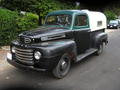
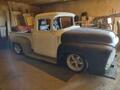
So if you decide to paint I would say--dont' do it too much--paint outside if you can--these polyurathanes dry fast and they can be color sanded and buffed even if you get some dust on it while painting etc--and use the best cover suit for yourself and ventilation system. In this photo , I look pretty messy, but my spray painting clothes are from years of spray painting houses with latex too. So its not urathane you see on me.
Myself if I painted something I would probably just use the epoxy primers which are super!! at sealing the metal etc, and just used less toxic things for the finish--maybe even some of the newer enamels. Paint products change from time to time and I suppose newer/less toxic things might come along. Years ago I painted water based auto stuff, but wasn't happy with it, and its my understanding from how to articles that the current water based paints are good if your a pro and have everything just right. They look a little complicated to me, for an amateur.
Good luck

my HobbyAir pumping fresh air from about 50 feet outside the shop. So far I'm not dead, and I still participate in active cycling/once I was an OK 40Km timetrial guy-not a winner-just not last. I still ride a lot at 64 and I'm not aware of any damage from car painting, but how would I know?? I think its pretty risky. And our hobby is somewhat moving away from the super clean look anyway. Not all of us, but many. And I think the environmental/health issues all are contributing to people moving towards a more patina look. I know my current 48F1 still have OEM green paint poking through overpaints here and there and is all OEM green in the interior and underneath etc, and I kinda value that. Even though its worn its kinda cool so I don't plan on doing any painting. Just do the mechanicals and all and enjoy the old trucks wrinkles--just like me at my age haha.
So if you decide to paint I would say--dont' do it too much--paint outside if you can--these polyurathanes dry fast and they can be color sanded and buffed even if you get some dust on it while painting etc--and use the best cover suit for yourself and ventilation system. In this photo , I look pretty messy, but my spray painting clothes are from years of spray painting houses with latex too. So its not urathane you see on me.
Myself if I painted something I would probably just use the epoxy primers which are super!! at sealing the metal etc, and just used less toxic things for the finish--maybe even some of the newer enamels. Paint products change from time to time and I suppose newer/less toxic things might come along. Years ago I painted water based auto stuff, but wasn't happy with it, and its my understanding from how to articles that the current water based paints are good if your a pro and have everything just right. They look a little complicated to me, for an amateur.
Good luck
Lead Driver


Joined: Aug 2006
Posts: 8,093
Likes: 652
From: Brentwood, TN

My only advice is to stay within your comfort zone...if you wear a respirator and the air smells fresh then the respirator is doing its job. Cyanates are deadly...the good news is that they are found mostly in clearcoats and not in primers and basecoats. One consideration that is seldom made in these discussions is the airborne paint density; in other words, how much paint and VOCs are in the air within the confines of the enclosed area in which you are spraying. Many production shops are spraying LOTS of paint and the density of paint in the air is far higher than most DIYers would ever see. A production shop might spray a primer surfacer, a basecoat, and a clear coat consecutively. Most of us would spray a couple of coats of primer and then come back the next day to sand and prep again. This is relevant for two reasons; one, there should never be an occasion in your home shop where the paint density is so high that there is a risk of an explosion and two, with lower densities your need for anything other than a good dual element filter is reduced.
I have been using SEM MetalLock primer surfacer and I really like it. I mention this product because it dries fast and has low VOC. In fact, any surfaces within the immediate area where I spray that get overspray on them I find that the overspray is merely dust that wipes right off...in other words the overspray is dry before it lands.
Here is a unit that I built to remove overspray and vapors from the area in which I spray. It is a little more than most would need in a home shop but I do enough painting to warrant the expense and the floor space it takes up in the garage when not in use. There is a two-stage filtration system on the input side, a paint arrestor (catches the "chunks") and a set of MERV 11 filters that remove any remaining dust or paint particles. Internally there is a 1 HP blower with a 3-spd selection. Air is drawn in, filtered and forced up through the output filtration system which consists of a dense layer of activated carbon to remove the vapors and another set of filters just to ensure that nothing is blown out into the paint area. This system recycles air within the booth and will filter all the air within a 2-car garage twice a minute. And yes, I do still wear a dual element respirator with a full face shield...the fluid in your eyes is a better conductor of airborne contaminants than your lungs.
Once again, stay within your comfort zone.
I have been using SEM MetalLock primer surfacer and I really like it. I mention this product because it dries fast and has low VOC. In fact, any surfaces within the immediate area where I spray that get overspray on them I find that the overspray is merely dust that wipes right off...in other words the overspray is dry before it lands.
Here is a unit that I built to remove overspray and vapors from the area in which I spray. It is a little more than most would need in a home shop but I do enough painting to warrant the expense and the floor space it takes up in the garage when not in use. There is a two-stage filtration system on the input side, a paint arrestor (catches the "chunks") and a set of MERV 11 filters that remove any remaining dust or paint particles. Internally there is a 1 HP blower with a 3-spd selection. Air is drawn in, filtered and forced up through the output filtration system which consists of a dense layer of activated carbon to remove the vapors and another set of filters just to ensure that nothing is blown out into the paint area. This system recycles air within the booth and will filter all the air within a 2-car garage twice a minute. And yes, I do still wear a dual element respirator with a full face shield...the fluid in your eyes is a better conductor of airborne contaminants than your lungs.
Once again, stay within your comfort zone.