When you click on links to various merchants on this site and make a purchase, this can result in this site earning a commission. Affiliate programs and affiliations include, but are not limited to, the eBay Partner Network.
-Begin by positioning the vehicle onto the hoist where it can be lifted. Roll the vehicle straight backwards just until you can open all four doors without hitting the posts of the hoist. Remove the rear seat (18mm nuts and TX-50 bolts I think). Remove all four door opening scuff plates by simply prying on them gently. Once the rear seat is removed, lift up on the carpet to expose the rear cab mount bolts. You will need a 24mm or 15/16" socket for the bolt on the driver side, and a 21mm or 13/16" socket for the bolt on the passenger side. Once removed, lift up on the carpet until access can be gained to the middle row bolts, just behind the front seats. You will see a rubber grommet plug to remove before you have access to the bolts. Again driver side bolt is 24mm or 15/16" and passenger side is 21mm or 13/16". Remove both the driver and passenger side kick panels. Remove the 10mm bolt securing the steering coupler to the steering column, and once removed, telescope the lower shaft all the way through the firewall. Roll up the carpet on both driver and passenger sides to expose the grommets covering the front cab mount bolts. Again driver side bolt is 24mm or 15/16" and passenger side is 21mm or 13/16". Once removed, this concludes everything needed to remove from inside the vehicle. Roll the vehicle forward to position it onto the lift.
-Raise the vehicle in the air to disconnect everything needed underneath. Begin by draining the cooling system (don't forget to remove the coolant degas bottle cap first). Loosen the plastic 19mm or 3/4" radiator drain petcock. Disconnect both front <acronym title="Anti-Lock Braking System">ABS</acronym> wheel speed sensors at the rearward sides of both front inner fenderwells. Disconnect the ground strap located underneath the vehicle, just behind the passenger side inner fender well (8mm bolt). Disconnect the parking brake cable at the junction just under the driver side framerail. Once done, fish the front cable through the body mount bracket and leave hanging. Disconnect the shifter cable at the transmission manual lever, and the cable mounting bracket and leave hanging. Disconnect the lower rad hose from the radiator. Disconnect the two transmission fluid cooler lines at the radiator (you will need to remove the safety lock plastic clips first, and you'll need the special spring lock coupler tool to disconnect the lines). Remove the two 8mm bolts that secure the power steering fluid cooler to the lower rad support facing the front of the vehicle, and leave the cooler hanging. Disconnect the transmission fluid cooler lines from the external fluid filter housing on the passenger side of the vehicle. Remove all plastic pushpins that secure the rubber air deflector to the lower rad support.
-Evacuate the A/C. Remove all the plastic pushpins at the upper rad support, and disconnect the main battery positive cable retaining push clips as well. Working on the passenger side of the vehicle in the engine compartment, disconnect the A/C line at the suction accumulator (one 13mm nut). Remove the one 8mm bolt securing the engine ground strap to the firewall, just behind the <acronym title="Manifold Absolute Pressure - MAP Sensor">MAP</acronym> sensor. Disconnect the vacuum line for your pulse vacuum hubs. Remove the passenger side battery. Disconnect the main wiring connected to passenger side battery positive cable. Disconnect the ground strap that's connected to the negative battery cable on the passenger side of the vehicle you now have access to, with the battery removed. Disconnect the "squeeze and pull" type connection by the vacuum (yellow with light blue stripe coloured wire). Disconnect the <acronym title="Manifold Absolute Pressure - MAP Sensor">MAP</acronym> sensor hose from the intake manifold, and move out of the way. Disconnect the heater hose at the passenger side, just below the alternator, where it connects to the metal tube going into the front cover. Disconnect the upper of the two A/C lines at the top of the A/C condensor (one 13mm nut). Remove both hot and cold side charge air cooler tubes (11mm or 7/16" to loosen the clamps). Disconnect the upper rad hose. Remove the two upper rad support brackets (four 8mm bolts in total). Remove the two 8mm bolts that secure the fan shroud to the rad and remove the shroud. Remove the coolant degas bottle (two 8mm bolts). Remove the entire air cleaner assembly (don't forget to remove the airflow restrictor gauge and disconnect the <acronym title="Mass Airflow Sensor">MAF</acronym> sensor first). Disconnect the main central junction box feed to the driver side battery positive cable. Remove the driver side battery. Remove the battery tray (four 13mm bolts). Disconnect two of the three <acronym title="Powertrain Control Module">PCM</acronym> main connectors (it will be pretty obvious which two). Disconnect the hose at the bottom of the power steering fluid reservoir (make sure you have a drain bucket below before doing this because it will be messy). Disconnect all lines (two I think both 18mm) to the to brake hydroboost, except the rubber hose going to power steering fluid reservoir. Disconnect the one of the two power steering fluid lines to the steering box, the one that connects to the power steering fluid cooler (20mm crow's foot or short line wrench needed). Disconnect the heater hose on the driver side, where it junctions into where it connects to the degas bottle. Disconnect all the electrical connectors on the driver side inner fender well. Position all wiring out of the way, in preparation for cab lifting. Disconnect the three <acronym title="Anti-Lock Braking System">ABS</acronym> HCU lines at the HCU and fold over (you will know which three I'm talking about by looking at them). Last, but not least, Remove the front two cab mount nuts on either side of the charge air cooler (18mm).
-Reposition hoist arms to the four corners of the cab, and have an assistant operate the lift SLOWLY, while someone else keeps watch on the progress of the lift. As the cab is raised, you will be able to address any forgotten disconnects at this point. <!-- / message --> <!-- sig --> __________________
Very nice write up reps to you, but don't you think you should start out by explaning what you are talking about. Instead of just going into the precedure. Maybe change the title to cab removal instructions. This should be in the tech folder.
Yes, I meant to answer the other post, but started my own by accident.
Originally Posted by texans
Very nice write up reps to you, but don't you think you should start out by explaning what you are talking about. Instead of just going into the precedure. Maybe change the title to cab removal instructions. This should be in the tech folder.
That sounds kind of annoying, but not too terribly bad. The only vehicle I have ever done this on to R&R engine was a chevy Astro van. It was VERY easy, even with Rear A/C. It was only the front half though (Unibody on front suspension frame)
I did a 7.3L in a 2002 Superduty. Came right out the front. It was surprisingly easy. I don't know if the 6.0L does that or not. Always worth a try once right?
Yes if you are going to pull the motor it can come out the front. All you have to do is take the front end apart. It's really easy. Takes 30 mins to an hour tops. Then you can pull the motor out the front. I would never lift the cab if I was going to pull the motor. The reason pepole lift the cab more times than not is to r&r the heads.
I read this a couple of weeks ago and joined the forum because of it. Then I was looking for it again and it took me couple hours to find it. Thank you very much for your detailed instructions! I already bookmarked the page so I don't lose it again.
Great thanks for posting! I plan to watch early tomorrow morning. Does it address how to get off rusty cab mount bolts that just spin? I only spent a few minutes on the cab bolts but they appear to have the entire bottom spinning with the bolt. Any suggestions? Pipe wrench? What if not trying to save the cab that I am removing? Thanks.
I joined the forum so that I could share a tip that took me two days and four hours of wasted effort and frustration to learn, but one that others may already be aware of.
Ford uses the strongest possible thread lock on their body mounts. The easiest, very easy in fact, way to release the bond is heat. Follow the same access steps as outlined in the original post. Then, 1) Protect anything you don't want roasted using aluminum foil or another appropriate material. 2) Heat each cab mount nut for about a minute using a propane torch. 3) Remove the flame and touch the hot bolt with a stick of pure paraffin or a paraffin candle all around. Allow the wax to seep into the bolt's pores and threads for a few seconds. 4) Apply steady pressure to the nut with a breaker bar or ratchet equipped with an extension handle, and it should now be free. 5) Fully separate the nut and bolt using your preferred method. My wife held the bolt head under the cab in place with another breaker bar, and after this procedure, we were able to remove all the cab bolts in under a minute each, including one that we had not previously worked on.
The original post is extremely helpful and allowed us to replace the cracked pipes, as well as the EGR-OC and down pipes, while we were at it.


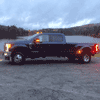






 remove cab for wiring ha