





7.3 oil question.......

Thread Starter
|
Junior User
Joined: Dec 2009
Posts: 67
Likes: 0
7.3 oil question.......
I have a 02, F-350, 7.3L. My question is.... how often should I be changing the oil???? Obviously taking 15q of oil and the filter ain't too cheap!!!!! Every 3K, 5K????
Thanks!
Thanks!

Postmaster
Joined: Apr 2006
Posts: 3,524
Likes: 2
From: CA Bay Area
I run Motorcraft oil for 5,000 and send a sample to Blackstone.
They advise me to run it for longer, so on Rotella oil I put 10,000 and have sample in the mail for the advise. Now I put Mobil 1 synthetic in it. With acceptable performance with Rotella I will shoot for 15 k on synthetic.
Oil ain't cheap????
On the 10,000 miles between the changes I spend over $3,000 on fuel. What is even a hundred bucks spend on synthetic comparing to that?
Also good oil can give you up to 2% fuel savings. Can you do the math for me?
They advise me to run it for longer, so on Rotella oil I put 10,000 and have sample in the mail for the advise. Now I put Mobil 1 synthetic in it. With acceptable performance with Rotella I will shoot for 15 k on synthetic.
Oil ain't cheap????
On the 10,000 miles between the changes I spend over $3,000 on fuel. What is even a hundred bucks spend on synthetic comparing to that?
Also good oil can give you up to 2% fuel savings. Can you do the math for me?

Post Fiend
Joined: Mar 2007
Posts: 26,966
Likes: 50
From: Texas
I change mine every 5,000 miles. I started getting my used oil tested and tried some different oils to see if the lab could find if my truck liked one better than the other.
Here's a link to my recent thread on this. https://www.ford-trucks.com/forums/9...000-miles.html
It's got my latest 2 reports from 2 different labs that indicate my engine is doing just fine with my oil change interval.
Here's a link to my recent thread on this. https://www.ford-trucks.com/forums/9...000-miles.html
It's got my latest 2 reports from 2 different labs that indicate my engine is doing just fine with my oil change interval.

Post Fiend
Joined: Sep 2006
Posts: 7,426
Likes: 6
From: Sioux Falls, SD
I'm running about 9,000-11,000 mile OCI's running Schaeffer's series 7000 15W-40 and the oilguard bypass system along with doing used oil analysis. I agree with what Pocket and others have mentioned above. If you do not want to do an oil analysis then I would recommend the same 5K oil change interval.
Here's a copy of my last UOA report. they only run $11-$20 depending on the lab.
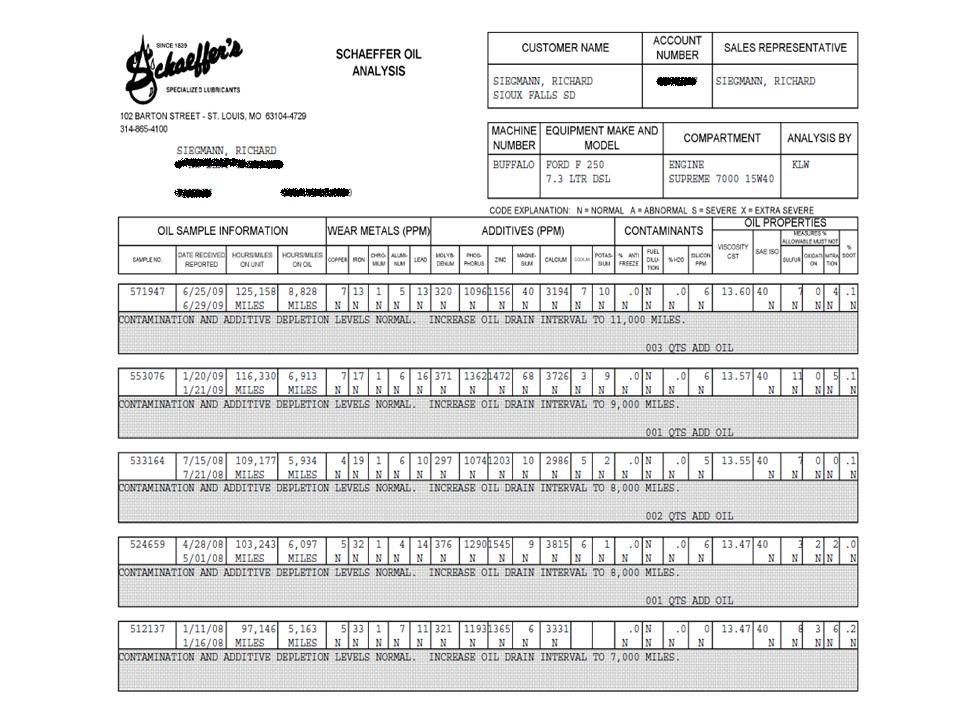
Here's a copy of my last UOA report. they only run $11-$20 depending on the lab.
Thread Starter
|
Junior User
Joined: Dec 2009
Posts: 67
Likes: 0
Trending Topics
More Turbo
Joined: Nov 2005
Posts: 687
Likes: 0
From: Prosper, TX
Is it weird that I have 4000 miles on my oil and it is not black yet? I am running schaeffer oil if that makes any difference. I was thinking of changing at 5 thou but I wonder if it will be black by then.
FTE Stories
Ford Trucks for Ford Truck Enthusiasts

Top 10 Most Expensive Ford Trucks Ever Sold on Bring a Trailer
Joe Kucinski
2027 Ford Super Duty Buyer's Guide (Every Model, Engine, & Package)
Brett Foote
Top 10 Ford Truck Tragedies
Joe Kucinski
AEV FXL Super Duty - the Super Duty Raptor Ford Doesn't Make
Brett Foote
Lobo Vs Lobo: Proof the F-150 Lobo Should Be Even Lower!
Michael S. Palmer
Ford's 2001 Explorer Sportsman Concept Looks For a New Home
Verdad Gallardo
10 Best Ford Truck Engines We Miss the Most!
Joe Kucinski
2026 Shelby F-150 Off-Road: Better Than a Raptor R?
Brett Foote
2027 Super Duty Carhartt Package First Look: 12 Things You NEED to Know!
Michael S. Palmer
Postmaster
Joined: Jun 2006
Posts: 2,647
Likes: 0
From: Fulltime RVer

...I run Motorcraft oil for 5,000 and send a sample to Blackstone.
They advise me to run it for longer, so on Rotella oil I put 10,000 and have sample in the mail for the advise. Now I put Mobil 1 synthetic in it. With acceptable performance with Rotella I will shoot for 15 k on synthetic ...
They advise me to run it for longer, so on Rotella oil I put 10,000 and have sample in the mail for the advise. Now I put Mobil 1 synthetic in it. With acceptable performance with Rotella I will shoot for 15 k on synthetic ...
...Well even though I plan to switch from Cat to Blackstone for my next UOA ...I certainly won't heed any of the "bad advice" I've seen in the "comments" section of so many of their UOA reports ...many of their comments seem to be intended to make the customer "feel good" about having invested $ in a UOA report ...and they encourage the customer to spend more $ on additional UOAs and less $ on oil changes! ...
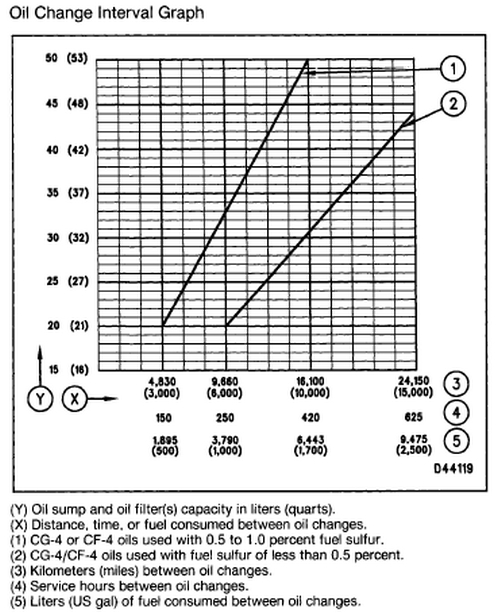
If anyone thinks the Ford recommended 3K to 5K-mile maximum OCI is some sort of "made up number" then consider the graph below which is for OTR engines and extend those lines down to the (16) qt capacity of a 7.3L PSD and compare those OCIs to the 3K to 5K-mile OCI recommended by Ford!
Almost everyone seems to think that they can "safely" run extended OCIs by using "synthetic oils" and/or "by-pass filters" however many 7.3L PSD owners who've tried this experienced poor UOAs and increased engine wear!
I also think that especially when towing up a long grade on a hot day that diverting 10% or more of the LOP flow just to feed a by-pass filter is a bad thing to do because when the engine is under a maximum load all of the LOP flow is needed to supply the HPOP and to lubricate critical engine parts and to cool the pistons! Below are just a few ..."quotes"... from the BITOG site...
..."Blackstone advised dumping the oil. I just changed the oil, went back to 15/40 Rotella T and OEM full flow filters. I did this as I will make 2 quick changes of oil and filter and with a 3rd fresh oil and filter change sample after 3,000 miles. I went back to factory system as changing Amsoil full flow and bypass 3 times is too expensive"...
High Iron, copper, lead 7.3 Amsoil Syn - Bob Is The Oil Guy
..."Pretty pleased with this sample. I removed my oilguard bypass and just ran a Fleetguard Stratapore ...the 15W40 dino performed just as well as the 5W40 Delo Syn I used to run for 1/2 the cost"...
1999 7.3L Ford Powerstroke - Delo 400 15W40 6281km - Bob Is The Oil Guy
..."Well Terry and I are concerned about the high FE trend that has developed. So the amsoil is going to come out and I am going to run a 5,000 interval of DELO 400 and resample"...
Amsoil 15W40 F350 02- 10,767 miles - Bob Is The Oil Guy
..."After almost 60 UOA's comparing/contrasting data logged for UOAs and bypass systems, I can tell you that there is precious little difference in actual performance when looking at UOA results."...
My own analysis of many 7.3L PSD UOA reports which is summarized below also indicates there's no "statistically significant" difference in UOA "Iron ppm" readings (which are the best indicator of "normal" engine wear) between a full-flow filter only and a full-flow filter combined with a by-pass filter ...and if anything the engine's with by-pass filters indicate a little more wear than the ones with full-flow filters!
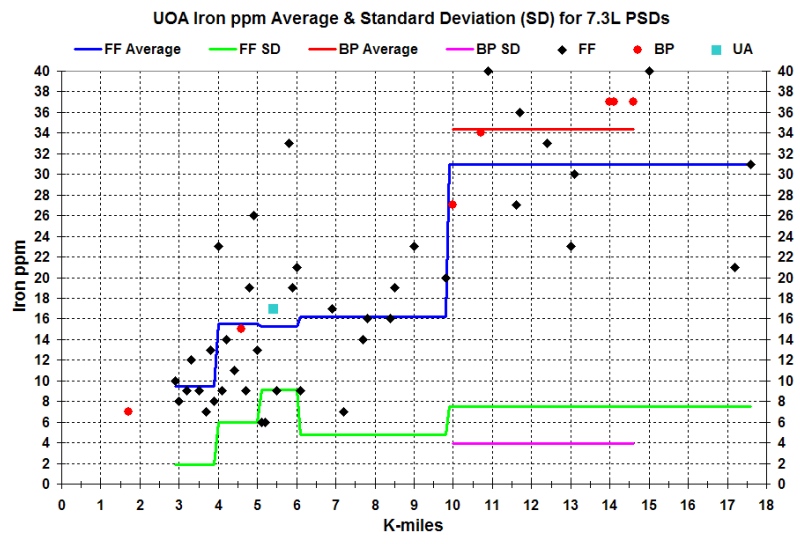
...The "correct OCI" for "minimizing" engine wear depends "only" on how hard your engine has been run ...and on how efficiently your oil filter removes "abrasive particles" from the oil supply ...and whether you use "conventional oil" or "synthetic oil" has no bearing whatsoever on determining the correct OCI for a given engine ...and this is also the stated opinion of Blackstone! ...
The bottom line is that even though the oil itself doesn't wear out and the oil contains an additive package that's sufficient to run OCIs longer than 5K-miles ...your oil sump is like a toilet and for best results it needs to be flushed often!
Post Fiend
Joined: Sep 2006
Posts: 7,426
Likes: 6
From: Sioux Falls, SD
I'm confused Ernest. I have not experience increased engine wear with my setup (Schaeffer's 7000 15W-40 and Oilguard Bypass) and I run a UOA on every oil change.
13ppm Iron is very good considering I towed 5,000 miles out of the 8,828 miles on the oil. 32' 5th wheel - approx 10,000 lbs after loaded, Smokey Mountains, Black Hills & +100 degree weather in Oklahoma.
Or am I missunderstanding something?
In addition, keep in mind that any used oil analysis can can be + or - 3 or 4 points. That is you can see a 3 to 4 point difference in wear metals when testing the same sample.
13ppm Iron is very good considering I towed 5,000 miles out of the 8,828 miles on the oil. 32' 5th wheel - approx 10,000 lbs after loaded, Smokey Mountains, Black Hills & +100 degree weather in Oklahoma.
Or am I missunderstanding something?
In addition, keep in mind that any used oil analysis can can be + or - 3 or 4 points. That is you can see a 3 to 4 point difference in wear metals when testing the same sample.



Postmaster
Joined: Jun 2006
Posts: 2,647
Likes: 0
From: Fulltime RVer
...I'm confused Ernest. I have not experience increased engine wear with my setup (Schaeffer's 7000 15W-40 and Oilguard Bypass) and I run a UOA on every oil change...
...13ppm Iron is very good considering I towed 5,000 miles out of the 8,828 miles on the oil. 32' 5th wheel - approx 10,000 lbs after loaded, Smokey Mountains, Black Hills & +100 degree weather in Oklahoma.
Or am I missunderstanding something?...
...13ppm Iron is very good considering I towed 5,000 miles out of the 8,828 miles on the oil. 32' 5th wheel - approx 10,000 lbs after loaded, Smokey Mountains, Black Hills & +100 degree weather in Oklahoma.
Or am I missunderstanding something?...
These are the 4 data points from your post #6 above... 5.2K-miles 33 ppm Iron, 5.9K-miles 19 ppm Iron, 6.9K-miles 17 ppm Iron, 8.8K-miles 13 ppm Iron ...and below I plotted them on one of my "wear-rate#" graphs.
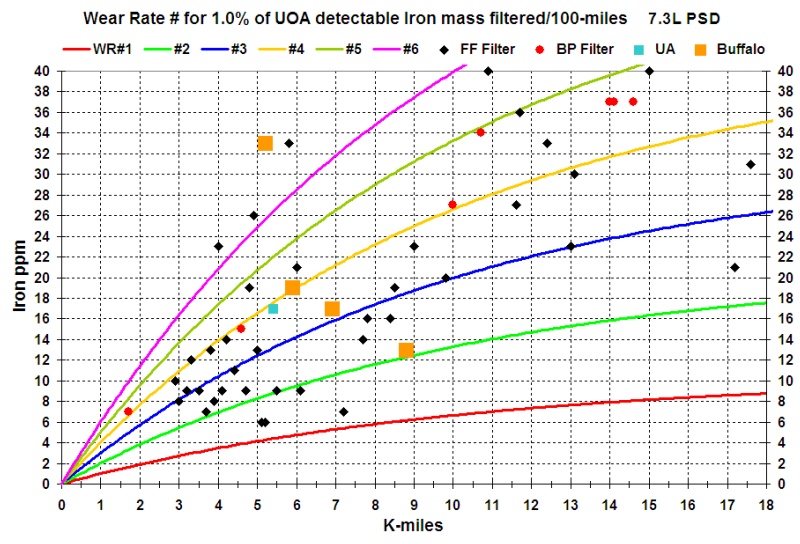
The data point you quote above... 13 ppm Iron at 8.8K-miles ...falls on the WR#2 curve ...and a WR#"2" indicates a wear-rate equal to "2" Iron BBs worth of "Iron mass" for each "25K-miles" traveled ...which is also a wear-rate of "2"/5 Iron BB per "5K-miles" traveled ...and this is a wear-rate of (2/5)(8.8/5)="0.70 Iron BBs" for the actual 8.8K-miles traveled.
As I explained in the thread for the "1 to 5 micron" size particles generated by "normal" wear mechanisms the amount of "Iron mass" that's "detectable" by a "UOA spectrometer" is only about 73% of the "actual" mass of Iron in the oil sample and this means that about... (0.70)/(0.73)="1 Iron BB" equivalent of Iron mass was "actually" worn away from your engine in 8.8K-miles ...and as I also discussed a single 728 u-lbm "Iron BB" typically produces 5,257,000,000 individual particles in the 1 to 5 micron range!
Well as bad as it might sound to have 5,257,000,000 abrasive Iron particles floating around in your engine's 16-qt oil supply a WR#2 wear rate is near the lowest end of my wear-rate scale ...and a WR#1 wear rate is a lower bound that's probably only achievable under optimum conditions ...but even if an engine was following the WR#1 wear rate curve and the OCI was increased from Ford's recommended 5K-mile maximum to 8K-miles the number of abrasive Iron particles floating around in the engine's 16-qt oil supply would increase by a factor of 6/4 which is a 50% increase!
Your data point... 19 ppm Iron at 5.9K-miles ...falls on the WR#4 curve as does the Blackstone "Universal Average" ...but I don't consider being "average" the same as being "good" or "desirable"! For example blood testing labs compare my cholesterol reading with a "universal average" for men in my age group ...and being "average" means I've got a 50% probability of having a heart attack which most definitely isn't a "good" or "desirable" situation to contemplate!
If you look along the WR#4 curve you'll see 3 red dots that represent data from the same engine ...and if an engine is operated at comparable loads then the measurements of Iron ppm vs K-miles traveled should follow a curve like the ones shown on my "wear-rate#" graph ...and the fact that your data points jump between curves has me puzzled as does the fact that your data indicates your engine wears at a lower rate if you increase the OCI?
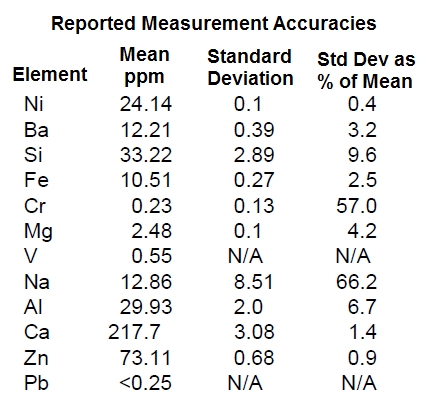
The table below gives some reported measurement accuracies and multiplying the "Standard Deviation" given for "Iron ppm" of "+/-0.27 ppm" by 3 gives a "+/-3-sigma" measurement error of "+/-0.8 ppm" when the target value is "10.51 ppm Iron" ...and this implies a "+/-3-sigma" measurement accuracy of +/-(0.8)/(10.51) or "+/-7.6%" and the "+/-3-sigma" means that 99.7% of the measured values are between "+/-3 Standard Deviations" of the "target value" being measured so there's only a "0.3% chance" that a "measured value" is more than "+/-7.6%" from the "target value"!

Post Fiend

Joined: Feb 2002
Posts: 10,600
Likes: 3
From: Carhenge
Navistar recommends 10,000 mile OCI for our engines in medium duty applications.
Of course, some common sense should be used depending on how long it takes you to put on 10,000 miles, but the manufacturer's recommendations are good enough for me.
Of course, some common sense should be used depending on how long it takes you to put on 10,000 miles, but the manufacturer's recommendations are good enough for me.
Post Fiend
Joined: Mar 2007
Posts: 26,966
Likes: 50
From: Texas
Wow, I would have guessed it would be based on hours or a much, much lower mileage. I figure a lot of the medium duty applications would include hours and hours of idle time.
Post Fiend
Joined: Sep 2006
Posts: 7,426
Likes: 6
From: Sioux Falls, SD
I'm trying to follow your thought process Ernest. Just bear with me, I do have a degree in Aeronautical Science but I'm no Engineer. Gosh - I haven't been online in 2 months and one of the first FTE threads I jump in on I get sucked into one of Ernesteugene's graphs! 
Alright - please God , let me be able to hold onto the thought process and remain focused. Oh, and please help me remember this in the morning and/or after 3-4 beers.
OK, I'm ready now.........
These are the 4 data points from your post #6 above... 5.2K-miles 33 ppm Iron, 5.9K-miles 19 ppm Iron, 6.9K-miles 17 ppm Iron, 8.8K-miles 13 ppm Iron ...and below I plotted them on one of my "wear-rate#" graphs.
The data point you quote above... 13 ppm Iron at 8.8K-miles ...falls on the WR#2 curve ...and a WR#"2" indicates a wear-rate equal to "2" Iron BBs worth of "Iron mass" for each "25K-miles" traveled ...which is also a wear-rate of "2"/5 Iron BB per "5K-miles" traveled ...and this is a wear-rate of (2/5)(8.8/5)="0.70 Iron BBs" for the actual 8.8K-miles traveled.
OK, I understand the graph and how my UOA Iron levels pertain to the Wear Rate curves, along with the iron mass wear rate.
I am running the oilguard bypass filter which filters down to the 1-2 micron level, I can't recall the eficiency rating though. Shouldn't this significantly reduce the 5,257,000,000 particles?
Well, during the 33 and 32 ppm iron oil samples on 1/11/08 and 4/28/08 I did beat it up and down the 1/4 mile track a few times and on the dyno after getting the bigger injectors in. So that might account for the iron levels.
Your thoughts?
Alright - please God , let me be able to hold onto the thought process and remain focused. Oh, and please help me remember this in the morning and/or after 3-4 beers.
OK, I'm ready now.........
These are the 4 data points from your post #6 above... 5.2K-miles 33 ppm Iron, 5.9K-miles 19 ppm Iron, 6.9K-miles 17 ppm Iron, 8.8K-miles 13 ppm Iron ...and below I plotted them on one of my "wear-rate#" graphs.
The data point you quote above... 13 ppm Iron at 8.8K-miles ...falls on the WR#2 curve ...and a WR#"2" indicates a wear-rate equal to "2" Iron BBs worth of "Iron mass" for each "25K-miles" traveled ...which is also a wear-rate of "2"/5 Iron BB per "5K-miles" traveled ...and this is a wear-rate of (2/5)(8.8/5)="0.70 Iron BBs" for the actual 8.8K-miles traveled.
As I explained in the thread for the "1 to 5 micron" size particles generated by "normal" wear mechanisms the amount of "Iron mass" that's "detectable" by a "UOA spectrometer" is only about 73% of the "actual" mass of Iron in the oil sample and this means that about... (0.70)/(0.73)="1 Iron BB" equivalent of Iron mass was "actually" worn away from your engine in 8.8K-miles ...and as I also discussed a single 728 u-lbm "Iron BB" typically produces 5,257,000,000 individual particles in the 1 to 5 micron range!
Well as bad as it might sound to have 5,257,000,000 abrasive Iron particles floating around in your engine's 16-qt oil supply a WR#2 wear rate is near the lowest end of my wear-rate scale ...and a WR#1 wear rate is a lower bound that's probably only achievable under optimum conditions ...but even if an engine was following the WR#1 wear rate curve and the OCI was increased from Ford's recommended 5K-mile maximum to 8K-miles the number of abrasive Iron particles floating around in the engine's 16-qt oil supply would increase by a factor of 6/4 which is a 50% increase!
Your data point... 19 ppm Iron at 5.9K-miles ...falls on the WR#4 curve as does the Blackstone "Universal Average" ...but I don't consider being "average" the same as being "good" or "desirable"! For example blood testing labs compare my cholesterol reading with a "universal average" for men in my age group ...and being "average" means I've got a 50% probability of having a heart attack which most definitely isn't a "good" or "desirable" situation to contemplate!
If you look along the WR#4 curve you'll see 3 red dots that represent data from the same engine ...and if an engine is operated at comparable loads then the measurements of Iron ppm vs K-miles traveled should follow a curve like the ones shown on my "wear-rate#" graph ...and the fact that your data points jump between curves has me puzzled as does the fact that your data indicates your engine wears at a lower rate if you increase the OCI?
Your data point... 19 ppm Iron at 5.9K-miles ...falls on the WR#4 curve as does the Blackstone "Universal Average" ...but I don't consider being "average" the same as being "good" or "desirable"! For example blood testing labs compare my cholesterol reading with a "universal average" for men in my age group ...and being "average" means I've got a 50% probability of having a heart attack which most definitely isn't a "good" or "desirable" situation to contemplate!
If you look along the WR#4 curve you'll see 3 red dots that represent data from the same engine ...and if an engine is operated at comparable loads then the measurements of Iron ppm vs K-miles traveled should follow a curve like the ones shown on my "wear-rate#" graph ...and the fact that your data points jump between curves has me puzzled as does the fact that your data indicates your engine wears at a lower rate if you increase the OCI?
Your thoughts?