


Electrical conondrum

Senior User
Joined: May 2008
Posts: 127
Likes: 0
I forgot to mention that a 5 amp draw is as much as some head lights. Have you or family members added any electrical do-dads prior to the problem?
do you have power windows and maybe one of the buttons gets stuck in up?
do you have power windows and maybe one of the buttons gets stuck in up?

Der Postmeister
Joined: Sep 2006
Posts: 6,859
Likes: 560
From: Long Beach, Calimexiforia

Ford's been ECUing since 81' that I know of. Started w/ MCU, then OBD-1, OBD-2. My 87' 302 EFI A/T is OBD-1. 87' Carbed may be MCU but there is an ECU either way! The stuff's not easy to find for a reason. We're supposed to think it's all "Magic", beyond our grasp, so we take it to the dealer for everything! One big myth is that base time can only be 10BTDC. I've been running happily at 16BTDC for 4 yrs. now. Computer advance starts from base time whatever it's set at! (not to change the subject)

Lead Driver


Joined: Aug 2006
Posts: 5,670
Likes: 13
From: Sand Lake, MI
It has a dura spark module, dura spark II IIRC? it doesn't use a relay like a EEC does.
As suggested yea I'd lean toward something added by a PO maybe, something anything added that wasn't run though a fuse?
As suggested yea I'd lean toward something added by a PO maybe, something anything added that wasn't run though a fuse?

Thread Starter
|
pedant
Joined: Jan 2008
Posts: 23,576
Likes: 40
From: EXTREME southwest CT
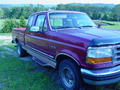
Sadly, I am the only owner.
I pretty much know every nut and bolt on this truck personally.
Just a "Custom" so no power windows, A/C, exterior lights, etc...
Yes it is the famous (or infamous) blue grommet DuraSpark II module. But from all the wiring diagrams I've seen it only receives power in start and run.
The distributor has both vacuum and centrifugal advance. Mine is recurved and starts @ 11 Deg.
gpedens,
By "tin can looking" things do you mean the flasher relays? With the turn signal one on the front of the fuse block and the 4 way hazard flasher on the back.
No underhood light and the interior light, ashtray and glove box lights function normally with both door switches.
My harness is in good shape with recent wireloom. (well, 2 years ago when I swapped the engine)
I'm kind of leaning toward a fried triode in the "new" 130A 3G alternator.
I know Ryan McCormick sells them for $40 online.
I pretty much know every nut and bolt on this truck personally.
Just a "Custom" so no power windows, A/C, exterior lights, etc...
Yes it is the famous (or infamous) blue grommet DuraSpark II module. But from all the wiring diagrams I've seen it only receives power in start and run.
The distributor has both vacuum and centrifugal advance. Mine is recurved and starts @ 11 Deg.
gpedens,
By "tin can looking" things do you mean the flasher relays? With the turn signal one on the front of the fuse block and the 4 way hazard flasher on the back.
No underhood light and the interior light, ashtray and glove box lights function normally with both door switches.
My harness is in good shape with recent wireloom. (well, 2 years ago when I swapped the engine)
I'm kind of leaning toward a fried triode in the "new" 130A 3G alternator.
I know Ryan McCormick sells them for $40 online.
Senior User
Joined: May 2008
Posts: 127
Likes: 0
The flasher things are usually round. The breakers are on the same board as the fuses and they are in little rectangular cans about 1 inch wide by 5/16 thick by 3/4 inch high. Since you have the bear bones type truck, it may not have any breakers.
Did you look under the hood and see how many wires you had on the starter relay? Thats the relay the big red battery cable goes to. it is usually just a foot or 2 from the battery. The starter relay will have 2 big terminals for the 2 big red cables and it will have 1 or 2 small terminals. Check all the wires on the starter relay for current , one at a time. Well you dont need to check the big red one from the battery.
Is there more than one red wire on the red ot + battery terminal? If yes check it too.
Did you look under the hood and see how many wires you had on the starter relay? Thats the relay the big red battery cable goes to. it is usually just a foot or 2 from the battery. The starter relay will have 2 big terminals for the 2 big red cables and it will have 1 or 2 small terminals. Check all the wires on the starter relay for current , one at a time. Well you dont need to check the big red one from the battery.
Is there more than one red wire on the red ot + battery terminal? If yes check it too.
Senior User
Joined: May 2008
Posts: 127
Likes: 0
Geeze, I forgot to mention if you think it is the alternator, just unplug the wires to the alternator. I think there is one or 2 plugs. Now that I think of it one of the wires from the starter relay probably goes to the alternator.
Thread Starter
|
pedant
Joined: Jan 2008
Posts: 23,576
Likes: 40
From: EXTREME southwest CT
Yes, my Alternator output goes through a 175A Mega fuse and connects to the hot lug of the starter solenoid. There is only one (green w/ red) wire going in and one (red) wire out of my 3G.
I am using an adapter harness like this:

And this,,,,

I also have 3 fuseable links on the hot lug, but no breakers like you describe at the fuse panel under the dash.
I have had the plug on my old 2G melt twice. Good riddance!
I am using an adapter harness like this:
And this,,,,
I also have 3 fuseable links on the hot lug, but no breakers like you describe at the fuse panel under the dash.
I have had the plug on my old 2G melt twice. Good riddance!
FTE Stories
Ford Trucks for Ford Truck Enthusiasts

3 Best / 3 Worst Parts of Modern Ford Ownership
Brett Foote
10 Amazing Upgrades That Solve Common Ford Truck Owner Headaches
Pouria Savadkouei
Every 2026 Ford Engine Explained
Brett Foote
10 Ugly Ford Trucks That We Still Kinda Love
Joe Kucinski
10 Things Every Truck Owner NEEDS (2026 Edition)
Michael S. Palmer
Rezvani's Latest Post-Apocalyptic Monster Is a Ford F-150 Raptor Underneath
Verdad Gallardo
Top 10 Most Expensive Ford Trucks Ever Sold on Bring a Trailer
Joe Kucinski
2027 Ford Super Duty Buyer's Guide (Every Model, Engine, & Package)
Brett Foote
Top 10 Ford Truck Tragedies
Joe Kucinski
Elder User
Joined: Nov 2005
Posts: 834
Likes: 0
Had a diode fail in an alternator. Didn't measure the amp draw, but if drained the battery in a few hours.
I would bet on the alternator, but if it is not, you could try hooking the battery up and waiting a couple of hours, then start touching or using an Infrared temp gun to check for something being very warm. That much power will heat up whatever is the problem.
Good Luck Frank
I would bet on the alternator, but if it is not, you could try hooking the battery up and waiting a couple of hours, then start touching or using an Infrared temp gun to check for something being very warm. That much power will heat up whatever is the problem.
Good Luck Frank


Thread Starter
|
pedant
Joined: Jan 2008
Posts: 23,576
Likes: 40
From: EXTREME southwest CT
I have replaced the mechanical pump and both tanks at one point or another.
I think you are thinking about 'hot fuel handling' where a low pressure pump circulates fuel up past the carb and returns back to the tank in an effort to eliminate vapor lock.
My truck was ordered from a dealer in Larchmont, NY and may not be optioned this way due to the climate here.
Thread Starter
|
pedant
Joined: Jan 2008
Posts: 23,576
Likes: 40
From: EXTREME southwest CT
Yep, it's the alternator...
Checked after work today.
And the guy at my local auto parts won't "trust" my application over the phone. He wants me to take it out and bring it to his counter to match up before he will get one from his warehouse.
 GAAAAAAH!!!!
Flipping dipstick.
Other things drive off that belt.
I DON'T have time to go over there three times for one part.
I want to pick it up, do it at my leisure and return the core later.
I could buy one off Ebay for $50 + $15 shipping, NOT $189.99 + $25 core + $11.40Tx if I felt like driving around for a week and unhooking my battery everywhere I go.

Checked after work today.
And the guy at my local auto parts won't "trust" my application over the phone. He wants me to take it out and bring it to his counter to match up before he will get one from his warehouse.
GAAAAAAH!!!!Flipping dipstick.
Other things drive off that belt.
I DON'T have time to go over there three times for one part.
I want to pick it up, do it at my leisure and return the core later.
I could buy one off Ebay for $50 + $15 shipping, NOT $189.99 + $25 core + $11.40Tx if I felt like driving around for a week and unhooking my battery everywhere I go.
Thread Starter
|
pedant
Joined: Jan 2008
Posts: 23,576
Likes: 40
From: EXTREME southwest CT
Aaaa,
I disconnected all the lugs from the always hot post of the solenoid and connected my meter to that end of the battery + cable.
I tried each of the fuseable links first and saw no current flowing when set to 10 amp scale. When connected to the alternator output cable it shot right up to 4.8x Amps.
I disconnected all the lugs from the always hot post of the solenoid and connected my meter to that end of the battery + cable.
I tried each of the fuseable links first and saw no current flowing when set to 10 amp scale. When connected to the alternator output cable it shot right up to 4.8x Amps.
Senior User
Joined: May 2008
Posts: 127
Likes: 0
thanks ardwrkn, that kind of detail will help the less technical folks. I have one of them clip on DC amp meters that makes it real easy as long as you can get to the wire. Dont even need to disconnect. It will read to about 10 milliamps or 0.01 amps DC. But when you get right down to it, the meter I use the most is one sold by Harbor Freight. They run it on sale for $3 or free with a $30 to $50 purchase. It is a digital meter and will 10 amps DC, check a transistor, 0.2 and 2 vdc scale. I have bought several over the years and keep one in several places. Given several away to the youngins boyfriends or others that seem to be interested in DYI. You can check most car sensors with them. Their biggest weakness is the probe end breaks off fairly often due to the small wire and bending motion using the meter. Main thing to remember is to check it on a known something before you use it, but that applies to all meters and test equipment.