


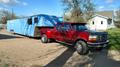


4x4 guys?

Elder User
Joined: Sep 2005
Posts: 837
Likes: 0
From: Standish ME
If you have manual hubs you will see a little turn **** in the center of your front wheels. turn both the driver and passenger side ones to the "lock" position. Then in the cab of the truck pull back on the 4x4 lever until it engages. For 4L you have to push the shifter down and then pull back once more. Sometimes the linkage can get rusty and not let you put it into 4L so make sure that you lube it up somehow next time you are under the truck.
Also once you are out of 4WD and you have unlocked your hubs you may need to drive the truck in reverse for a few feet to let the T-case disengage.
Also once you are out of 4WD and you have unlocked your hubs you may need to drive the truck in reverse for a few feet to let the T-case disengage.

Posting Guru
Joined: Nov 2007
Posts: 2,158
Likes: 0
From: West Texas
To shift into 4 high, lock the hubs then the first time do it from a stop, after that if you hit a clear patch of road just shift into 2 high on the fly and when you see snow again shift back to 4 high but never do it while your wheels are spinning! You can do it at any reasonable speed but I wouldn't do it over 60 myself.
To shift to 4 low, always do it with transmission in neutral and truck stopped completely. Shift in and out stopped and in neutral.
Do NOT run in 4 wheel on dry pavement ever. It's ok if the hubs are locked but do not put the shifter in 4 wheel on anything hard. Be easy going around corners too as the gears like to bind, especially if you have a locker in the back like me. I can't turn on ice sometimes. I have to slow way down and goose it around the corner to make the front end pull around.
To shift to 4 low, always do it with transmission in neutral and truck stopped completely. Shift in and out stopped and in neutral.
Do NOT run in 4 wheel on dry pavement ever. It's ok if the hubs are locked but do not put the shifter in 4 wheel on anything hard. Be easy going around corners too as the gears like to bind, especially if you have a locker in the back like me. I can't turn on ice sometimes. I have to slow way down and goose it around the corner to make the front end pull around.
Posting Guru
Joined: Nov 2007
Posts: 2,158
Likes: 0
From: West Texas
Because you won't have a transfer case for long if you do. Do not use it in the rain either. It needs to be only on surfaces where the wheel scan slip, like mud, snow sand or ice. Never on pavement unless it's covered with ice or snow. You will tear it up fast.
Oh, one last thing about how to use it.
Your door sticker has specific tire pressures listed for a reason. One of them being that it is 4 wheel drive. Most people don't know this but you actually have a different gear ratio in the front adn back. Like 4.09 front and 4.10 back. The tire pressures on teh door sticker fit into that equation by keeping the front end turning just a little faster than the rear to help prevent gear bind. I know not many people know this but even a rear axle pulls the truck. It doesn't push it. With two axles on opposite ends pulling together the one you steer with always needs to go faster or you will have problems. It's the same deal on a multiscrew ship. Propellers pull even when they are in the back.
Keep it as stock as you can except for the exhaust. 4 inch is more than enough and it will surprise you how much better it runs.
Oh, one last thing about how to use it.
Your door sticker has specific tire pressures listed for a reason. One of them being that it is 4 wheel drive. Most people don't know this but you actually have a different gear ratio in the front adn back. Like 4.09 front and 4.10 back. The tire pressures on teh door sticker fit into that equation by keeping the front end turning just a little faster than the rear to help prevent gear bind. I know not many people know this but even a rear axle pulls the truck. It doesn't push it. With two axles on opposite ends pulling together the one you steer with always needs to go faster or you will have problems. It's the same deal on a multiscrew ship. Propellers pull even when they are in the back.
Keep it as stock as you can except for the exhaust. 4 inch is more than enough and it will surprise you how much better it runs.

Thread Starter
|
Postmaster
Joined: Nov 2009
Posts: 4,556
Likes: 0
From: Crapy southern New Jersey
Because you won't have a transfer case for long if you do. Do not use it in the rain either. It needs to be only on surfaces where the wheel scan slip, like mud, snow sand or ice. Never on pavement unless it's covered with ice or snow. You will tear it up fast.
Oh, one last thing about how to use it.
Your door sticker has specific tire pressures listed for a reason. One of them being that it is 4 wheel drive. Most people don't know this but you actually have a different gear ratio in the front adn back. Like 4.09 front and 4.10 back. The tire pressures on teh door sticker fit into that equation by keeping the front end turning just a little faster than the rear to help prevent gear bind. I know not many people know this but even a rear axle pulls the truck. It doesn't push it. With two axles on opposite ends pulling together the one you steer with always needs to go faster or you will have problems. It's the same deal on a multiscrew ship. Propellers pull even when they are in the back.
Keep it as stock as you can except for the exhaust. 4 inch is more than enough and it will surprise you how much better it runs.
Oh, one last thing about how to use it.
Your door sticker has specific tire pressures listed for a reason. One of them being that it is 4 wheel drive. Most people don't know this but you actually have a different gear ratio in the front adn back. Like 4.09 front and 4.10 back. The tire pressures on teh door sticker fit into that equation by keeping the front end turning just a little faster than the rear to help prevent gear bind. I know not many people know this but even a rear axle pulls the truck. It doesn't push it. With two axles on opposite ends pulling together the one you steer with always needs to go faster or you will have problems. It's the same deal on a multiscrew ship. Propellers pull even when they are in the back.
Keep it as stock as you can except for the exhaust. 4 inch is more than enough and it will surprise you how much better it runs.
Trending Topics
Posting Guru
Joined: Nov 2007
Posts: 2,158
Likes: 0
From: West Texas
You can shift in and out of 4 hi and 2 hi at any speed. I like to keep it under 60 myself just because I did it once when I had a almost flat tire I didint' know about and it didn't feel too good. For auto hubs, the first time you shift into 4 hi, you need to stop then you can shift in and out all you want unless you have backed up. Backing up unlocks them if it in 2 wheel. Just make sure your tire pressures are right and it will be ok.
FTE Stories
Ford Trucks for Ford Truck Enthusiasts

Top 10 Fords at 2026 Carlisle Ford Nationals
Joe Kucinski
3 Best / 3 Worst Parts of Modern Ford Ownership
Brett Foote
10 Amazing Upgrades That Solve Common Ford Truck Owner Headaches
Pouria Savadkouei
Every 2026 Ford Engine Explained
Brett Foote
10 Ugly Ford Trucks That We Still Kinda Love
Joe Kucinski
10 Things Every Truck Owner NEEDS (2026 Edition)
Michael S. Palmer
Rezvani's Latest Post-Apocalyptic Monster Is a Ford F-150 Raptor Underneath
Verdad Gallardo
Top 10 Most Expensive Ford Trucks Ever Sold on Bring a Trailer
Joe Kucinski
2027 Ford Super Duty Buyer's Guide (Every Model, Engine, & Package)
Brett Foote
Posting Guru
Joined: May 2006
Posts: 1,327
Likes: 1
From: Kingsport, TN
 4x4 ?
4x4 ?
Just for U'r info... there is a 4x4 thread. Most of "them" almost take for granted what to do with a 4x4 AND how to do it. It's nice to find a
 . One word to the wise DO NOT track sideways on a hill - unless you want to roll to the bottom. AND - street tread doesn't work too well - get M/S tires, not AT's. Just a bit of common cents.
there is a 4x4 thread. Most of "them" almost take for granted what to do with a 4x4 AND how to do it. It's nice to find a . One word to the wise DO NOT track sideways on a hill - unless you want to roll to the bottom. AND - street tread doesn't work too well - get M/S tires, not AT's. Just a bit of common cents.

Logistics Pro
Joined: Jan 2005
Posts: 4,129
Likes: 4
From: Brandon, MB

A question like that would get you flamed hard in the 4x4 forum. Here, at home in the OBS PSD forum, life is good. These guys ROCK!
Last edited by Fullcrew7.3; Feb 7, 2010 at 09:22 PM. Reason: Spelling
Thread Starter
|
Postmaster
Joined: Nov 2009
Posts: 4,556
Likes: 0
From: Crapy southern New Jersey
That why I posted it here
Posting Guru
Joined: May 2006
Posts: 1,327
Likes: 1
From: Kingsport, TN
dougbrown - Hiway tread/front & M/S rear ?? IF you R off-road, you might want good steering... There migfht be a slight UNDER-steer thing going on in 4x4 off-road. Running "slicks" on the front may be fun if on THICK ice - but not good if you're on a narrow trail or going up a steep incline. IF you're playing in a smooth/level field, it won't matter much at slow speed. IF you want to be serious about off-road later, get an extra set of 8-10 inch rims and mount M/S tread for when you go play...(It's easier & cheaper to change tires than to replace fenders or more. BETTER YET - go play with somebody else in their 4x4 and learn.

Fleet Mechanic

Joined: Aug 2007
Posts: 1,508
Likes: 2
From: The boonies by Dallas OR
When you turn your truck into a circle, the front end travels around a tighter curve than the rear end. The longer the wheelbase, the more pronounced the effect. Watch a long vehicle like a school bus and the effect is very apparent.
The transfer case doesn't have a differential. It tries to force the front and rear axle to spin at the same exact speed. When you're going straight all is good, but the moment you turn at all the front wheels are going slower than the rear. Something must slide or break. If the ground is slick, then a wheel just slides. If the ground has some give like a gravel road, you'll notice the truck hop. What's happening is the frame and suspension are all twisting to take up the speed difference until one wheel finally gets enough force to slip. The better the traction, the more violent the hopping. If you do this on dry pavement it'll hop a few times then a u-joint or the T-case chain will bust.
Fleet Mechanic
Joined: Aug 2007
Posts: 1,508
Likes: 2
From: The boonies by Dallas OR
A bit of advice on long life of the 4x4 parts:
Many people will notice that the front end parts won't last as long time wise as the rear end stuff even though the rear end stuff turns far more miles. This is because machinery doesn't do as well when it sits unused, particularly when it's exposed to the weather. A front end left to sit will get rust spots on bearing races, dried out seals and so on. It will last longer if it moves at least some.
If you have manual hubs, whenever you're running with the hubs unlocked, drive a few miles in 4 hi. Since the hubs are unlocked, nothing is strained. But everything up front will spin some and lubricate up.
Many people will notice that the front end parts won't last as long time wise as the rear end stuff even though the rear end stuff turns far more miles. This is because machinery doesn't do as well when it sits unused, particularly when it's exposed to the weather. A front end left to sit will get rust spots on bearing races, dried out seals and so on. It will last longer if it moves at least some.
If you have manual hubs, whenever you're running with the hubs unlocked, drive a few miles in 4 hi. Since the hubs are unlocked, nothing is strained. But everything up front will spin some and lubricate up.