



Why was the Excursion discontinued?

Cargo Master
Joined: Nov 2008
Posts: 2,332
Likes: 2
From: Summit, MS
It was either 04 or 05 when I worked as a salesman at the largest Ford store in the state. They had row after row of Explorers, Expeditions, Super Duties, you name it but there was only TWO Excursions on the whole lot. And they sat there for months and months.
Post Fiend
Joined: Oct 2002
Posts: 11,314
Likes: 4
Old adage:
"Ya can't sell, what ya ain't got" - Maybe those two were the wrong ones
I too agree it was so they could build more superduties, and don't blame them !
I got mine - but had to hit every dealer in Dallas area to find my 05....
really wanted another limited, but this EB had all the equipment...
and I will drive it AFTER the wheels fall off
"Ya can't sell, what ya ain't got" - Maybe those two were the wrong ones
I too agree it was so they could build more superduties, and don't blame them !
I got mine - but had to hit every dealer in Dallas area to find my 05....
really wanted another limited, but this EB had all the equipment...
and I will drive it AFTER the wheels fall off

Elder User
Joined: Aug 2007
Posts: 980
Likes: 1
From: Stuart, FL
THe Ex was priced cheaper than the Expy with a gas engine. More vehicle, less money. But with the Ex you COULD get the diesel and they charged out the nose for it. Again, supply and demand.
Elder User
Joined: Aug 2007
Posts: 980
Likes: 1
From: Stuart, FL
Old adage:
"Ya can't sell, what ya ain't got" - Maybe those two were the wrong ones
I too agree it was so they could build more superduties, and don't blame them !
I got mine - but had to hit every dealer in Dallas area to find my 05....
really wanted another limited, but this EB had all the equipment...
and I will drive it AFTER the wheels fall off
"Ya can't sell, what ya ain't got" - Maybe those two were the wrong ones
I too agree it was so they could build more superduties, and don't blame them !
I got mine - but had to hit every dealer in Dallas area to find my 05....
really wanted another limited, but this EB had all the equipment...
and I will drive it AFTER the wheels fall off
Posting Guru
Joined: Oct 2006
Posts: 1,714
Likes: 0
$55,251...........I don't believe there are any Expys that stickered at $55K!
Posting Guru
Joined: Oct 2006
Posts: 1,714
Likes: 0
I think your 100% correct! Not many people can swing $50K for an SUV! Those other cheaper SUV sales went to the Sub and Yukon XL's which in the lower trim levels went for around $29K, and fully loaded in the low $40's.....Ford knew they had the only 3/4 ton Diesel SUV with the Excursion and didn't flex too much downward on there OTD pricing! The Diesels I looked at were always outrageous priced, the 5.4's went reasonably, but even the V10's were pricey when new!
FTE Stories
Ford Trucks for Ford Truck Enthusiasts

10 Things Every Truck Owner NEEDS (2026 Edition)
Michael S. Palmer
Rezvani's Latest Post-Apocalyptic Monster Is a Ford F-150 Raptor Underneath
Verdad Gallardo
Top 10 Most Expensive Ford Trucks Ever Sold on Bring a Trailer
Joe Kucinski
2027 Ford Super Duty Buyer's Guide (Every Model, Engine, & Package)
Brett Foote
Top 10 Ford Truck Tragedies
Joe Kucinski
AEV FXL Super Duty - the Super Duty Raptor Ford Doesn't Make
Brett Foote
Lobo Vs Lobo: Proof the F-150 Lobo Should Be Even Lower!
Michael S. Palmer
Ford's 2001 Explorer Sportsman Concept Looks For a New Home
Verdad Gallardo
10 Best Ford Truck Engines We Miss the Most!
Joe Kucinski
Elder User
Joined: Aug 2007
Posts: 980
Likes: 1
From: Stuart, FL
That's with the Diesel. If it's gas they were cheaper. At least that's how I remember it.

Posting Guru
Joined: Aug 2007
Posts: 2,440
Likes: 1
Excursion production figures
For those of you wondering about Excursion production figures, here's what I got from Ford about a year ago.
A break down by year.
2000
69,811
2001
36,967
2002
28,398
2003
25,619
2004
21,669
2005
24,097
A break down by year.
2000
69,811
2001
36,967
2002
28,398
2003
25,619
2004
21,669
2005
24,097
More Turbo
Joined: Jul 2007
Posts: 523
Likes: 1
From: Indiana
I kick myself for not getting one in 2003 when the 0% financing was big and our Expedition was reaching 150k...wife didn't want to drive anything that big. Now she complains that I have to make 2 trips to take the camper and boat places because the ****-ant grand caravan can't haul squat.

Cargo Master


Joined: Jan 2008
Posts: 2,219
Likes: 190
From: Colorado Springs
He was in fact meaning that is is a FULL size. Standard: full size. opposite of subcompact. An excursion is a bit smaller than a bus too.
Cargo Master

Joined: Mar 2005
Posts: 2,790
Likes: 24
From: Mount Royal, NJ

Just for the sake of history, posterity and what not, here is an article I saved from the web a few years back. It has some interesting insight that they knew the market would be small:
Making The Monster | Automotive Industries | Find Articles at BNET
Automotive Industries, August 1999, Cheryl Jensen
Making The Monster
Creating and building Ford's giant new Excursion SUV.
When Ford decided to combat General Motors' Suburban, it considered the most obvious and presumably simple approach: stretch the successful F-150-based Expedition by about 20 inches.
It seemed a good plan, but it didn't work, recalls Ken Timmer, chief program engineer. Too expensive, and it wouldn't provide the comfort, trailer towing capability or the interior volume necessary.
But building a completely new platform was also out of the question, considering the size of the market, Timmer notes. While the large SUV segment had doubled to over 150,000 units by 1998, it still wasn't big enough to support a unique vehicle. So Ford's Super Duty platform, the over-8,500-pounds GVW models that include the F-250 through F-550, got the nod.
"Being able to launch from, and carry over two-thirds of the parts from the Super Duty, contributed to the program's cost-effectiveness," says Timmer. "The cab back to the B-pillar is common with the F-250. Then we extended the rest of vehicle to form a utility body."
Advertisement
Also, boosting the Super Duty's 300,000-unit annual production volume by 50,000 Excursions made a juicy financial plan. About 60% of the Excursion mix is expected to be four-wheel-drive models.
60 Prototypes
While Ford officials will not divulge the investment in the UW137 program, Timmer says it took 23 months from approval to Job One. Platform sharing and computer-aided engineering (CAE) permitted them to go directly into production tooling, shaving approximately six months off the program.
"We had a good base of computer-aided modeling from the Super Duty program to determine what the structural rigidity needs would be to make it (the Excursion) solid," he explains. But using Super Duty as the program's foundation didn't mean it would be easy to engineer what would become the world's largest sport utility.
One of the most challenging areas was the rear area around the D-pillars and across the rear header, says Timmer. Since that area was patterned after Expedition's, "the team had some good clues for where we wanted to be," he says. But testing showed that those areas required additional reinforcement.
Nevertheless, Timmer maintains, "the modifications were much less than would have been normally necessary if we had been doing it on a total prototype basis." He says around 60 prototypes were built; "but normally a program of this nature would have at least double that."
Deriving Excursion from Super Duty had its advantages, but it also posed challenges. A major one was how to convert a heavy-duty, commercial chassis and powertrain into something acceptable to a growing personal-use market.
Key changes included modifying the suspension to give Excursion a smoother, softer ride. Spring rates were reduced up to 20% in conjunction with changes to the shock valving, says Timmer. The two were done in concert, "to reduce some of the low-speed damping," he recalls. This gives a softer feel over small bumps.
Timmer admits there was concern over whether the Super Duty's Twin I-Beam front suspension could be tamed for use in the 4x2 version of the Excursion. However, the decades-old design has a reputation for strength and toughness that the program felt was very important to keep -- in a refined mode.
To reduce steering effort and improve on-center feel on the 4x4 configuration, engineers made changes to the F-250 platform's torsion bars and increased the Pitman arm length. Engine mounts were also revised for improved vibration control. The mounts on the 4x2 chassis had the most significant changes, Timmer says.
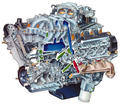
Excursion's engines come directly from the Super Duty. The standard 4x2 powerplant is the 5.4L V-8; the 6.8L V-10 is standard on 4x4s. Also available is the 7.3L Navistar-built V-8 diesel. Four-wheel-drive customers can order either the 5.4L V-8 or the diesel.
Ford takes pride in claiming Excursion will be certified with the U.S. Environmental Protection Agency as a Low-Emission Vehicle (LEV) in all states and on all engines, a claim the company hopes will help deflect criticism of the truck's overall size and fuel consumption. Though LEV certification is voluntary, Excursion really only meets medium-duty truck LEV levels, because of its over 8,500-pound weight. These regs are roughly twice as "dirty" as passenger-car LEV levels -- the "loophole" noted by Excursion's (and Suburban's) enemies.
Those engines will be fed by one part not carried over from the Super Duty: the fuel tank. The biggest Super Duty tank is 38 gallons. The Excursion gets a 44-gallon tank for better range since market research shows the target buyer drives long distances on vacations and is likely to use more fuel because of trailering.
Despite being dubbed the "Ford Valdez" by hecklers, the Excursion was a logical move into yet another subset of the truck market. And a smart move at that: analysts reckon Ford will net upwards of $20,000 profit per vehicle.
Making Excursion at Louisville meant new body, trim and paint departments.
Excursion is built at Ford's Kentucky Truck Plant in Louisville, where all Super Duty models are produced. In overall length (226.7 inches) it is only slightly longer than an F-250 Regular Cab (222.2 inches) with an eight-foot pickup box. And it's shorter than SuperCab and Crew Cab models.
"When you see this vehicle going down the line, it fits right in," observes Ken Timmer, chief program engineer. "It's the same configuration and size as everything else built at that plant."
The manufacturing differences are the result of building a longer sport-utility body instead of a cab attached to a pickup box. At 126 inches long, Excursion's finished roof panel is 56 inches longer than the Crew Cab's panel.
The vehicle's longer body and the vehicle's impact on plant capacity necessitated a unique body shop, says Buster McCreary, plant launch manager for Excursion.
Advertisement
A new stamping plant was built adjacent to the plant, and a new Schuler press was purchased to produce some of Excursion's unique parts, including the roof and door panels. The Schuler is also being used for Super Duty front doors and roofs.
In addition, the plant added a new trim area and paint department for Excursion, says McCreary. Engine, frame and chassis lines are shared with the Super Duty models. These unique facilities weren't as expensive as they could have been, since the Excursion program utilizes space and equipment made available when Ford stopped building heavy-duty Class 8 trucks at the Kentucky plant. Other cost savings resulted from reducing the complexity of parts installed at the assembly plant.
"For example, we reduced the complexity of the headliner from 53 to 7 parts as a result of manufacturing input," McCreary notes. "It's a real savings, because when you reduce complexity you reduce floor space utilized."
Despite the media attention paid to the size of the vehicle and its emissions, Ford's new giant "really wasn't a difficult vehicle from the manufacturing perspective," says McCreary.
-- CJ
COPYRIGHT 1999 Cahners Publishing Company
COPYRIGHT 2000 Gale Group
Making The Monster | Automotive Industries | Find Articles at BNET
Automotive Industries, August 1999, Cheryl Jensen
Making The Monster
Creating and building Ford's giant new Excursion SUV.
When Ford decided to combat General Motors' Suburban, it considered the most obvious and presumably simple approach: stretch the successful F-150-based Expedition by about 20 inches.
It seemed a good plan, but it didn't work, recalls Ken Timmer, chief program engineer. Too expensive, and it wouldn't provide the comfort, trailer towing capability or the interior volume necessary.
But building a completely new platform was also out of the question, considering the size of the market, Timmer notes. While the large SUV segment had doubled to over 150,000 units by 1998, it still wasn't big enough to support a unique vehicle. So Ford's Super Duty platform, the over-8,500-pounds GVW models that include the F-250 through F-550, got the nod.
"Being able to launch from, and carry over two-thirds of the parts from the Super Duty, contributed to the program's cost-effectiveness," says Timmer. "The cab back to the B-pillar is common with the F-250. Then we extended the rest of vehicle to form a utility body."
Advertisement
Also, boosting the Super Duty's 300,000-unit annual production volume by 50,000 Excursions made a juicy financial plan. About 60% of the Excursion mix is expected to be four-wheel-drive models.
60 Prototypes
While Ford officials will not divulge the investment in the UW137 program, Timmer says it took 23 months from approval to Job One. Platform sharing and computer-aided engineering (CAE) permitted them to go directly into production tooling, shaving approximately six months off the program.
"We had a good base of computer-aided modeling from the Super Duty program to determine what the structural rigidity needs would be to make it (the Excursion) solid," he explains. But using Super Duty as the program's foundation didn't mean it would be easy to engineer what would become the world's largest sport utility.
One of the most challenging areas was the rear area around the D-pillars and across the rear header, says Timmer. Since that area was patterned after Expedition's, "the team had some good clues for where we wanted to be," he says. But testing showed that those areas required additional reinforcement.
Nevertheless, Timmer maintains, "the modifications were much less than would have been normally necessary if we had been doing it on a total prototype basis." He says around 60 prototypes were built; "but normally a program of this nature would have at least double that."
Deriving Excursion from Super Duty had its advantages, but it also posed challenges. A major one was how to convert a heavy-duty, commercial chassis and powertrain into something acceptable to a growing personal-use market.
Key changes included modifying the suspension to give Excursion a smoother, softer ride. Spring rates were reduced up to 20% in conjunction with changes to the shock valving, says Timmer. The two were done in concert, "to reduce some of the low-speed damping," he recalls. This gives a softer feel over small bumps.
Timmer admits there was concern over whether the Super Duty's Twin I-Beam front suspension could be tamed for use in the 4x2 version of the Excursion. However, the decades-old design has a reputation for strength and toughness that the program felt was very important to keep -- in a refined mode.
To reduce steering effort and improve on-center feel on the 4x4 configuration, engineers made changes to the F-250 platform's torsion bars and increased the Pitman arm length. Engine mounts were also revised for improved vibration control. The mounts on the 4x2 chassis had the most significant changes, Timmer says.
Excursion's engines come directly from the Super Duty. The standard 4x2 powerplant is the 5.4L V-8; the 6.8L V-10 is standard on 4x4s. Also available is the 7.3L Navistar-built V-8 diesel. Four-wheel-drive customers can order either the 5.4L V-8 or the diesel.
Ford takes pride in claiming Excursion will be certified with the U.S. Environmental Protection Agency as a Low-Emission Vehicle (LEV) in all states and on all engines, a claim the company hopes will help deflect criticism of the truck's overall size and fuel consumption. Though LEV certification is voluntary, Excursion really only meets medium-duty truck LEV levels, because of its over 8,500-pound weight. These regs are roughly twice as "dirty" as passenger-car LEV levels -- the "loophole" noted by Excursion's (and Suburban's) enemies.
Those engines will be fed by one part not carried over from the Super Duty: the fuel tank. The biggest Super Duty tank is 38 gallons. The Excursion gets a 44-gallon tank for better range since market research shows the target buyer drives long distances on vacations and is likely to use more fuel because of trailering.
Despite being dubbed the "Ford Valdez" by hecklers, the Excursion was a logical move into yet another subset of the truck market. And a smart move at that: analysts reckon Ford will net upwards of $20,000 profit per vehicle.
Making Excursion at Louisville meant new body, trim and paint departments.
Excursion is built at Ford's Kentucky Truck Plant in Louisville, where all Super Duty models are produced. In overall length (226.7 inches) it is only slightly longer than an F-250 Regular Cab (222.2 inches) with an eight-foot pickup box. And it's shorter than SuperCab and Crew Cab models.
"When you see this vehicle going down the line, it fits right in," observes Ken Timmer, chief program engineer. "It's the same configuration and size as everything else built at that plant."
The manufacturing differences are the result of building a longer sport-utility body instead of a cab attached to a pickup box. At 126 inches long, Excursion's finished roof panel is 56 inches longer than the Crew Cab's panel.
The vehicle's longer body and the vehicle's impact on plant capacity necessitated a unique body shop, says Buster McCreary, plant launch manager for Excursion.
Advertisement
A new stamping plant was built adjacent to the plant, and a new Schuler press was purchased to produce some of Excursion's unique parts, including the roof and door panels. The Schuler is also being used for Super Duty front doors and roofs.
In addition, the plant added a new trim area and paint department for Excursion, says McCreary. Engine, frame and chassis lines are shared with the Super Duty models. These unique facilities weren't as expensive as they could have been, since the Excursion program utilizes space and equipment made available when Ford stopped building heavy-duty Class 8 trucks at the Kentucky plant. Other cost savings resulted from reducing the complexity of parts installed at the assembly plant.
"For example, we reduced the complexity of the headliner from 53 to 7 parts as a result of manufacturing input," McCreary notes. "It's a real savings, because when you reduce complexity you reduce floor space utilized."
Despite the media attention paid to the size of the vehicle and its emissions, Ford's new giant "really wasn't a difficult vehicle from the manufacturing perspective," says McCreary.
-- CJ
COPYRIGHT 1999 Cahners Publishing Company
COPYRIGHT 2000 Gale Group