


Check Engine Codes---Help!!

Thread Starter
|
New User
Joined: Dec 2009
Posts: 6
Likes: 0
From: Houston, TX
Check Engine Codes---Help!!
My check engine light is on. I've been told what the codes are that could be problem. I am on a budget, but, think I need to just replace EGR Solenoid or the DPFE sensor to fix it.  Here are the codes:
PO732 Gear 2 incorrect ratio
PO401 EGR insufficient flow detected
PO171 System lean bank 1
PO174 System lean bank 2
PO300 Random misfire detected
Repair shop said I needed spark plugs replaced, fuel filter changed, EGR solenoid-sensor replaced, Clean TB, Clean fuel injectors, Idle control motor.
What do you think? How much should it cost? Do you think I can change the EGR solenoid-sensor or DPFE sensor, reset the check engine light, and be good?
Here are the codes:PO732 Gear 2 incorrect ratio
PO401 EGR insufficient flow detected
PO171 System lean bank 1
PO174 System lean bank 2
PO300 Random misfire detected
Repair shop said I needed spark plugs replaced, fuel filter changed, EGR solenoid-sensor replaced, Clean TB, Clean fuel injectors, Idle control motor.
What do you think? How much should it cost? Do you think I can change the EGR solenoid-sensor or DPFE sensor, reset the check engine light, and be good?
Postmaster
Joined: May 2003
Posts: 3,310
Likes: 9
From: E.Lincoln County, NC

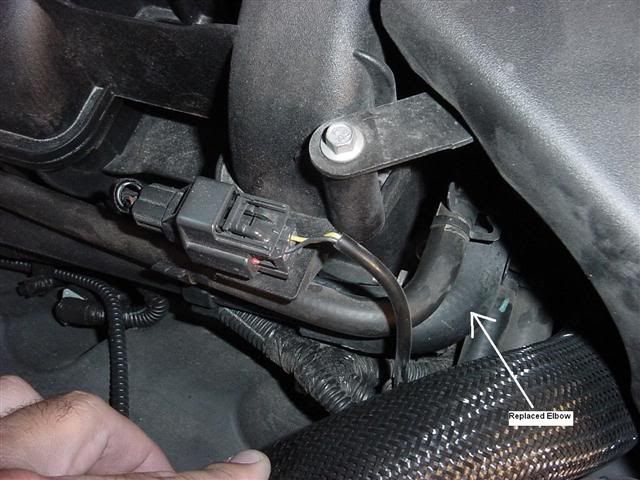
You have an '02 Explorer according to your profile. Do you have the 4.0L SOHC V6? If so, the PCV elbow is the first thing I would check. They're bad to split on the bottom and it will cause the 171 & 174 codes.
Thread Starter
|
New User
Joined: Dec 2009
Posts: 6
Likes: 0
From: Houston, TX
Help...Answer
I ask because of the diagnostic codes that appeared. One dealt with insufficent fuel flow detected and another stating random misfiring. The repair shop guy said that the EGR solenoid & sensor need to be replaced and that it will probably fix the flow issue. He also said that the spark plugs all need to be replaced, however, what he didn't know is that about a month ago I had a tuneup and they replaced the plugs. I thought it was possible that a tune up would solve problem and it didn't.
However, we were talking (not with repair guy) and thought that it possibly is not my fuel filter because he said the fuel pressure was fine and that when it idled (stopping at a light, acceleration, or stopping quickly) the pressure would go down. We seem to think it's just the sensor that needs replaced. The Explorer only has 65,000 miles on it and it's a 2002. It shouldn't need a fuel filter. I've had the truck die on me at stop lights twice while driving.
Here's the codes:
PO401 EGR insufficient flow detected
PO171 System lean bank 1
PO174 System lean bank 2
PO300 Random misfire detected
What do you think?
However, we were talking (not with repair guy) and thought that it possibly is not my fuel filter because he said the fuel pressure was fine and that when it idled (stopping at a light, acceleration, or stopping quickly) the pressure would go down. We seem to think it's just the sensor that needs replaced. The Explorer only has 65,000 miles on it and it's a 2002. It shouldn't need a fuel filter. I've had the truck die on me at stop lights twice while driving.
Here's the codes:
PO401 EGR insufficient flow detected
PO171 System lean bank 1
PO174 System lean bank 2
PO300 Random misfire detected
What do you think?
Postmaster
Joined: May 2003
Posts: 3,310
Likes: 9
From: E.Lincoln County, NC
There's nothing there about insufficient fuel flow. The insufficient flow is the EGR gasses flow measured by the DPFE. The 171 & 174 lean conditions are most likely caused by a vacuum leak, thus the need to check the PCV elbow. The 300 random misfire can be caused by the lean condition too. The 401 code may be a sticking EGR valve, which could also cause it to stall when you stop and it comes to an idle, if it sticks open. Most common stalling is the IAC (Idle Air Control) valve though. Most common 401 is the DPFE (EGR sensor) sensor.
Thread Starter
|
New User
Joined: Dec 2009
Posts: 6
Likes: 0
From: Houston, TX
Ok, so your saying...
So, basically, you are saying...check the PCV elbow for a leak and change the EGR sensor and that this will probably fix the issues. Am I right?
Trending Topics
Postmaster
Joined: May 2003
Posts: 3,310
Likes: 9
From: E.Lincoln County, NC
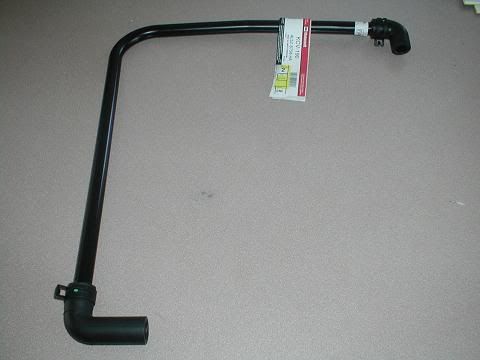
That's what I'd say from the descriptions you're giving. Replace the DPFE (EGR) sensor with a OEM Ford 4U7Z-9J460-AA or a Motorcraft DPFE4. Aftermarket sensors are known to fail much sooner than the OEM ones. I think you will find the elbow cracked/leaking. It's always on the bottom of the hose. Replacement number "should" be Motorcraft KCV190 or OEM Ford 4L5Z6758HA. After doing this be sure to have your codes cleared or just disconnect the battery for 5-10 minutes.

================================================== ======================
ISSUE:
Some vehicles may exhibit a malfunction indicator lamp (MIL) "ON" with or without the following symptoms: Rough Running, Lack of Power, Surge or Poor Fuel Economy, along with diagnostic trouble codes (DTC's) P0401, P0402, P1400 or P1401. This may be caused by an intermittently functioning tube-mounted delta pressure feedback EGR (DPFE) sensor (Figure 1).
NOTE: ALL LISTED APPLICATIONS CAN NOW BE SERVICED WITH DPFE SENSOR 4U7Z-9J460-AA (MOTORCRAFT DPFE4)
================================================== ======================
ISSUE:
Some vehicles may exhibit a malfunction indicator lamp (MIL) "ON" with or without the following symptoms: Rough Running, Lack of Power, Surge or Poor Fuel Economy, along with diagnostic trouble codes (DTC's) P0401, P0402, P1400 or P1401. This may be caused by an intermittently functioning tube-mounted delta pressure feedback EGR (DPFE) sensor (Figure 1).
NOTE: ALL LISTED APPLICATIONS CAN NOW BE SERVICED WITH DPFE SENSOR 4U7Z-9J460-AA (MOTORCRAFT DPFE4)
FTE Stories
Ford Trucks for Ford Truck Enthusiasts

10 Things Every Truck Owner NEEDS (2026 Edition)
Michael S. Palmer
Rezvani's Latest Post-Apocalyptic Monster Is a Ford F-150 Raptor Underneath
Verdad Gallardo
Top 10 Most Expensive Ford Trucks Ever Sold on Bring a Trailer
Joe Kucinski
2027 Ford Super Duty Buyer's Guide (Every Model, Engine, & Package)
Brett Foote
Top 10 Ford Truck Tragedies
Joe Kucinski
AEV FXL Super Duty - the Super Duty Raptor Ford Doesn't Make
Brett Foote
Lobo Vs Lobo: Proof the F-150 Lobo Should Be Even Lower!
Michael S. Palmer
Ford's 2001 Explorer Sportsman Concept Looks For a New Home
Verdad Gallardo
10 Best Ford Truck Engines We Miss the Most!
Joe Kucinski
Thread Starter
|
New User
Joined: Dec 2009
Posts: 6
Likes: 0
From: Houston, TX
Thanks!
Thanks alot! I'm going to check the hose & deal with the DPFE sensor. I've been getting the run around with auto repair shops. They all want to do seperate diagnostic tests (costing $65-$100) to figure out the problem. I am sick of spending the money to be told the same thing. I think you are probably correct on the hose & sensor. I'm going to fix those issues and see how it goes.
Kristi
Kristi
Postmaster
Joined: May 2003
Posts: 3,310
Likes: 9
From: E.Lincoln County, NC
Every make and model has a "typical" issue of some sort. These are the Explorer 4.0L's. I haven't had a problem with either .... yet. But I'm on several Explorer sites and this is always a hot topic. Let us know how it turns out. Good luck!
Thread Starter
|
New User
Joined: Dec 2009
Posts: 6
Likes: 0
From: Houston, TX
So, just got home from repair shop. Got the EGR sensor replaced. It seems to be running a whole lot better. Of course, it's only a short 5 minute ride, so I'm going to watch it for a couple of days. I let it idle in the driveway for a minute and felt a bit of shaking but not nearly as bad and it didn't seem to want to die on me. I take this as a good sign. Thanks for all your help.
Kristi
Kristi
Posting Guru
Joined: Apr 2008
Posts: 2,424
Likes: 2
From: Albemarle, NC
I think you need to check you PCV elbow too. Also, with the age and mileage, you should DEFFINATLY replace the fuel filter, just for maint. Not that it has anything to do with your problem, but it needs to be done regardless.

New User
Joined: Jan 2010
Posts: 3
Likes: 0
Similar issue-possible DPFE/Intake manifold gaskets
I get the 171 and 174 codes as well. I have gone through an entire can of carb cleaner to find vacuum leaks-and have found none! I have twice looked at that PCV Hose as a weak point, but seen/felt/ nothing and carb cleaner hasn't shown anything there either.
So I think I'm down to Intake Manifold Gaskets or DPFE Sensor. Would the intake manifold gaskets have any leak there that would have reacted/shown up with the carb cleaner test though?
How difficult a R&I is the DPFE Sensor?
Thanks guys!
So I think I'm down to Intake Manifold Gaskets or DPFE Sensor. Would the intake manifold gaskets have any leak there that would have reacted/shown up with the carb cleaner test though?
How difficult a R&I is the DPFE Sensor?
Thanks guys!

Postmaster
Joined: Oct 2009
Posts: 3,432
Likes: 7
The carb cleaner test in my opinion is inconclusive. If you get an idle up a leak is present, but if you don't get an idle up that doesn't mean anything. I have seen all to many leaks that refused to show up with the cleaner test. The reason is that the cleaner is still a liquid. Air may flow through a leak well, but get a liquid in there, it will fill the leak and slow it down to the point that it can't draw in enough cleaner to result in any rpm change, and the computer can mask it too since it has an idle air controller. Only larger leaks will result in enough RPM change to make this test conclusive. So let me give you another tool. If you combine this test with a good scan tool and look for changes in the STFT while testing for leaks, you will look for a strong positive fuel trim that drops down while spraying the leak area.

Thread
Thread Starter
Forum
Replies
Last Post
Stephanie Miller
Explorer, Sport Trac, Mountaineer & Aviator
3
Sep 19, 2013 09:58 PM
Shoob36
1997 - 2006 Expedition & Navigator
9
Mar 5, 2012 11:54 PM
