


dual quad build, what needed

Thread Starter
|
Elder User
Joined: Dec 2007
Posts: 526
Likes: 0
From: fallbrook ca.
dual quad build, what needed
ok, im helping my buddy plan a 390 build to go in one of his cougars.
currently we have 390 block, standard rotating assembly, cj heads, and an edelbrock dual quad manifold
this just what hes found so far on the property we have hundreds of carbs to choose from, we also MAY have steel crank layin around somewhere, but i dont know.
so, how do we make a 390 breath through 8v's? obviously its a high rpm engine, but how high? 6500, 7000, 8000rpm? also would forged pistons be required for this?
this is just my educated guess.
10.5:1cr
forged pistons
290/290 solid cam
roller rockers
dual 500cfm or higher?
open up oiling system
arp bolts on bottom end
headers & dual 3.5/4
possibly steel crank
currently we have 390 block, standard rotating assembly, cj heads, and an edelbrock dual quad manifold
this just what hes found so far on the property we have hundreds of carbs to choose from, we also MAY have steel crank layin around somewhere, but i dont know.
so, how do we make a 390 breath through 8v's? obviously its a high rpm engine, but how high? 6500, 7000, 8000rpm? also would forged pistons be required for this?
this is just my educated guess.
10.5:1cr
forged pistons
290/290 solid cam
roller rockers
dual 500cfm or higher?
open up oiling system
arp bolts on bottom end
headers & dual 3.5/4
possibly steel crank
Laughing Gas

Joined: Aug 2008
Posts: 840
Likes: 8
I run twin 600 cfm vacuum Holley's. I originaly used a pair of stock 1850s. Three mods are necessary.
#1 You need to connect the vacuum cans together. You can buy the kit, but what I did was to drill and tap the covers and install 90Deg grease fittings with the spring and ***** removed. It was kind of neat as the fittings faced each other, so a short rubber tube was all I needed.
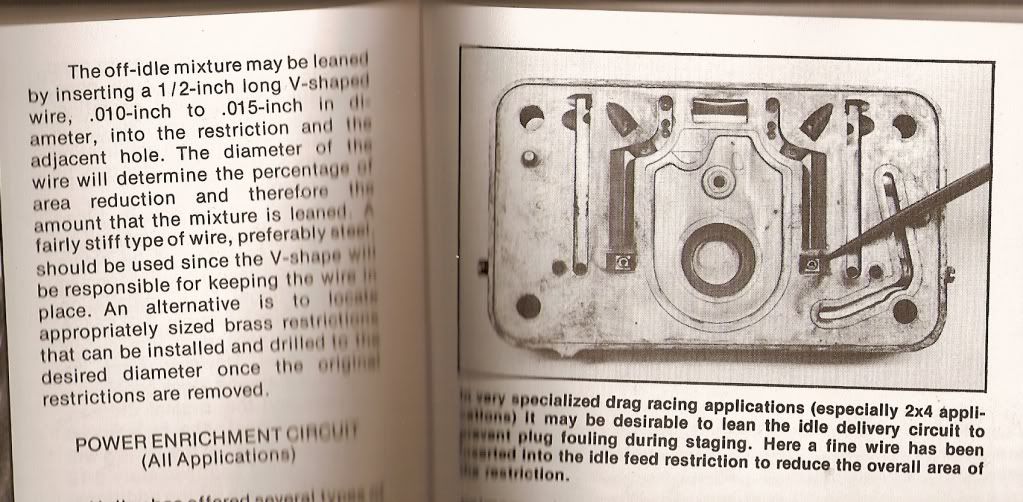
#2 The idle circuit is designed for single carb use. You need to restrict the idle passage or you will probably wind up with all 4 idle mixture screws all the way in, which works satisfactorily, but isn't optimized
#3 You need to drill a hole in the secondary carb bell-crank closer to the pivot point to get the mechanical advantage that allows the carbs to hit WOT simulatanously.
Eventually, I had Pony Carbs fix me up a pair of new ones. They seem to work the same as what I had, but I do have more range adjustment on the idle screws and they wound up somewhere betwen 1/4 and 1/2 turn out.
The front carb opens approx 30% before the rear one but due to the linkage being more agressive on the rear, they both wind up at WOT at the same time. See mod #3 above.
I havn't found a need to have the transfer slot open at all. If I try for that, my idle is way too high even with the secondaries adjusted just shy of sticking. Just adjust the idle stop screws evenly to get the idle you want, ...don't leave one carb closed and adjust the idle with the other. Balance them.
I use the lightest vacuum springs available (but not the shorty ones) with no trouble. Heavier vehicles may require stiffer springs (Holley kits are available).
Again, two carbs delivering twice as much fuel as required through the idle passage when at idle. I first used two generic carbs, and really couldn't get the idle to peak with the screws. All the way in seemed to be "almost" right. Guess some fuel must have been drawn through the transfer slots even though they wern't uncovered. Restricting the idle passages in the primary metering block is the answer.
The idle circuit is set by a fixed jet and is a rough setting. Fine tuning is possible by the adj screws. With twin carbs, it seems that even with the adj screws all the way in, the idle can be too rich. Carbs designed for 2x4 operation should have this taken care of, but if you purchase two carbs, each designed for single opration, you can have a problem.
The answer is to have a carb shop replace the idle jets with smaller ones, or to insert a fine "V"-shaped wire into each of the jets to effectively reduce it.
Here's a bad pic from Dave Emanuel's book on Holleys:
I found stock carbs did run OK, but with the screws all the way in. I replaced them eventually with units from Pony Carburators and they must have done something to the jets as I can now run with all screws about 1/4 to 1/2 turn out.
Edit: Two more things. 1/ If you need dimensions on wherre to drill the rear carb bellcrank pivot hole, let me know and i cna measure it for you. 2/ You also need cross-over linkage as the carbs are mounted reverse of normal (primary's towards the back of the engine). It's still available. I've seen it somewhere on the net. If you can't find it, let me know and I'll see if I can find it.
Here's a pic of the cross-over linkage from Gessford's:

and here's a pic of it installed:

#1 You need to connect the vacuum cans together. You can buy the kit, but what I did was to drill and tap the covers and install 90Deg grease fittings with the spring and ***** removed. It was kind of neat as the fittings faced each other, so a short rubber tube was all I needed.
#2 The idle circuit is designed for single carb use. You need to restrict the idle passage or you will probably wind up with all 4 idle mixture screws all the way in, which works satisfactorily, but isn't optimized
#3 You need to drill a hole in the secondary carb bell-crank closer to the pivot point to get the mechanical advantage that allows the carbs to hit WOT simulatanously.
Eventually, I had Pony Carbs fix me up a pair of new ones. They seem to work the same as what I had, but I do have more range adjustment on the idle screws and they wound up somewhere betwen 1/4 and 1/2 turn out.
The front carb opens approx 30% before the rear one but due to the linkage being more agressive on the rear, they both wind up at WOT at the same time. See mod #3 above.
I havn't found a need to have the transfer slot open at all. If I try for that, my idle is way too high even with the secondaries adjusted just shy of sticking. Just adjust the idle stop screws evenly to get the idle you want, ...don't leave one carb closed and adjust the idle with the other. Balance them.
I use the lightest vacuum springs available (but not the shorty ones) with no trouble. Heavier vehicles may require stiffer springs (Holley kits are available).
Again, two carbs delivering twice as much fuel as required through the idle passage when at idle. I first used two generic carbs, and really couldn't get the idle to peak with the screws. All the way in seemed to be "almost" right. Guess some fuel must have been drawn through the transfer slots even though they wern't uncovered. Restricting the idle passages in the primary metering block is the answer.
The idle circuit is set by a fixed jet and is a rough setting. Fine tuning is possible by the adj screws. With twin carbs, it seems that even with the adj screws all the way in, the idle can be too rich. Carbs designed for 2x4 operation should have this taken care of, but if you purchase two carbs, each designed for single opration, you can have a problem.
The answer is to have a carb shop replace the idle jets with smaller ones, or to insert a fine "V"-shaped wire into each of the jets to effectively reduce it.
Here's a bad pic from Dave Emanuel's book on Holleys:
I found stock carbs did run OK, but with the screws all the way in. I replaced them eventually with units from Pony Carburators and they must have done something to the jets as I can now run with all screws about 1/4 to 1/2 turn out.
Edit: Two more things. 1/ If you need dimensions on wherre to drill the rear carb bellcrank pivot hole, let me know and i cna measure it for you. 2/ You also need cross-over linkage as the carbs are mounted reverse of normal (primary's towards the back of the engine). It's still available. I've seen it somewhere on the net. If you can't find it, let me know and I'll see if I can find it.
Here's a pic of the cross-over linkage from Gessford's:
and here's a pic of it installed:

Super Moderator


Joined: Apr 2004
Posts: 34,495
Likes: 2,809

Do some head and rocker arm research for your high rpm set up. An extra support at the end of the rocker arms IIRC.
It'll last a lot longer if you hold it to 6500....
Have you considered going bigger with a stroker crank? A 390 will go to 445 if you get a stroker.
Good luck with it.
It'll last a lot longer if you hold it to 6500....
Have you considered going bigger with a stroker crank? A 390 will go to 445 if you get a stroker.
Good luck with it.
Laughing Gas
Joined: Aug 2008
Posts: 840
Likes: 8
My engine is only mildly modified compared to some, but I did add a lot of parts for reliability. Let me see:
428 IU crank
TRW Forged pistons 9.5:1
Sealed Power rings
stock rods with ARP bolts
clevite bearings
API balancer
Aftermarket timing gear set (forget the make)
Crane solid lifter Fireball cam, 294 adv duration
Crane solid lifters
Crane pushrods
Crane adj rocker arms
Crane valve retainers and caps
Crane dual valve springs
Harland Sharpe single hole hardened rocker shafts
FPP end and center rocker support stands
FPP solid rocker spacers
HV oil pump
Heavy duty oil pump drive
Oil gallery between pump and filter enlarged
Oil holes in main bearing saddles chamfered to align with holes in bearings
Resitrictors put in oil gallery's to rocker shafts
Lifter oil galleries blocked off
Large gallery oil filter adapter
FEl-pro HP gaskets (very important for head gaskets)
Mallory non-vacuum dist with Pertornix Ignitor
can't think of anything else at the moment...
428 IU crank
TRW Forged pistons 9.5:1
Sealed Power rings
stock rods with ARP bolts
clevite bearings
API balancer
Aftermarket timing gear set (forget the make)
Crane solid lifter Fireball cam, 294 adv duration
Crane solid lifters
Crane pushrods
Crane adj rocker arms
Crane valve retainers and caps
Crane dual valve springs
Harland Sharpe single hole hardened rocker shafts
FPP end and center rocker support stands
FPP solid rocker spacers
HV oil pump
Heavy duty oil pump drive
Oil gallery between pump and filter enlarged
Oil holes in main bearing saddles chamfered to align with holes in bearings
Resitrictors put in oil gallery's to rocker shafts
Lifter oil galleries blocked off
Large gallery oil filter adapter
FEl-pro HP gaskets (very important for head gaskets)
Mallory non-vacuum dist with Pertornix Ignitor
can't think of anything else at the moment...
Thread Starter
|
Elder User
Joined: Dec 2007
Posts: 526
Likes: 0
From: fallbrook ca.
Trending Topics
Laughing Gas
Joined: Aug 2008
Posts: 840
Likes: 8
I got mine from FPP, but they are now out of business. I suggest you call Flatlander or Campbell. Flatlander website only mentions 427/428 forged TRWs and Campbell is pushing Ross. I think it was Campbell who had some old stock on TRWs, but I deleted the e-mails I had with them last year.
It may be wise not to limit yourself to TRW, or even forged. Hypereutetic are a very good alternative to forged.
Flatlander Racing - TRW Pistons
Ford 390 410 427 428 Pistons Ross FE Engine Forged Pistons
On my list in the previouus post, you can add a windage tray, large-tube oil pick-up (Boss 302 fits, although I switched to Aviad pan and pick-up), and I forgot to mention, I adjusted my oil pump for 85 psi max.
It may be wise not to limit yourself to TRW, or even forged. Hypereutetic are a very good alternative to forged.
Flatlander Racing - TRW Pistons
Ford 390 410 427 428 Pistons Ross FE Engine Forged Pistons
On my list in the previouus post, you can add a windage tray, large-tube oil pick-up (Boss 302 fits, although I switched to Aviad pan and pick-up), and I forgot to mention, I adjusted my oil pump for 85 psi max.
FTE Stories
Ford Trucks for Ford Truck Enthusiasts

Top 10 Most Expensive Ford Trucks Ever Sold on Bring a Trailer
Joe Kucinski
2027 Ford Super Duty Buyer's Guide (Every Model, Engine, & Package)
Brett Foote
Top 10 Ford Truck Tragedies
Joe Kucinski
AEV FXL Super Duty - the Super Duty Raptor Ford Doesn't Make
Brett Foote
Lobo Vs Lobo: Proof the F-150 Lobo Should Be Even Lower!
Michael S. Palmer
Ford's 2001 Explorer Sportsman Concept Looks For a New Home
Verdad Gallardo
10 Best Ford Truck Engines We Miss the Most!
Joe Kucinski
2026 Shelby F-150 Off-Road: Better Than a Raptor R?
Brett Foote
2027 Super Duty Carhartt Package First Look: 12 Things You NEED to Know!
Michael S. Palmer
Senior User
Joined: Feb 2006
Posts: 355
Likes: 1
TRW has not been a supported brand name in the aftermarket since 1996. The brand name has been Speed-Pro since then. I know this because I wrote the catalog in every year from 1994 until 2004 when management killed off the division's resources. Then they moved production from Missouri to India, killed the quality, and crippled availabilty.
Probe now lists a 390 dish and flat top. Not sure on current availability yet - but should be priced fairly and a good quality part. Hypers are just fine in fuel injected, electronically managed vehicles where knock sensors and O2 sensors will protect the engine. I would not run them in anything carbureted that I cared about. A risk taken with no reward.
Probe now lists a 390 dish and flat top. Not sure on current availability yet - but should be priced fairly and a good quality part. Hypers are just fine in fuel injected, electronically managed vehicles where knock sensors and O2 sensors will protect the engine. I would not run them in anything carbureted that I cared about. A risk taken with no reward.
Laughing Gas
Joined: Aug 2008
Posts: 840
Likes: 8
TRW has not been a supported brand name in the aftermarket since 1996. The brand name has been Speed-Pro since then. I know this because I wrote the catalog in every year from 1994 until 2004 when management killed off the division's resources. Then they moved production from Missouri to India, killed the quality, and crippled availabilty.
Probe now lists a 390 dish and flat top. Not sure on current availability yet - but should be priced fairly and a good quality part. Hypers are just fine in fuel injected, electronically managed vehicles where knock sensors and O2 sensors will protect the engine. I would not run them in anything carbureted that I cared about. A risk taken with no reward.
Probe now lists a 390 dish and flat top. Not sure on current availability yet - but should be priced fairly and a good quality part. Hypers are just fine in fuel injected, electronically managed vehicles where knock sensors and O2 sensors will protect the engine. I would not run them in anything carbureted that I cared about. A risk taken with no reward.
I probably shouldn't have made the comment about using hypereutectic pistons. I did have a basis for it though. A friend of mine kept blowing up his boat engine. A Mercruiser inboard/outboard...basically a Chev 350 for an engine. It had been rebuilt using automotive parts when he bought it (vs Mercruiser parts). He broke pistons (cast), rods (stock) and even a crank (cast). Finally, he put in a steel truck crank, aftermarket rods and hypereutectic pistons. Never a problem after that. And a boat engine runs pretty hard for long periods of time. Carburated engine, 16 ft boat, 64 mph. So it seemed to me that hypereutectics were pretty good. Maybe they worked for him, but were at their limit.
*yes, to most of you, I am a foreigner, but I'm sure you catch my drift. LOL....when I visit the USA, I'm an "alien" !!!

Tuned
Joined: Mar 2009
Posts: 360
Likes: 3
From: Napa
We did one similar about 25 yrs ago for a '68 Cougar GT, original 390GT + .030. You'll want the forged flattops with CJ heads, and they're not that hard to find- just probably won't find any TRW's unless they're real dusty. It had a 2x4 low riser manifold with two #1850 600 Holleys, which actually work pretty well. If you use the factory setup, you shouldn't have to modify the linkage or the carb arms, you just adjust it from the back out- hold both carbs wide open, and adjust the linkage to fit at that point, and the progressive will work right- actually very simple to adjust. Do you have an old Edelbrock, or a new one? The oldies aren't known for making much power, and if you have a new one, you may be unpleasantly surprised to find out that only the Carter/ Edelbrock carbs fit  The LR setup also fit under the stock Cougar hood. He originally had a leetle Crower Monarch potato cam in it, ran alright but nothing special, I got him a 290/570 juice cam from Holman Moody that brought it to life- actually was pretty strong at that point. And it won't be a high-RPM screamer, you an run an MSD 6AL with a 6000 chip and it'll run forever. Don't need a steel crank, but good rod bolts- and if you happen on to a set of the 13/32 bolt rods, so much the better, and still fairly light
The LR setup also fit under the stock Cougar hood. He originally had a leetle Crower Monarch potato cam in it, ran alright but nothing special, I got him a 290/570 juice cam from Holman Moody that brought it to life- actually was pretty strong at that point. And it won't be a high-RPM screamer, you an run an MSD 6AL with a 6000 chip and it'll run forever. Don't need a steel crank, but good rod bolts- and if you happen on to a set of the 13/32 bolt rods, so much the better, and still fairly light

Post Fiend
Joined: Mar 2004
Posts: 6,056
Likes: 8
From: Union, Washington
Unless this is a race car build, a pair of 600's is still and awlful lot of carb. For the street engine a pair of 390 CFM Holley 4 barrels would be ideal. To much carb will kill the bottom end deader than a chicken crossing the road.
Senior User
Joined: Feb 2006
Posts: 355
Likes: 1
I respectfully disagree. They are on progressive linkage and have vacuum secondary carbs. It will run as if it has a 600 double pumper - the secondary barrels will likely almost never even open up at all - we see this on the dyno all the time.
Post Fiend
Joined: Mar 2004
Posts: 6,056
Likes: 8
From: Union, Washington
Running on just the primaries causes poor fuel distribution, especially at high RPM. He would be better off to run a pair of 2 barrel carbs than your way. Beside the throttle response would be better with the smaller venturis of the 390 CFM carbs.
Tuned
Joined: Mar 2009
Posts: 360
Likes: 3
From: Napa

Thread
Thread Starter
Forum
Replies
Last Post
JacoFordCummins
Engine Swaps
45
Nov 4, 2020 09:09 AM
greentruck72
FE & FT Big Block V8 (332, 352, 360, 390, 406, 410, 427, 428)
8
Sep 6, 2016 11:06 PM
Hickfied
FE & FT Big Block V8 (332, 352, 360, 390, 406, 410, 427, 428)
7
Jan 9, 2011 02:14 PM
Rusty_S
General Automotive Discussion
4
May 5, 2010 05:02 PM
