


Raising (not lowering)

Hotshot


Joined: Oct 2004
Posts: 15,882
Likes: 88
From: Durham NC
but how much camber did it have before you raised it? Was it maxed out? Was the lower control arm parallel with the ground or was it already angled? 1" can change the alignment (and the handling) a lot depending on the geometry and where you start from. In our racing, 1/2* of camber can make the difference between carving a corner or pushing like a dump truck (another southern metaphor). Might I suggest you go to your cp and put in your location: city, town, crossroad, or local navigation marker (nuther southern joke)  and state so it shows up under your post #s. That way if other members are nearby or traveling thru they can contact you.
and state so it shows up under your post #s. That way if other members are nearby or traveling thru they can contact you.
Thread Starter
|
Tuned

Joined: Apr 2008
Posts: 485
Likes: 2

I feel a little caught in the middle on this project. Pure restorationists think I should take the truck back to stock (or should have never bought a truck that had been tampered with). Darksiders think I should have left it lowered, and maybe done a few more evil things to it.
In fact, all I want is a truck that looks fairly stock but has a few modern conveniences (Power Steering, Power Disc Brakes, A/C). Fortunately, the only person I really have to make happy is me. I'm close to getting there.
At the same time as this project, I'm also restoring a 1970 Chevy C10 that is bone stock, and I'm keeping it that way. Nobody is telling me I'm crazy over at the Chevy forum (at least not out loud).
BTW, I'm about 20 clicks northwest of the Big Chicken. A little place called Ruby Ridge. Make sure you let us know you're coming or bad things can happen. ;-)
Peace,
Hotshot
Joined: Oct 2004
Posts: 15,882
Likes: 88
From: Durham NC
Is that also known as Young Harris? If so I have been down there a few times, not too far from Deals Gap, The Tail of the Dragon, one of my favorite roads!
Trust me, I really have nothing against the MC clip, I'm just concerned with helping you solve your handling problem in a way that has the best chance of sucess. One last question, since you are looking for a stock look, you aren't using bias ply tires or reverse offset wheels to tuck the tires under the fenders by any chance are you?
Trust me, I really have nothing against the MC clip, I'm just concerned with helping you solve your handling problem in a way that has the best chance of sucess. One last question, since you are looking for a stock look, you aren't using bias ply tires or reverse offset wheels to tuck the tires under the fenders by any chance are you?

Freshman User
Joined: Mar 2010
Posts: 48
Likes: 0
From: Tucson, AZ
Thread Starter
|
Tuned
Joined: Apr 2008
Posts: 485
Likes: 2
No, I'm after a "somewhat stock look". I put smoothies with the script Ford hubcaps, but they're 8" wide with P275/60R15 on back, P23570R15 on front. Not very stock-looking, but more stock-looking than the Cragars that were on it when I bought it.
The paint job is not as good as it appears in the photos. I'm taking it back to it's original color, Sheridan Blue (soon I hope).
Peace,
Thread Starter
|
Tuned
Joined: Apr 2008
Posts: 485
Likes: 2
Hotshot
Joined: Oct 2004
Posts: 15,882
Likes: 88
From: Durham NC
Those spindles aren't that bad an idea. Used with the shorter (lowering) springs to give the ride height you are looking for, the camber gain of a lowered suspension and a lower roll center for better handling. There are a couple guys around here that autocross their late model modded MCs with lowered suspension that handle pretty well for a large American sedan.
Ruby Ridge must be a dirt patch, neither Goggle Earth nor MS Streets and Trips have any idea where it is. LOL!
Ruby Ridge must be a dirt patch, neither Goggle Earth nor MS Streets and Trips have any idea where it is. LOL!

Cargo Master
Joined: Apr 2009
Posts: 3,038
Likes: 4
From: South west Idaho

There is a Ruby Ridge that made big national news a few years back . Check the F B I files. Google in ,ruby ridge idaho,it's in boundary county.
FTE Stories
Ford Trucks for Ford Truck Enthusiasts

Top 10 Most Expensive Ford Trucks Ever Sold on Bring a Trailer
Joe Kucinski
2027 Ford Super Duty Buyer's Guide (Every Model, Engine, & Package)
Brett Foote
Top 10 Ford Truck Tragedies
Joe Kucinski
AEV FXL Super Duty - the Super Duty Raptor Ford Doesn't Make
Brett Foote
Lobo Vs Lobo: Proof the F-150 Lobo Should Be Even Lower!
Michael S. Palmer
Ford's 2001 Explorer Sportsman Concept Looks For a New Home
Verdad Gallardo
10 Best Ford Truck Engines We Miss the Most!
Joe Kucinski
2026 Shelby F-150 Off-Road: Better Than a Raptor R?
Brett Foote
2027 Super Duty Carhartt Package First Look: 12 Things You NEED to Know!
Michael S. Palmer
Cargo Master
Joined: Apr 2009
Posts: 3,038
Likes: 4
From: South west Idaho
sorry Doroville, I'm not trying to lead readers from your thread. I just wanted ex to know just because he can't find something doesnt mean it don't exist. Took me 30 seconds to find it. He likes to get the last word in , so just bear with him. I think you are trying to get it the way you want it your way, which is good. 
Hotshot
Joined: Oct 2004
Posts: 15,882
Likes: 88
From: Durham NC
Sorry Jim, I think Doroville realizes I am just kidding with another southerner (note the laughing smilies...). Unless they moved ID to GA or Atlanta (the Big Chicken) to ID recently he lives in a different Ruby Ridge from yours, but then again I checked his profile before I went Googling (or flamed someone rather than adding anything helpful to the topic)...
Cargo Master
Joined: Apr 2009
Posts: 3,038
Likes: 4
From: South west Idaho
Sorry Jim, I think Doroville realizes I am just kidding with another southerner (note the laughing smilies...). Unless they moved ID to GA or Atlanta (the Big Chicken) to ID recently he lives in a different Ruby Ridge from yours, but then again I checked his profile before I went Googling (or flamed someone rather than adding anything helpful to the topic)...
 I thought you were kidding, I was too . I knew it was a different ruby ridge than the one out here. Bad things happened out here and its not what idaho is about , allthough some people only remember that part
  . With all the things going on nowdays ,we all need to kid around and laugh a little
  . All of my family are from the ozarks and my daughter is in Raleigh N C , so I know a little about southern humor.You have a good day now. Jim

Postmaster

Joined: Apr 2000
Posts: 3,890
Likes: 9
From: La Verne, California
Different people have different objectives with their trucks.
Some people are "restorers", and meticulously put their trucks back to it's original condition.
Some people are "hot rodders" or "customizers", and do all kinds of things to their trucks to make them unique or to generally look cool.
I'm actually neither of these types. I like the original looks of these old trucks, but I'm not hung-up on keeping it all original. I intend to use my truck as a driver, so I want modern conveniences (drive train, suspension, interior). I don't intend to show the truck (other than every time I stop to get gas), so I don't care if a judge would deduct points because something isn't original to the truck. I've heard someone refer to this type as a "resto-rod".
Anyway, this is why I want to raise the truck back closer to it's original ride height. I want it to look somewhat stock, but drive like a late model truck.
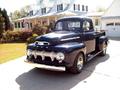
Here are a few photos. I still haven't had a chance to get under the truck to take pictures of the Camaro clip.


Some people are "restorers", and meticulously put their trucks back to it's original condition.
Some people are "hot rodders" or "customizers", and do all kinds of things to their trucks to make them unique or to generally look cool.
I'm actually neither of these types. I like the original looks of these old trucks, but I'm not hung-up on keeping it all original. I intend to use my truck as a driver, so I want modern conveniences (drive train, suspension, interior). I don't intend to show the truck (other than every time I stop to get gas), so I don't care if a judge would deduct points because something isn't original to the truck. I've heard someone refer to this type as a "resto-rod".
Anyway, this is why I want to raise the truck back closer to it's original ride height. I want it to look somewhat stock, but drive like a late model truck.
Here are a few photos. I still haven't had a chance to get under the truck to take pictures of the Camaro clip.
The possibility of you hitting any numerous types of obstructions in the road that can cause that kind of damage happens a tick more than some want us to believe is possible.
So by all means bring the Olde Girl back to as close to Factory Ride Height as you believe that you may be able to achieve.
Just because the P.O. has it done, doesn't mean You've to keep her that way, no matter how much these others pitch a fit about it.
Freshman User
Joined: Mar 2010
Posts: 48
Likes: 0
From: Tucson, AZ
what I was suggesting was that you place the original springs back on the front so that you have your ride comfort and camber back, then add the spindles to bring the front back up to where you want it.
Thread Starter
|
Tuned
Joined: Apr 2008
Posts: 485
Likes: 2
Here are a few posts from a thread over at the HAMB where a guy had a similar issue to mine. Of course these are all just opinions, and opinions on the HAMB are no better than opinions on FTE (some would say that they're not as good, but I won't go there).
Peace,
-DV
--------------------------------
If all the parts are right and nothing has been butchered, you could have a bent crossmember. We used to straighten those on the frame rack. You are basically moving the upper control arms back out.
The aftermarket first came up with a set of offset control arm shafts to deal with this. Later the adjustable upper control arms came out.
If it was mine I'd straighten it.
--------------------------------------
If there are no shims between the upper shafts and the frame and the bolts are tight (long wrench and reef on it tight) and the camber is still too negative there are two things that can be done.
A. swap the shafts for offset shafts.
B. have the subframe "rolled" This means that they chain the frame rails to the front end rack and use a bottle jack (usually 20 ton or more) to push the crossmember up rolling the rails out and in the process bringing back the positive camber.
What happens with a lot of these frames is that over time and miles the weight of the car and engine causes the frame rails to turn in at the top reducing the camber.
You do need to take it to someone who knows what he is doing and is setup to work on frames and subframes. Usually in any larger city or metroplex area there is a spring and frame shop that does truck, motorhomes and what not.
-----------------------------------------------------
Instead of paying an alignment shop I'd concider having a frame shop spec it out. Usally not that bad price wise to get it on a frame rack and checked. 9 times out of 10 on a Nova subframe too much negative camber is a sagged crossmember. Very commen on those. Usally not too expensive to have it pulled either, especially if it's already set up on the rack. Years ago I use to do 3 or 4 Nova subframe clips a month, probably one out of 6 had a sagging crossmember. The frame guy at the bodyshop next door to me got real good at fixing those.
---------------------------------------------------------------
GM cars from the '60s and early '70s are all known for sagging crossmembers. As earlier stated, the weight of the engine and the constant pounding of the suspension from normal driving cause the suspension crossmember to "roll in". This makes it impossible to make proper camber adjustments.
This can be corrected by pulling the structure back on a frame machine or offset upper cross shafts in the upper control arms.
I have a '67 Chevelle wagon that has this problem. Had the front end aligned and could not get the camber set correctly. Went to a local yard that has many old '60s A bodies. I measured the distance between the mounting surfaces for the upper control arm cross shafts. This distance varied as much as 5/8"!
Any time that these GM front suspensions are used, they need to be checked and possibly jacked apart a little beyond what is factory specifications. They will sag again unless reinforced!
Hotshot
Joined: Oct 2004
Posts: 15,882
Likes: 88
From: Durham NC
Doroville,
On all the HAMB posts they are trying to correct too much camber, not too little which is the problem you are trying to correct. In theory I could imagine that a crossmember could possibly sag, but from experience I don't believe it happens "regularly from highway driving" tho, but they probably were built that way, the result of sloppy factory tollerences and assemblyline workers common on US cars in that era. Case in point: My brother has raced this Olds Omega (ne Nova)
for the last 5 years. He pulls 2-3' wheelstands on every run, and the car has never exhibited any crossmember sag. In fact he just removed the OEM crossmember he believes was overbuilt and replaced it with a lighter handbuilt one for this season.
Are you sure the offset shafts you used helped give you more caster? They should have moved the upper control arm pivot towards the center of the chassis or the lower control arm away depending on which they went on. If they were ment to correct "sag" then they would be backwards for your application. Can you post a picture of your upper and lower control arm mounting arrangement?
On all the HAMB posts they are trying to correct too much camber, not too little which is the problem you are trying to correct. In theory I could imagine that a crossmember could possibly sag, but from experience I don't believe it happens "regularly from highway driving" tho, but they probably were built that way, the result of sloppy factory tollerences and assemblyline workers common on US cars in that era. Case in point: My brother has raced this Olds Omega (ne Nova)
for the last 5 years. He pulls 2-3' wheelstands on every run, and the car has never exhibited any crossmember sag. In fact he just removed the OEM crossmember he believes was overbuilt and replaced it with a lighter handbuilt one for this season.
Are you sure the offset shafts you used helped give you more caster? They should have moved the upper control arm pivot towards the center of the chassis or the lower control arm away depending on which they went on. If they were ment to correct "sag" then they would be backwards for your application. Can you post a picture of your upper and lower control arm mounting arrangement?