



differential question for 2003 super duty

Thread Starter
|
Junior User
Joined: Feb 2007
Posts: 87
Likes: 0
differential question for 2003 super duty
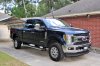
I posted this in the clutch, transmission ,etc. forum with 11 views and no answers... I have a 2003 super duty with the 5.4 and 33" tires and a 4.10 rear, would switching to a 4.30 anti-slip setup increase the performance of the truck? anyone running a 4.30 on a 5.4? and since my setup has been the same since the truck was new (over 100k miles), would it have any adverse effect on my transmission or engine (the swap, I mean) thx in advance for any help I can get. and how would my fuel economy suffer?

Post Fiend
Joined: Mar 2009
Posts: 11,798
Likes: 14
From: Mt. Shasta California
I posted this in the clutch, transmission ,etc. forum with 11 views and no answers... I have a 2003 super duty with the 5.4 and 33" tires and a 4.10 rear, would switching to a 4.30 anti-slip setup increase the performance of the truck? anyone running a 4.30 on a 5.4? and since my setup has been the same since the truck was new (over 100k miles), would it have any adverse effect on my transmission or engine (the swap, I mean) thx in advance for any help I can get. and how would my fuel economy suffer?

Senior User
Joined: Feb 2004
Posts: 111
Likes: 0
From: Orange County, So. Calif
An opinion: The 4:30 over the 4:10 will give slightly better acceleration. Not only initially, but also when passing another vehicle. The limited slip is of no effect unless in/on slippery road conditions. The 4:30 will be easier on the motor and trans due to the increased torque multiplication. Fuel mileage will vary, depending on ones driving habits. You will get less mileage with full throttle starts, but you will enjoy the acceleration.
Bottom line: "IF" you want good fuel mileage, in fact super fuel mileage, take the bus...
Bottom line: "IF" you want good fuel mileage, in fact super fuel mileage, take the bus...
Thread Starter
|
Junior User
Joined: Feb 2007
Posts: 87
Likes: 0
So I wouldn't feel a considerable gain in acceleration and rear-wheel horsepower? So what I'm saying is, when climbing steep hills at highway or close to highway speeds, would my truck still downshift or would I really notice considerable performance?
Thread Starter
|
Junior User
Joined: Feb 2007
Posts: 87
Likes: 0
are lockers truly that bad for non off-road use? I mean I live in northern New Jersey and lately have been doing most of my driving on pavement. (the economy has decreased my trips to northern Pennsylvania)

Lead Driver

Joined: May 2003
Posts: 9,303
Likes: 48
From: Lyndonville, Vermont

Not really bad but a TT will work fine. If you don't need traction stay with what you have..
Dick
Dick
Trending Topics
Post Fiend
Joined: Mar 2009
Posts: 11,798
Likes: 14
From: Mt. Shasta California
Some more power, less downshifting, and some more gas, not that much difference.
FTE Stories
Ford Trucks for Ford Truck Enthusiasts

Top 10 Most Expensive Ford Trucks Ever Sold on Bring a Trailer
Joe Kucinski
2027 Ford Super Duty Buyer's Guide (Every Model, Engine, & Package)
Brett Foote
Top 10 Ford Truck Tragedies
Joe Kucinski
AEV FXL Super Duty - the Super Duty Raptor Ford Doesn't Make
Brett Foote
Lobo Vs Lobo: Proof the F-150 Lobo Should Be Even Lower!
Michael S. Palmer
Ford's 2001 Explorer Sportsman Concept Looks For a New Home
Verdad Gallardo
10 Best Ford Truck Engines We Miss the Most!
Joe Kucinski
2026 Shelby F-150 Off-Road: Better Than a Raptor R?
Brett Foote
2027 Super Duty Carhartt Package First Look: 12 Things You NEED to Know!
Michael S. Palmer
Thread Starter
|
Junior User
Joined: Feb 2007
Posts: 87
Likes: 0
had the hypertech programmer on high octane setting, considerable gains, but the higher cost of 93 octane had me go back to OEM settings. Have a K&N air filter and flowmaster super 44 dual outlet muffler.
Cargo Master
Joined: Jan 2007
Posts: 2,243
Likes: 79
From: Roman Forest, TX
I went from a 3.73 to a 4.30 in mine at about 95,000 miles. I noticed a "considerable" difference, especially on the initial "git up and go". Pulling my boat (about 4,000 pounds) it really did nice. Very little downshifting. With my travel trailer (about 5500 pounds and a big wall in the front!), at highway speeds it made a little difference, but not enough to write home about. With any significant hill or overpass it still downshifted (out of overdrive). On the flatland of I-10 it did pretty well. But for the most part, I still locked out overdrive when pulling anything. At 70mph I run at about 2200 - 2300 RPM, where with the 3.73's I was doing around 1900. As for gas mileage, very little difference running day to day. Even pulling my toys is very little difference. It's hard to get an accurate reading of the gas mileage when towing as conditions are always different (different terrain, different road conditions, different weather (headwinds or not)).
Sooooo, what does all the above mean...it depends on how much you are willing to spend going from a 4.10 to a 4.30. Again, I went from a 3.73 to a 4.30. I only paid $400 for a complete rear end, and another $400 or so to get it installed (and 4 new Bilstein shocks since they had the truck in the air anyway!). I think going from a 4.10 to a 4.30 would net you very little in the end, and it might not justify the cost.
Sooooo, what does all the above mean...it depends on how much you are willing to spend going from a 4.10 to a 4.30. Again, I went from a 3.73 to a 4.30. I only paid $400 for a complete rear end, and another $400 or so to get it installed (and 4 new Bilstein shocks since they had the truck in the air anyway!). I think going from a 4.10 to a 4.30 would net you very little in the end, and it might not justify the cost.

You Keep What You Kill
Joined: Dec 2006
Posts: 4,902
Likes: 2
From: Huntersville, NC
Selecting the right gears is like selecting the right wife... you can marry a pretty woman or you can marry an ugly woman... it's going to cost you just as much when you marry them, or God forbid, if you divorce them. 
You Keep What You Kill
Joined: Dec 2006
Posts: 4,902
Likes: 2
From: Huntersville, NC
You can purchase a quality tuner for approximately $400.00 and use the performance tune that requires 93 octane fuel. The difference between 89 octane fuel and 93 octane fuel is generally 20 cents per gallon. If you completely fill your 38 gallon tank per week, that's an additional "premium" cost of $7.60. On an annual basis, that's an additional "premium" cost of $395.20. Some people may find that a performance tune and 93 octane fuel provides the missing performance that they need.
You can install new gears to ensure that your truck's engine is operating in the power band. The cost of gears varies depending on the size but let's say the average cost of gears is $255.00 per axle (This was the actual average cost of 4.10 and higher Yukon gears at BroncoGraveYard.com). That's a total cost of $510.00 for a 4x4 truck. I would estimate that the labor and misc. parts for the install are approximately $600.00 per axle. So, we are looking at $1,710.00 for new gears installed.
Now let's compare the two options. If I can accomplish the desired results with new gears, then the breakeven point is in 3.3 years. That's taking the $1,710.00 gear cost minus the $400.00 tuner cost, which equals $1,310.00. I then divide the $1,310.00 by the "premium" cost of $395.20 per year, which gives me 3.31 years.
So, if you plan to keep your truck more than 3 years, it actually is cheaper to install new gears than to use a performance tune and 93 octane fuel. Obviously, if you use less fuel per year, the longer the breakeven point.

Postmaster
Joined: Oct 2008
Posts: 3,924
Likes: 6
From: Richmond BC
not to mention the reduced strain on ur engine and tranny... Gears is always the best bet, sometiems its just hard to pull the trigger and git ur done...