





Funny video......

Thread Starter
|
Elder User
Joined: May 2007
Posts: 595
Likes: 0
From: South LA
Funny video......
This looks and sounds like a PSD, doesn't it?
This is something funny to see, esp for a southerner.
YouTube - North Dakota Railroad Crossing
This is something funny to see, esp for a southerner.
YouTube - North Dakota Railroad Crossing

Smokin
Joined: Jun 2006
Posts: 8,849
Likes: 0
I showed that video to my other half, the railroader...and he went  "he's lucky he didn't derail at that crossing".
Snow/ice and other elements on the track can cause locomotive/cars to slip right off the tracks.
Sweet video though.
"he's lucky he didn't derail at that crossing". Snow/ice and other elements on the track can cause locomotive/cars to slip right off the tracks.
Sweet video though.

Post Fiend
Joined: Mar 2007
Posts: 26,966
Likes: 50
From: Texas
Another comment from a Southern boy here, but he says he's worried about the snow and ice at the crossing? What about the other 100 miles of white stuff? He's not worried about it derailing anywhere else?

Senior User
Joined: Jun 2005
Posts: 148
Likes: 0
From: Shelter Island, NY

Hay F350-6
Noticed your logo. Who were you with?
I was in VMFA 542 Nam 66/67/68 F4 Phantom pilot.

Noticed your logo. Who were you with?
I was in VMFA 542 Nam 66/67/68 F4 Phantom pilot.
Trending Topics
Smokin
Joined: Jun 2006
Posts: 8,849
Likes: 0
The majority of derailments happen at crossings because of the nature of track and something called a wheel flange.
A flange acts like a cap on each wheel to keep the wheel from slipping off the track.
On normal track the flange will reach from the tie to the top of the track and in this case the flange is not restricted.
Crossings are designed to be smooth, so when they construct the railway at a crossing, a tiny path called a flangeway is created. A flangeway creates just enough of a groove for the wheel to get through the crossway, and flangeways are about 1/2 the depth of a typical flange. Oftentimes these flangeways get packed with ice and snow..and the flangeway groove is severely restricted. At this point, there is nothing keeping the wheel on the track.
According to a man who has picked up dozens, possibly hundreds of derailments, its a miracle that locomotive didn't derail, as fast as he was going.
FTE Stories
Ford Trucks for Ford Truck Enthusiasts

Top 10 Fords at 2026 Carlisle Ford Nationals
Joe Kucinski
3 Best / 3 Worst Parts of Modern Ford Ownership
Brett Foote
10 Amazing Upgrades That Solve Common Ford Truck Owner Headaches
Pouria Savadkouei
Every 2026 Ford Engine Explained
Brett Foote
10 Ugly Ford Trucks That We Still Kinda Love
Joe Kucinski
10 Things Every Truck Owner NEEDS (2026 Edition)
Michael S. Palmer
Rezvani's Latest Post-Apocalyptic Monster Is a Ford F-150 Raptor Underneath
Verdad Gallardo
Top 10 Most Expensive Ford Trucks Ever Sold on Bring a Trailer
Joe Kucinski
2027 Ford Super Duty Buyer's Guide (Every Model, Engine, & Package)
Brett Foote
Post Fiend


Joined: Jun 2006
Posts: 9,714
Likes: 2
From: White Mnt's,New Hampshire
I believe there is something in front of them wheels to cleans the tracks.. they plow them around here all my life at that speed and I have never seen or heard of one de railing do to snow and ice...any thing is possible..not saying it wont happen..just rare it does..other wise they would make them guy's slow down..
Post Fiend
Joined: Mar 2007
Posts: 26,966
Likes: 50
From: Texas

I was a ground pounder with the 7th out in Pendleton. Got out almost 20 years after you did. I took a hop in an F4 once. (you can guess what the pilot did). None of that bothered me too much. The scary part was when he backed off to cruising speed. I was sure we were dropping like a rock.

Semper Fi.
Smokin
Joined: Jun 2006
Posts: 8,849
Likes: 0
I believe there is something in front of them wheels to cleans the tracks.. they plow them around here all my life at that speed and I have never seen or heard of one de railing do to snow and ice...any thing is possible..not saying it wont happen..just rare it does..other wise they would make them guy's slow down..
I had no idea how often trains slipped off their tracks until I met Randy. His sole job was and is still to 1) manage maintenance and 2) perform pickups for derailments.
I guess there are various tools they use to clear flangeways, but none are foolproof. The new GE locomotives actually have an air puffing mechanism that supposedly "blows" the snow and ice out of the flangeway. He says tracks that get used a lot don't experience as many problems as a track that may only see a few trains a week.
Post Fiend
Joined: Jun 2006
Posts: 9,714
Likes: 2
From: White Mnt's,New Hampshire
that's interesting..I have seen them stopped in odd places before..never looked to see why...thanks for sharing this info Randy..next time I see one sitting still in a odd place..ill have to go look a little closer..id like to watch them put it back on the tracks...
Smokin
Joined: Jun 2006
Posts: 8,849
Likes: 0
Sorry for the hijack OP!
Here is a pic of Randy at a good size derailment in Denver winter before last.

I think he's having fun sharing this with you guys.
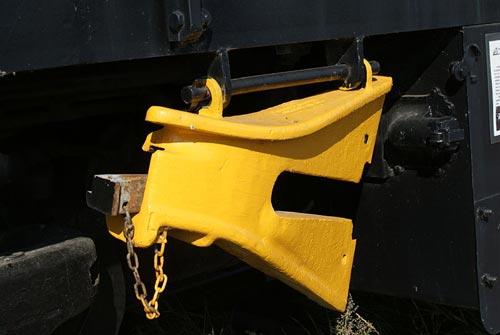
He says when the derailment is a minor one, just a few trucks off the track, and the track is in good condition, they can use oak blocks and something called a Frog to guide a car back onto its track.
here's a frog:
And here is a piece of equipment they use often in more serious derailments, its called a sideboom:

Here are two sidebooms lifting a locomotive:

And they use a few different types of cranes to lift cars/locomotives..back onto tracks or to ship out if they are heavily damaged.
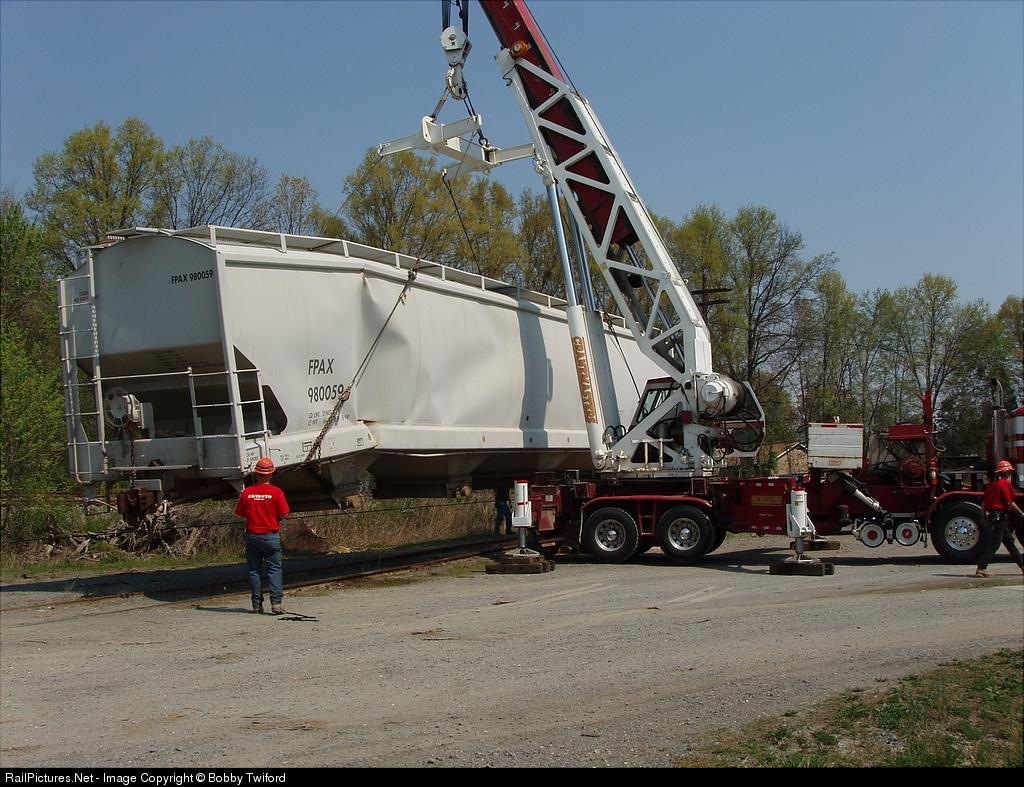
Here is a pic of Randy at a good size derailment in Denver winter before last.
I think he's having fun sharing this with you guys.
He says when the derailment is a minor one, just a few trucks off the track, and the track is in good condition, they can use oak blocks and something called a Frog to guide a car back onto its track.
here's a frog:
And here is a piece of equipment they use often in more serious derailments, its called a sideboom:
Here are two sidebooms lifting a locomotive:
And they use a few different types of cranes to lift cars/locomotives..back onto tracks or to ship out if they are heavily damaged.
Post Fiend
Joined: Mar 2007
Posts: 26,966
Likes: 50
From: Texas
You've posted that picture before. I still can't figure out what he has to bend down to look at, so I'll just ask. The train parts are plenty big, the tracks are big enough to see when standing next to them. What's so small he has to bend down to look at?
Smokin
Joined: Jun 2006
Posts: 8,849
Likes: 0
Its funny..such huge derailments are often caused by a faulty wheel...or a bad piece of track with a crack in it..tiny little things in the grand scheme of things.