


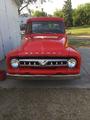


53 fuel gauge
Thread Starter
|
Laughing Gas


Joined: Sep 2008
Posts: 966
Likes: 27
From: Missouri
53 fuel gauge
I have noticed that when I fill my truck, my gauge does not go all the way to the full mark. So I do not let it go very far down to the empty side of it. My truck was converted to 12v by a PO so not sure how it was done. The gas gauge is the only stock gauge working.

Elder User
Joined: Jan 2006
Posts: 956
Likes: 0
From: Bend, Oregon
you'll need to check the fuel float sending unit these came either 6v or 12v...most likely you still have the 6v...headlight switch...which needs to be changed out for a 12v switch, or go to your local auto parts and buy several porcilin reducers...to place "in line." your heater motor and wiper mots are also, 6v which need reducers as well to run...all bulbs need to be 12v as well
Thread Starter
|
Laughing Gas
Joined: Sep 2008
Posts: 966
Likes: 27
From: Missouri
low54, my lights, heater motor and wiper motor are 12 volt. Not sure about the light switch. All this was done by a PO. They put aftermarket temp, oil and battery under the dash. Is there one porclin reducer that can be put in line for the stock guages?
Elder User
Joined: Jan 2006
Posts: 956
Likes: 0
From: Bend, Oregon
The fuel gauge will need to have a dropping resistor attached between the positive terminal and the positive wire supply power to the gauge. This type of dropping resistor is available from most of the classic truck parts suppliers for about $10.00. you can also use this application for your positive wrie into your light switch

Ford Parts Specialist
Joined: Nov 2006
Posts: 88,826
Likes: 785
From: Simi Valley, CA

The same issue that affects the 1957/79 fuel sending unit float, also affects the 1936/56 float.
The float is made of two pieces of copper soldered together.
Solder breaks down, gas seeps in, float slowly settles to the bottom of the tank.
Dennis Carpenter has the float listed on page 41 of his catalog.
The float is made of two pieces of copper soldered together.
Solder breaks down, gas seeps in, float slowly settles to the bottom of the tank.
Dennis Carpenter has the float listed on page 41 of his catalog.
Trending Topics

Post Fiend
Joined: May 2008
Posts: 7,641
Likes: 21
From: Poway, Ca.
HI Pappy,
Well it's been a long time since we all had the fuel gauge/sending unit debate! You guys a slackin' off.
You can use the stock gauge and sending unit in you 53 if it has been converted to 12 volt as long as the sending unit was manufactured to go with that particular gauge. There are lots of guys who want to measure the ohmage spread and steel sending units off some hulk and try an make it match, but trust me on this - use the sending unit built for the gauge.
It can be done, but it's apain to match and often the ranges are different.
If you have both the stock gauge and sending unit, all you need to do with the 12 volt conversion is install this little voltage drop resistor (it is one of many types) on the back of your gauge. Mine is done that way and it works perfectly.
Here's the picture and part number from C&G:

Also, as I recall one of my very first posts - a million years ago, was about how to calibrate your gauge after you install the voltage drop. It was necessary for me to do mine and it did the same thing as you report - didn't quite go to full. It was my "'World Famous' Cardboard Box Fuel Gauge Calibration Technique." tee hee - I'll try and find it and repost the link. It works - 100%
I'm not sure many folks realize this but the 48-56 Ford Fuel gauges "Full" and "Empty" needle postions on the are adjustable. There is a small hole in the back of the gauge and little tiny alligators teeth inside there that you can insert a small screw driver and adjust the needle.
So, If you want to, you can make your fuel gauge very accurate - if you feel like fooling with it. With mine I got it to a point where I could tell when it hit's "centered on empty" I have two gallons or 25 miles on the odometer to go. I've deliberately run it out of gas about 4 times just to check, and it is within 1/2 mile EVERY time. (It's also run out of gas at 25 miles the other half dozen time I've forgotten to get gas when it was showing empty - tee hee)
Here is the link read post #13 - good luck:
https://www.ford-trucks.com/forums/7...m-a-idiot.html
Julie
Well it's been a long time since we all had the fuel gauge/sending unit debate! You guys a slackin' off.
You can use the stock gauge and sending unit in you 53 if it has been converted to 12 volt as long as the sending unit was manufactured to go with that particular gauge. There are lots of guys who want to measure the ohmage spread
and steel sending units off some hulk and try an make it match, but trust me on this - use the sending unit built for the gauge. It can be done, but it's apain to match and often the ranges are different.
If you have both the stock gauge and sending unit, all you need to do with the 12 volt conversion is install this little voltage drop resistor (it is one of many types) on the back of your gauge. Mine is done that way and it works perfectly.
Here's the picture and part number from C&G:
Also, as I recall one of my very first posts - a million years ago, was about how to calibrate your gauge after you install the voltage drop. It was necessary for me to do mine and it did the same thing as you report - didn't quite go to full. It was my "'World Famous' Cardboard Box Fuel Gauge Calibration Technique." tee hee - I'll try and find it and repost the link. It works - 100%
I'm not sure many folks realize this but the 48-56 Ford Fuel gauges "Full" and "Empty" needle postions on the are adjustable. There is a small hole in the back of the gauge and little tiny alligators teeth inside there that you can insert a small screw driver and adjust the needle.
So, If you want to, you can make your fuel gauge very accurate - if you feel like fooling with it. With mine I got it to a point where I could tell when it hit's "centered on empty" I have two gallons or 25 miles on the odometer to go. I've deliberately run it out of gas about 4 times just to check, and it is within 1/2 mile EVERY time. (It's also run out of gas at 25 miles the other half dozen time I've forgotten to get gas when it was showing empty - tee hee)
Here is the link read post #13 - good luck:
https://www.ford-trucks.com/forums/7...m-a-idiot.html
Julie
FTE Stories
Ford Trucks for Ford Truck Enthusiasts

Rezvani's Latest Post-Apocalytic Monster Is a Ford F-150 Raptor Underneath
Verdad Gallardo
Top 10 Most Expensive Ford Trucks Ever Sold on Bring a Trailer
Joe Kucinski
2027 Ford Super Duty Buyer's Guide (Every Model, Engine, & Package)
Brett Foote
Top 10 Ford Truck Tragedies
Joe Kucinski
AEV FXL Super Duty - the Super Duty Raptor Ford Doesn't Make
Brett Foote
Lobo Vs Lobo: Proof the F-150 Lobo Should Be Even Lower!
Michael S. Palmer
Ford's 2001 Explorer Sportsman Concept Looks For a New Home
Verdad Gallardo
10 Best Ford Truck Engines We Miss the Most!
Joe Kucinski
2026 Shelby F-150 Off-Road: Better Than a Raptor R?
Brett Foote
Post Fiend
Joined: Mar 2007
Posts: 5,776
Likes: 2
From: springfield il
usually the ceramic ones are the best , and most of the time like the one in julie's pic , one per gauge or ..... mid fifty sells one to do the whole cluster , but you still gotta get a seperate one for the sending unit me thinks .........
Post Fiend
Joined: May 2008
Posts: 7,641
Likes: 21
From: Poway, Ca.
Well, the siganl flo wpath of th epower to the gauges goes to the gauges first then out to ground through the sending units. You should be able to use a single ceramic unit such as a "Vol-ta-drop" but they usually work best at about 5 maps - which throws a lot of fluctuation at gauges. The unit at MId Fifties sounds good but I'm not familiar with it. You shouldn't need extra pieces for the sending units as the voltage is stepped down before it reaches the gauge and runs through to ground (with a given impedance to "indicate") via the sending unit.
Julie
Julie

Thread
Thread Starter
Forum
Replies
Last Post
Pappys53
1948 - 1956 F1, F100 & Larger F-Series Trucks
26
Jan 21, 2009 07:47 PM
snipa
1948 - 1956 F1, F100 & Larger F-Series Trucks
14
Jul 7, 2005 09:07 AM