


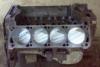

400 Engine Problem

Postmaster
Joined: Aug 2001
Posts: 4,270
Likes: 5
From: Delaware
If someone advanced the cam timing by changing the timing gears, that only affects the valve opening and closing times. It does not affect the ignition timing.
The ignition timing should be set to factory specs, usually about 10 degrees BTDC with the vacuum advance disconnected.
The ignition timing should be set to factory specs, usually about 10 degrees BTDC with the vacuum advance disconnected.

Cargo Master


Joined: Dec 2004
Posts: 2,232
Likes: 3
From: NE Texas
Don't set the ignition timing based solely on initial setting. Run the RPM up and make sure you don't have more than about 34 or 35 with the vac advance plugged. If maximum advance is at 35 or so and initial is at 10 then 10 is okay.
These engines are sometimes a little picky about the advance curve. You may have to play with the timing a little to get it running decent.
All that said, don't get too carried away perfecting the ignition timing until you know that everything else is okay. The compression check sounded good and the vacuum sounds reasonable. How do your plugs look beyond the oil on the ones you mentioned? Do they look rich or lean?
These engines are sometimes a little picky about the advance curve. You may have to play with the timing a little to get it running decent.
All that said, don't get too carried away perfecting the ignition timing until you know that everything else is okay. The compression check sounded good and the vacuum sounds reasonable. How do your plugs look beyond the oil on the ones you mentioned? Do they look rich or lean?

Thread Starter
|
Junior User
Joined: Mar 2005
Posts: 93
Likes: 0
From: Jacksonville, AR
well just replaced them but the ones i just pulled out the rear 4 cylinders were black as where the 4 front cylinders were brown so it seems like it was running a little rich but since than i readjusted the mixture and turned the idle down a bit i think part of the problem may have been a high set idle so it may have been getting too much gas in the mornings i dunno how accurate i am on this

Senior User
Joined: Mar 2007
Posts: 458
Likes: 1
Sorry to change the subject but does anyone know how to take those compression readings and figure his compression ratio? I have a fresh built 400 and i was going to do a compression test to find my exact ratio.
never mind
http://en.wikipedia.org/wiki/Compression_ratio
never mind
http://en.wikipedia.org/wiki/Compression_ratio

Posting Guru
Joined: Mar 2005
Posts: 2,068
Likes: 0
From: western montana
Back to the prob at hand. If you remove spark from each plug individually while the engine is running you will notice a 2-300 rpm drop that goes away once the spark is returned...ie the engine runs noticeably worse...makes sense. I wonder if you were to do that if you wouldn't find that there is no real difference when you pull the spark on #4. Mine is doing the same thing...my vacuum is a bit low and i'm wondering if i might be leaking at the intake at #4- as pondered above. I'd also be curious about valve train geometry and rocker/lifter noise.
Cargo Master
Joined: Dec 2004
Posts: 2,232
Likes: 3
From: NE Texas
There are just too many variables in play to determine CR via a compression test with any accuracy at all.
FTE Stories
Ford Trucks for Ford Truck Enthusiasts

Top 10 Fords at 2026 Carlisle Ford Nationals
Joe Kucinski
3 Best / 3 Worst Parts of Modern Ford Ownership
Brett Foote
10 Amazing Upgrades That Solve Common Ford Truck Owner Headaches
Pouria Savadkouei
Every 2026 Ford Engine Explained
Brett Foote
10 Ugly Ford Trucks That We Still Kinda Love
Joe Kucinski
10 Things Every Truck Owner NEEDS (2026 Edition)
Michael S. Palmer
Rezvani's Latest Post-Apocalyptic Monster Is a Ford F-150 Raptor Underneath
Verdad Gallardo
Top 10 Most Expensive Ford Trucks Ever Sold on Bring a Trailer
Joe Kucinski
2027 Ford Super Duty Buyer's Guide (Every Model, Engine, & Package)
Brett Foote


Thread
Thread Starter
Forum
Replies
Last Post
fosgate3
1987 - 1996 F150 & Larger F-Series Trucks
21
Sep 25, 2020 06:50 PM
