





Making a F3 lighter
Thread Starter
|
Junior User
Joined: Feb 2008
Posts: 51
Likes: 0
From: Winnipeg, Manitoba Canada
Making a F3 lighter
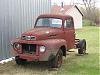
I have a 49 F3 that I will never use for hauling more then a few sheets of plywood/drywall or the odd auto part. I have a trailer for heavy hauling. So to help take some pressure off the engine....inturn not burn as much gas...what can I do to make my truck lighter.
I know the curb weight of the F3 is 3969, and the cw of the F2 is 3310. So what I'm thinking is making mine more like a F2.
I'm keeping the 8 lug rims...well 1 piece 16 inchers I got. Also I have a Dana 60 from a 72 F250. These will change my weight. Don't know how heavy the two rears are in comparison.
What else make the F2 and F3 different, the extra springs under the bed can't weigh 600 pounds? To change springs (no F2's in Canada), do I just take out a few leafs or is it more complicated then that?
Are the old bias plys heavier then newer radials of similar size?
Thanks
I know the curb weight of the F3 is 3969, and the cw of the F2 is 3310. So what I'm thinking is making mine more like a F2.
I'm keeping the 8 lug rims...well 1 piece 16 inchers I got. Also I have a Dana 60 from a 72 F250. These will change my weight. Don't know how heavy the two rears are in comparison.
What else make the F2 and F3 different, the extra springs under the bed can't weigh 600 pounds? To change springs (no F2's in Canada), do I just take out a few leafs or is it more complicated then that?
Are the old bias plys heavier then newer radials of similar size?
Thanks

Elder User
Joined: Jan 2008
Posts: 658
Likes: 0
From: N.W. Mo.
The rear axle and springs are all I can think of that would make a difference and I'm not sure the axle is different.
Swapping the rear with the dana will probably loose you a little weight as will lightening the springs. If you have overloads loose them, they're heavy. If you get a better gear ratio with the dana that will probably help more on the gas than the weight will.
Richard
Swapping the rear with the dana will probably loose you a little weight as will lightening the springs. If you have overloads loose them, they're heavy. If you get a better gear ratio with the dana that will probably help more on the gas than the weight will.
Richard

Posting Guru
Joined: Feb 2002
Posts: 1,392
Likes: 2
From: Michigan
If anything, I think a Dana 60 may actually weigh more than the old Timken Split rear end, at least it seemed that way when I did the dana 60 swap a while ago. However, I know with the dana 60 you can get a much more highway/gas friendly gear ratio. Honestly I don't see what would make an F-3 so much heavier than the F-2, they were basically identical trucks minus a heavier springs.. curious as to the nearly 600lb differance. Are you sure those stats are for the same bodied truck? (ie both with either flatbeds or both with express beds?, same engines? etc)
Marmon-Herrington Man


Joined: Jul 2005
Posts: 11,986
Likes: 444
From: Central Illinois

The 52 Dealer Handbook says that an F-2 has a curb weight of 3685 when equipped with the biggest optional 7.50 x 16 tires. An F-3 is 3915 when equipped with the WM 17s and the biggest option of 7.00 tires on front and 7.50s on the rear. So the difference is heavier stock springs, and heavier wheels and tires. I don't see any other differences, except that on a 49 you'd have the 14" rear brakes on an F-3 which would add somewhat to the weight difference for that year.
Marmon-Herrington Man
Joined: Jul 2005
Posts: 11,986
Likes: 444
From: Central Illinois
The frames are the same. Rear brakes on 48 - early 51 were bigger, 14" on F-3s, then they standardized on 12" for both F-2 and F-3 in late 51 and 52. The differences are wheels, tires, and springs. Even there, the F-3 could be optioned to come with the lighter duty F-2 springs if the owner wanted it that way. Seems odd, but that's what the Chassis Manual shows.
Thread Starter
|
Junior User
Joined: Feb 2008
Posts: 51
Likes: 0
From: Winnipeg, Manitoba Canada
What do overloads look like exactly....are they a small stack of leafs that sit on top of the main stack, seperated by a small block. I have a 48 and a 49, and both sets of leafs are identical.
How can I loose a few springs?
How can I loose a few springs?
Trending Topics
Marmon-Herrington Man
Joined: Jul 2005
Posts: 11,986
Likes: 444
From: Central Illinois
They look just as you describe. I just looked through dozens of on-line photos and the only one I can find is on an F-1. The brackets that mount at the front and rear of the overload springs I'm sure are the same for F-1, F-2, or F-3. At least they look the same. There's a real good diagram of overloads in the Chassis Manual. Maybe one the the guys that has if on disc can post a pic from that. See if this helps.
As for loosing springs, there's been a number of threads on that. You might do a search to see which specific springs guys pull. Stu
As for loosing springs, there's been a number of threads on that. You might do a search to see which specific springs guys pull. Stu
FTE Stories
Ford Trucks for Ford Truck Enthusiasts

Top 10 Most Expensive Ford Trucks Ever Sold on Bring a Trailer
Joe Kucinski
2027 Ford Super Duty Buyer's Guide (Every Model, Engine, & Package)
Brett Foote
Top 10 Ford Truck Tragedies
Joe Kucinski
AEV FXL Super Duty - the Super Duty Raptor Ford Doesn't Make
Brett Foote
Lobo Vs Lobo: Proof the F-150 Lobo Should Be Even Lower!
Michael S. Palmer
Ford's 2001 Explorer Sportsman Concept Looks For a New Home
Verdad Gallardo
10 Best Ford Truck Engines We Miss the Most!
Joe Kucinski
2026 Shelby F-150 Off-Road: Better Than a Raptor R?
Brett Foote