




wiring help

Senior User
Joined: Jun 2008
Posts: 205
Likes: 1
OK real easy here. You should have a three wire harness to the engine, One wire is the oil sending unit second wire is the water temperature sending unit and the third wire is the +12V that goes to the "bat" side of the coil. the - (negative) side of the coil goes to the single wire coming from the distributor.
To find out which of the three wires is what do the following:
for the +12V you will find that on a single wire, that will be for the coil
take the remaining two wires and ground one to the engine anywhere and see which gauge (water or oil) moves. Then you know what the last wire is for.
I hope this helps.
To find out which of the three wires is what do the following:
for the +12V you will find that on a single wire, that will be for the coil
take the remaining two wires and ground one to the engine anywhere and see which gauge (water or oil) moves. Then you know what the last wire is for.
I hope this helps.

MSEE
Joined: Apr 2004
Posts: 10,386
Likes: 35
From: Austin, TX

Don't put +12V to the coil; you will burn it out. On both breaker-points and electronic ignition systems, the coil is powered through a resistor wire from the dash harness. This drops the coil voltage to 7-9V. The dash harness also uses a bypass wire to feed the coil directly to battery voltage during cranking, and through the resistive wire while the key is in run. It's not as simple as taking any hot-in-run wire and hooking it up to the coil.
The diagram below is for a Duraspark system. For a points system like your '74 has, the 'TACH' terminal of the coil (negative side) goes to the breaker points, instead of the Duraspark box. You can also ignore all the other Duraspark circuitry such as the pickup in the distributor.
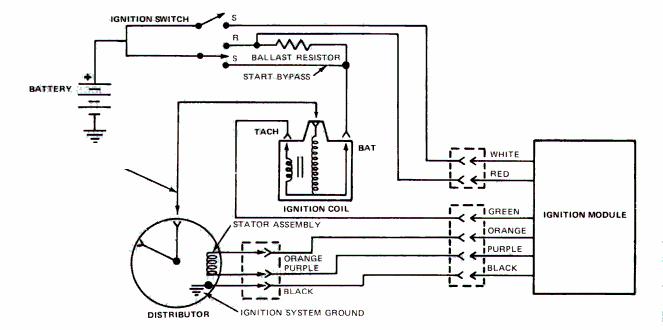
I haven't credited the source of this image because it is so widely reproduced and distributed.
The diagram below is for a Duraspark system. For a points system like your '74 has, the 'TACH' terminal of the coil (negative side) goes to the breaker points, instead of the Duraspark box. You can also ignore all the other Duraspark circuitry such as the pickup in the distributor.
I haven't credited the source of this image because it is so widely reproduced and distributed.

Thread Starter
|
New User
Joined: Jun 2008
Posts: 18
Likes: 0
From: TRUCKEE CA
Trending Topics

New User
Joined: Jan 2011
Posts: 1
Likes: 0
74 wiring diagram
I found a great diagram at fordification.net
Last edited by Bigreyiii; Jan 23, 2011 at 07:44 PM. Reason: Spelling
FTE Stories
Ford Trucks for Ford Truck Enthusiasts

10 Best Ford Truck Engines We Miss the Most!
Joe Kucinski
2026 Shelby F-150 Off-Road: Better Than a Raptor R?
Brett Foote
2027 Super Duty Carhartt Package First Look: 12 Things You NEED to Know!
Michael S. Palmer
10 Most Surprising 2026 Ford Truck Features!
Joe Kucinski
Top 10 Ford Trucks Coming to Mecum Indy 2026
Brett Foote
5 Best / 5 Worst Ford Truck Wheels of All Time
Joe Kucinski
Ford Super Duty: 5 Things Owners LOVE, 5 Things They LOATHE!
Joe Kucinski
Every 2026 Ford Truck Engine RANKED from WORST to FIRST!
Michael S. Palmer
The Best F-150 Deal of Every Trim Level (XL through Raptor)
Joe Kucinski
Junior User
Joined: Dec 2009
Posts: 92
Likes: 0
Don't put +12V to the coil; you will burn it out. On both breaker-points and electronic ignition systems, the coil is powered through a resistor wire from the dash harness. This drops the coil voltage to 7-9V. The dash harness also uses a bypass wire to feed the coil directly to battery voltage during cranking, and through the resistive wire while the key is in run. It's not as simple as taking any hot-in-run wire and hooking it up to the coil.
The diagram below is for a Duraspark system. For a points system like your '74 has, the 'TACH' terminal of the coil (negative side) goes to the breaker points, instead of the Duraspark box. You can also ignore all the other Duraspark circuitry such as the pickup in the distributor.
I haven't credited the source of this image because it is so widely reproduced and distributed.
The diagram below is for a Duraspark system. For a points system like your '74 has, the 'TACH' terminal of the coil (negative side) goes to the breaker points, instead of the Duraspark box. You can also ignore all the other Duraspark circuitry such as the pickup in the distributor.
I haven't credited the source of this image because it is so widely reproduced and distributed.
Hotshot


Joined: Apr 2009
Posts: 14,333
Likes: 247
From: Stanley, VA
What they are talking about is the wiring for the automatic choke. The original wiring for the factory carb receives its power from the stator terminal of the alternator. This is AC current not DC. If you put a voltmeter on it, it will read somewhere in the area of 7-9 volts. The aftermarket carb's. choke is designed to run on 12 volts DC. Several people here have reported running the factory wiring to the aftermarket carb without any problems.

Thread
Thread Starter
Forum
Replies
Last Post
fordum
1987 - 1996 F150 & Larger F-Series Trucks
2
Nov 2, 2005 06:31 PM
