


Leaking Gas When Filling

Thread Starter
|
Freshman User
Joined: Jan 2005
Posts: 42
Likes: 0
From: St. Joe Mo
Leaking Gas When Filling
Well well well, when I went to fill my van yesterday a lot more gas than usual leaked out -
I looked up under there and it looks like there is a deteriorated rubber hose, looking a lot like a radiator hose, running from the filler cap to the tank.
Called the neck maybe?
I'm thinking a radiator hose would not hold up, and my local parts store could not help me out -
My questions are:
I looked up under there and it looks like there is a deteriorated rubber hose, looking a lot like a radiator hose, running from the filler cap to the tank.
Called the neck maybe?
I'm thinking a radiator hose would not hold up, and my local parts store could not help me out -
My questions are:
- Can I replace this hose without dropping the tank?
- Where oh where can I find a replacement hose at a reasonable price?
Thread Starter
|
Freshman User
Joined: Jan 2005
Posts: 42
Likes: 0
From: St. Joe Mo
Took matters into my own hands -
Pulled the old hose - the trick was to use a small 1/4" ratchet with a 8mm socket - worked fine, did not have to drop tank.
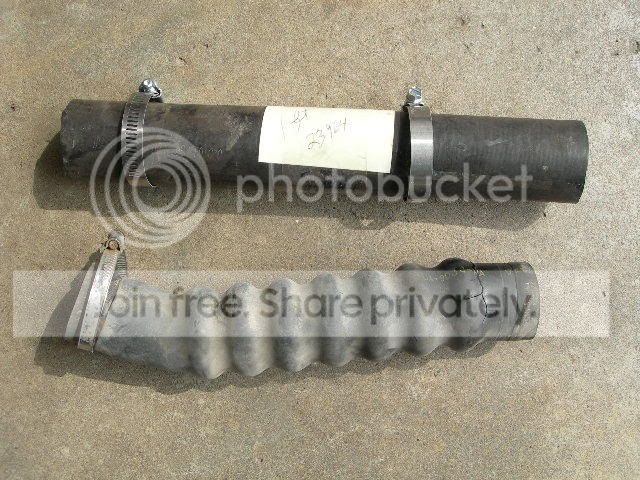
Measured the hose, it was 1 1/2" ID and about 11" long - found a local auto parts store (Bumper to Bumper) that stocked Bumper to Bumper p/n #24705 Fuel Filler Hose (Gates #23964).
Sold by the foot, list $19.23 my cost $9.05 - also picked up two new clamps, add another buck.
Here are the hoses, old and new:
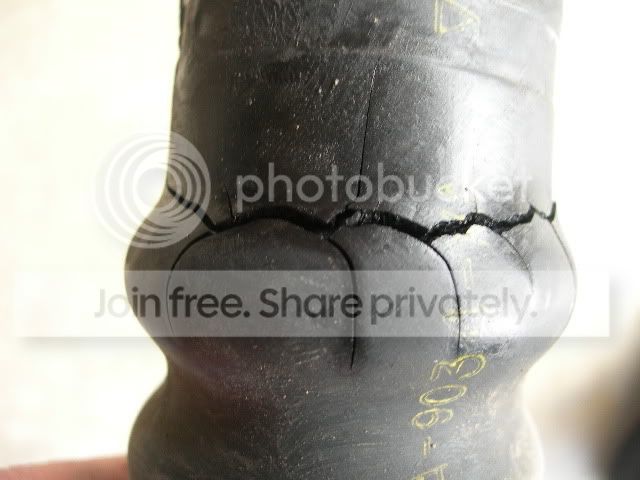
Here is the crack closest to the filler cap -
And here is the split where it went into the tank, ah, here is our leaker!
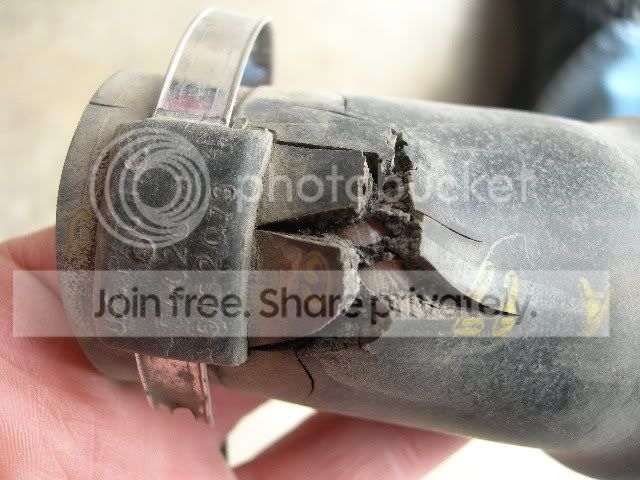
Yeah, it was really bad.
Then I noticed the vent hose was also bad, at the tank:
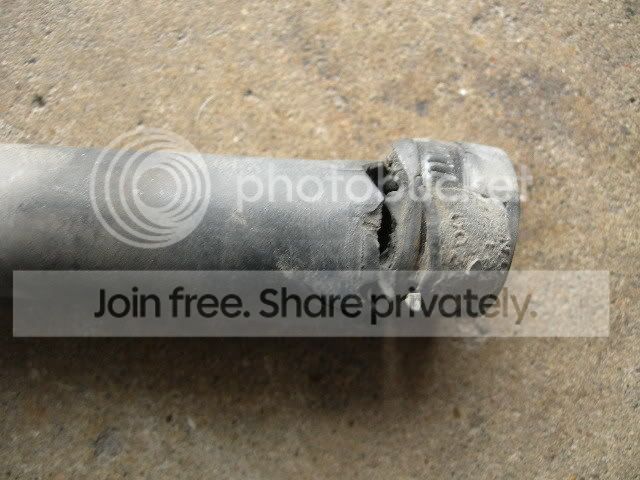
Nice, for it, I cut it in half, installed an aluminum pipe as a splice and to make up for the damaged hose I had to cut off, clamped it all back together and now I am leak free!!!
Hope this helps -
Next, I'm changing the filter, dirt had to find it's way in the system.
Pulled the old hose - the trick was to use a small 1/4" ratchet with a 8mm socket - worked fine, did not have to drop tank.
Measured the hose, it was 1 1/2" ID and about 11" long - found a local auto parts store (Bumper to Bumper) that stocked Bumper to Bumper p/n #24705 Fuel Filler Hose (Gates #23964).
Sold by the foot, list $19.23 my cost $9.05 - also picked up two new clamps, add another buck.
Here are the hoses, old and new:
Here is the crack closest to the filler cap -
And here is the split where it went into the tank, ah, here is our leaker!
Yeah, it was really bad.
Then I noticed the vent hose was also bad, at the tank:
Nice, for it, I cut it in half, installed an aluminum pipe as a splice and to make up for the damaged hose I had to cut off, clamped it all back together and now I am leak free!!!
Hope this helps -
Next, I'm changing the filter, dirt had to find it's way in the system.
Thread Starter
|
Freshman User
Joined: Jan 2005
Posts: 42
Likes: 0
From: St. Joe Mo
Here are pictures of the finished product -
New hoses from the filler neck going towards the fuel tank
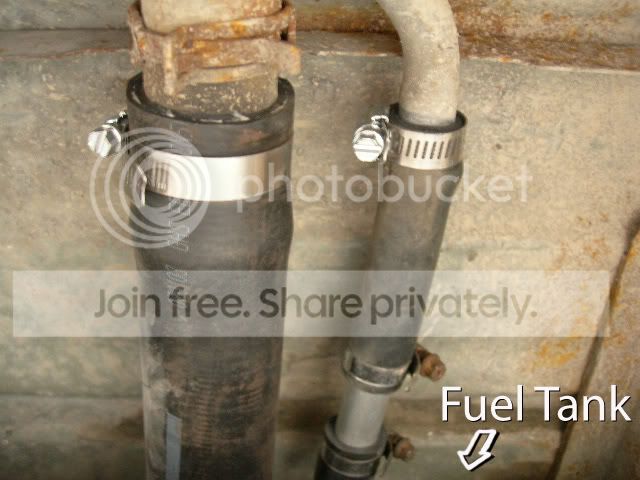
Note the aluminum tube used to allow the use of the old hose. The fuel house I bought as a replacement was too rigid to fit over the fittings. Earlier in the day, I had to shorten some aluminum crutches for my son, and I used one of the sections of tubing I had cut out for the extension piece of the vent line. As I had bought new clamps for the new hose that did not fit, and the old ones were OK, no more trips to the parts store were required.
Here are both hoses where they enter the fuel tank.
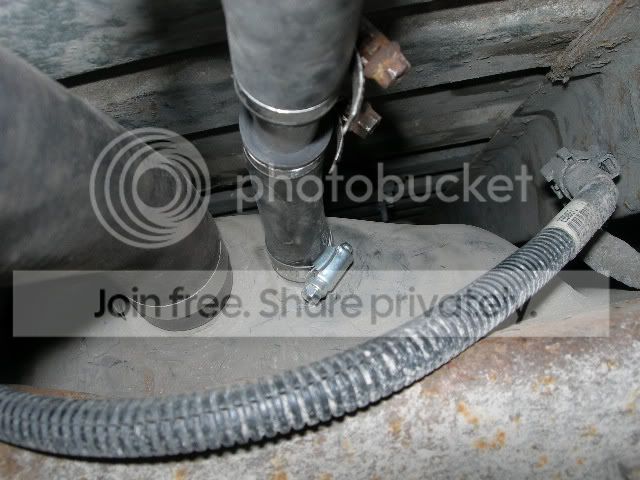
With a small quarter inch ratchet and a short socket, it was not that difficult to remove and again tighten the new clamps. You do it by feel, without removing the tank, you do it blind.
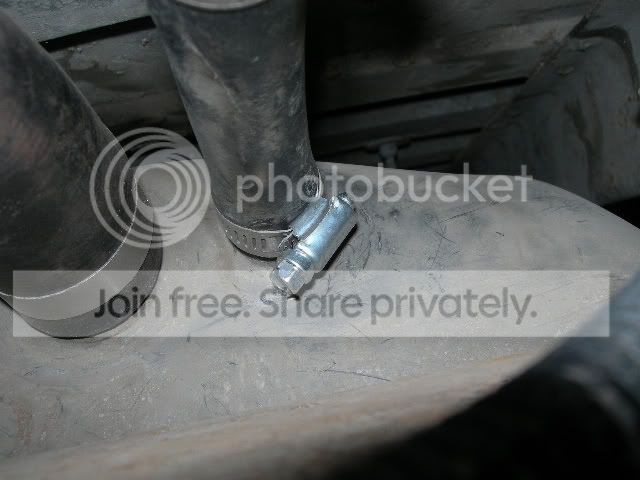
Close up of the hoses on the tank:
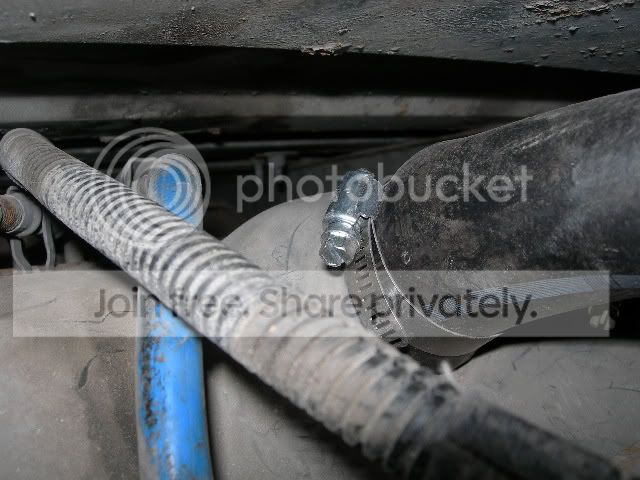
Close up of the fill neck going into the tank:
And to celebrate, a new fuel filter:
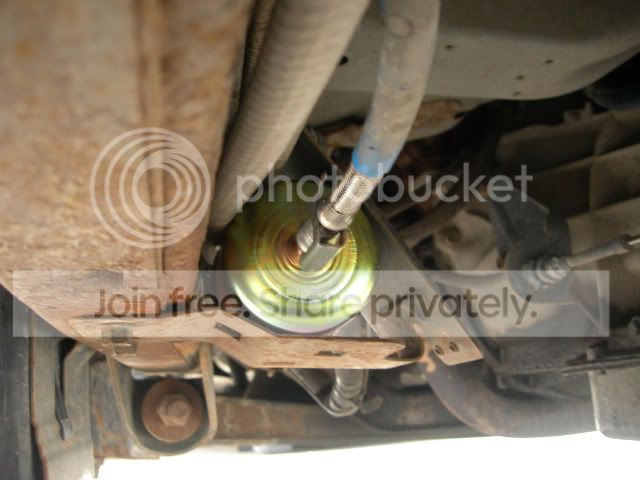
The old one was extremely difficult to blow through. I'm hoping there is a performance/fuel mileage increase with the new filter. With fuel injection, I'm not sure what, if anything, will change for the better.
Thanks for looking, hope you found this interesting.
New hoses from the filler neck going towards the fuel tank
Note the aluminum tube used to allow the use of the old hose. The fuel house I bought as a replacement was too rigid to fit over the fittings. Earlier in the day, I had to shorten some aluminum crutches for my son, and I used one of the sections of tubing I had cut out for the extension piece of the vent line. As I had bought new clamps for the new hose that did not fit, and the old ones were OK, no more trips to the parts store were required.
Here are both hoses where they enter the fuel tank.
With a small quarter inch ratchet and a short socket, it was not that difficult to remove and again tighten the new clamps. You do it by feel, without removing the tank, you do it blind.
Close up of the hoses on the tank:
Close up of the fill neck going into the tank:
And to celebrate, a new fuel filter:
The old one was extremely difficult to blow through. I'm hoping there is a performance/fuel mileage increase with the new filter. With fuel injection, I'm not sure what, if anything, will change for the better.
Thanks for looking, hope you found this interesting.

Senior User
Joined: Mar 2005
Posts: 145
Likes: 0
From: So. California
Exceptional display
Thank you for the excellent pictorial, and all those details.
You mentioned that the new hose was too rigid to fit, and then it seems you made it work. Am I correct? Did you need any special lubricant?
How many miles are on your vehicle? More importantly, how old is it?
Sorry to hear your son is on crutches.
Best wishes.
John
You mentioned that the new hose was too rigid to fit, and then it seems you made it work. Am I correct? Did you need any special lubricant?
How many miles are on your vehicle? More importantly, how old is it?
Sorry to hear your son is on crutches.
Best wishes.
John
Thread Starter
|
Freshman User
Joined: Jan 2005
Posts: 42
Likes: 0
From: St. Joe Mo
The new vent hose - it was too small, ever so slightly.
And it was fuel line, the vent may actually be gas resistant vent tubing - and more flexible.
The main 1.5" fuel fill hose worked fine.
The van is a 1995 with only 270,000 miles on it.
My youngest finally reached the age where you learn to not step on the basketball......
Ah, they grow up so quick!
Thank you, he'll be AOK in no time.
And it was fuel line, the vent may actually be gas resistant vent tubing - and more flexible.
The main 1.5" fuel fill hose worked fine.
The van is a 1995 with only 270,000 miles on it.
My youngest finally reached the age where you learn to not step on the basketball......
Ah, they grow up so quick!
Thank you, he'll be AOK in no time.

Senior User
Joined: Feb 2005
Posts: 333
Likes: 1
From: Toledo, Ohio
Steve,
Great pics, we could use some more pics of this type for other repairs, i.e. ball joints, rear heater hose deteriation, tune-up work etc.. Don't have a camera or the technology either. (maybe they could be put in gallery or articles ???)
270k!.... just broken in!
John
Great pics, we could use some more pics of this type for other repairs, i.e. ball joints, rear heater hose deteriation, tune-up work etc.. Don't have a camera or the technology either. (maybe they could be put in gallery or articles ???)
270k!.... just broken in!
John

Freshman User

Joined: Jun 2006
Posts: 32
Likes: 0
From: Ohio
I did the same as you but the main filler hose kinks and, when I try to put gas in the pump shuts off because of maybe too little of an opening. How did you get your large hose not to kink?
Trending Topics

New User
Joined: Dec 2005
Posts: 6
Likes: 0
Hey Boxer, on my '99 E-150, 4.2L the main filler hose kinks too, but i put 3 hose clamps with about 1/2 " in between where the kink was and it works perfectely, no more kink, but now i have another problem, when i drop the tank i might loose some wires or connectors and now the truck doesn't start, i suspect threre is no power to the gas pump, how to check, whre to start?
Sylvain
Sylvain
FTE Stories
Ford Trucks for Ford Truck Enthusiasts

10 Things Every Truck Owner NEEDS (2026 Edition)
Michael S. Palmer
Rezvani's Latest Post-Apocalyptic Monster Is a Ford F-150 Raptor Underneath
Verdad Gallardo
Top 10 Most Expensive Ford Trucks Ever Sold on Bring a Trailer
Joe Kucinski
2027 Ford Super Duty Buyer's Guide (Every Model, Engine, & Package)
Brett Foote
Top 10 Ford Truck Tragedies
Joe Kucinski
AEV FXL Super Duty - the Super Duty Raptor Ford Doesn't Make
Brett Foote
Lobo Vs Lobo: Proof the F-150 Lobo Should Be Even Lower!
Michael S. Palmer
Ford's 2001 Explorer Sportsman Concept Looks For a New Home
Verdad Gallardo
10 Best Ford Truck Engines We Miss the Most!
Joe Kucinski
Freshman User
Joined: Jun 2006
Posts: 32
Likes: 0
From: Ohio
Hi Sylvain. That's exactly what I did except I only put one clamp on and it seems to work fine. As far as your fuel pump, it is powered by a harness that plugs in on top of the tank. Check your fuse first, it's the 30 amp under the hood, at least in mine it is. Also, when you turn on the key to start listen for the pump to run for a few seconds. Other than that you might have to drop the tank again and check your connections.
Bill
Bill

New User
Joined: Feb 2008
Posts: 4
Likes: 0
Here are pictures of the finished product -
New hoses from the filler neck going towards the fuel tank
Note the aluminum tube used to allow the use of the old hose. The fuel house I bought as a replacement was too rigid to fit over the fittings. Earlier in the day, I had to shorten some aluminum crutches for my son, and I used one of the sections of tubing I had cut out for the extension piece of the vent line. As I had bought new clamps for the new hose that did not fit, and the old ones were OK, no more trips to the parts store were required.
Here are both hoses where they enter the fuel tank.
With a small quarter inch ratchet and a short socket, it was not that difficult to remove and again tighten the new clamps. You do it by feel, without removing the tank, you do it blind.
Close up of the hoses on the tank:
Close up of the fill neck going into the tank:
And to celebrate, a new fuel filter:
The old one was extremely difficult to blow through. I'm hoping there is a performance/fuel mileage increase with the new filter. With fuel injection, I'm not sure what, if anything, will change for the better.
Thanks for looking, hope you found this interesting.
New hoses from the filler neck going towards the fuel tank
Note the aluminum tube used to allow the use of the old hose. The fuel house I bought as a replacement was too rigid to fit over the fittings. Earlier in the day, I had to shorten some aluminum crutches for my son, and I used one of the sections of tubing I had cut out for the extension piece of the vent line. As I had bought new clamps for the new hose that did not fit, and the old ones were OK, no more trips to the parts store were required.
Here are both hoses where they enter the fuel tank.
With a small quarter inch ratchet and a short socket, it was not that difficult to remove and again tighten the new clamps. You do it by feel, without removing the tank, you do it blind.
Close up of the hoses on the tank:
Close up of the fill neck going into the tank:
And to celebrate, a new fuel filter:
The old one was extremely difficult to blow through. I'm hoping there is a performance/fuel mileage increase with the new filter. With fuel injection, I'm not sure what, if anything, will change for the better.
Thanks for looking, hope you found this interesting.
Exactly the problem I just fixed, thanks to your clear pictures and descriptions. Thanks for the help!
Martin (96 Club Wagon, 130k miles)

New User
Joined: May 2009
Posts: 9
Likes: 0
Also had exact same problem
... and this told me exactly what to do. Very nice write up and nice clear pics  . You've saved me a lot of research and running around.
Times like these, I really love the Internet - especially where finding answers on automotive and computer technology are concerned. However, as a long time practitioner in both those disciplines ... well, let's just say that most of the time, technology SUCKS
. You've saved me a lot of research and running around.Times like these, I really love the Internet - especially where finding answers on automotive and computer technology are concerned. However, as a long time practitioner in both those disciplines ... well, let's just say that most of the time, technology SUCKS


Thread
Thread Starter
Forum
Replies
Last Post
ElMoco
1999 - 2003 7.3L Power Stroke Diesel
46
Nov 28, 2016 09:42 PM
maclif
1967 - 1972 F-100 & Larger F-Series Trucks
9
Oct 26, 2016 04:36 AM
Ronnief150man
1973 - 1979 F-100 & Larger F-Series Trucks
23
May 26, 2016 09:34 AM
